The Cryosphere Divide: Blatten, Switzerland, Had a Warning. Nepal Faced Catastrophe
By Dr. Kusum Vyas

In an era of rapid climate change, the world’s high-mountain regions are undergoing profound changes. Glaciers, permafrost, and slopes that once appeared immovable are becoming increasingly capable of sudden and catastrophic failure.
Two disasters—separated by thousands of miles and more than a year—illustrate both the growing dangers of mountain environments and the profound difference that preparedness can make.
On May 28, 2025, a massive section of the Birch Glacier in Switzerland’s Lötschental Valley collapsed, sending millions of tons of rock, ice and water down the mountainside and burying much of the village of Blatten. Yet the human toll was remarkably limited: the approximately 300 residents had already been evacuated after authorities detected escalating danger. One person, a shepherd, was killed.
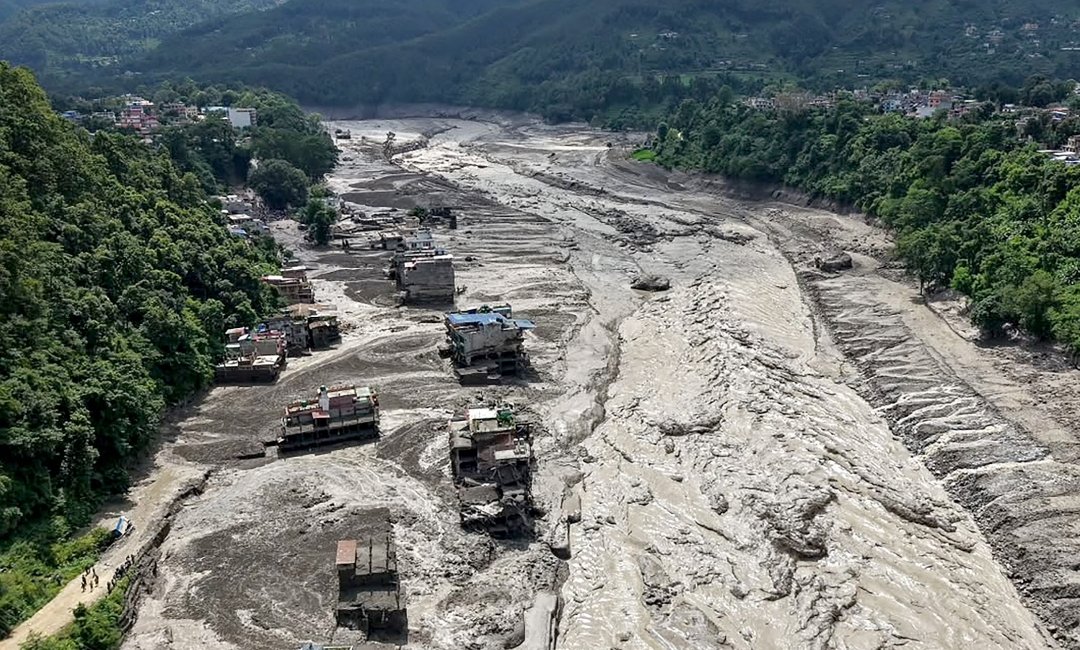
On August 26, 2026, a vastly different tragedy unfolded near the Nepal-Tibet border. An ice-and-rock avalanche generated a devastating surge through the Bhote Koshi river system, sweeping through communities, roads, bridges, and hydropower facilities. By September 13, reports put the death toll at approximately 1,386, with more than 5,000 people still missing.
These were not identical geological events. But they share an important warning: a changing mountain environment can create rapidly evolving hazards, while the human consequences depend heavily on where people live, what infrastructure has been built in harm’s way, and whether authorities can detect danger early enough to act.
When Mountains Become Unstable
High mountains are governed by a delicate interaction among ice, rock, water, temperature, and gravity. As temperatures rise, those relationships can change.
Blatten provided a dramatic example. Before the collapse, scientists and authorities had observed accelerating deformation and instability around the Birch Glacier and surrounding mountain. The warning was sufficiently clear that the village was evacuated before the catastrophic failure. When the mountain finally collapsed, the resulting mass buried roughly 90 percent of Blatten.
The lesson is not that climate change mechanically produces identical disasters everywhere. Rather, warming can alter the stability of mountain systems in ways that are difficult to predict from historical experience alone.
That distinction matters enormously in the Himalayas.
The August 2026 disaster began with the collapse of ice and bedrock near the Nepal-China border. The resulting mass entered the Bhote Koshi river system and developed into a destructive flood and debris-flow event, gathering additional sediment and material downstream. What began high in the mountains became a cascading disaster affecting communities and critical infrastructure many kilometers away.
The Human Footprint Matters
Climate change, however, should not become a convenient explanation that ends the discussion.
A mountain hazard becomes a humanitarian disaster when people and critical infrastructure are exposed to it.
In Switzerland’s Alpine regions, hazard maps and legally binding zoning rules restrict or prohibit construction in areas exposed to serious natural hazards, helping limit the human and infrastructural consequences when mountains fail.
Himalayan valleys have experienced rapid infrastructure development, particularly along major river corridors. Roads, bridges, transmission infrastructure, settlements, and hydropower projects increasingly occupy terrain exposed to floods, landslides, and debris flows.
The August disaster tragically demonstrated that vulnerability. Hydropower installations were damaged, while large numbers of workers were reported missing from tunnels and project sites.
This does not mean hydropower caused the glacier collapse or that every installation amplified the flood. Such claims require site-specific evidence.
But the broader reality is unmistakable: placing large numbers of people and critical infrastructure inside a rapidly developing high-mountain hazard corridor can turn a natural event into a mass-casualty disaster.
That is a lesson Nepal, China, India, and other Himalayan countries cannot afford to ignore.
The Crucial Difference: Warning Time
Perhaps the most important contrast between Blatten and the Himalayan catastrophe is not the amount of ice involved.
It is time.
In Blatten, monitoring of glacier deformation and surrounding slopes provided evidence that conditions were deteriorating. Authorities acted before the mountain failed.
That is what effective disaster management looks like. It does not require predicting the exact minute a mountain will collapse. It requires recognizing when the probability of catastrophic failure has become unacceptable—and acting before certainty arrives.
The Himalayan situation is far more difficult. A sudden glacier or rock collapse high above a river valley can generate a flood pulse that travels downstream with devastating speed.
That is why modern mountain-risk management must operate on several levels simultaneously: satellite observation, ground-based deformation monitoring, seismic detection, glacier and permafrost surveillance, river gauges, automated communications, and community-level warning systems.
And those systems must communicate across borders.
Geography Does Not Respect Political Boundaries
The Himalayas do not recognize political boundaries.
A collapse on one side of a mountain can generate a flood affecting communities, roads, hydropower facilities, and people many kilometers away—and potentially across an international border.
The August disaster demonstrated this danger. What began near the China-Nepal border rapidly became a transboundary emergency.
Nepal, China, India, and other Himalayan countries need mechanisms for the automatic, rapid exchange of critical hazard data—including river levels, seismic signals, satellite observations and alerts concerning unstable glaciers and slopes.
The objective should be simple: if a potentially catastrophic event is detected upstream, communities downstream should receive the warning in minutes, not hours.
The Swiss Lesson
Blatten offers an uncomfortable but hopeful lesson.
Switzerland did not prevent its mountain from collapsing. It could not.
What it did was recognize that the mountain was becoming dangerous and move people out of its path.
Nepal faces far greater geographic, economic, and infrastructural challenges. But that is precisely why international assistance is essential.
Scientific institutions and international organizations should help Himalayan nations expand monitoring networks, improve hazard mapping, establish evacuation protocols, and develop interoperable early-warning systems.
This should not be about stopping development. Nepal needs roads, electricity, and hydropower. Its people deserve economic opportunity.
But development in the Himalayas cannot be planned as though the mountains are geologically static.
A Warning for the Future
The greatest mistake would be to treat the Blatten and Nepal disasters simply as unavoidable acts of nature.
The physical events may have been natural. The scale of human exposure is not.
Changing climate conditions can alter high-mountain environments. Human development can increase the number of people and assets exposed to those hazards. And good monitoring, rapid communication and decisive evacuation can determine whether a mountain disaster becomes a tragedy measured in lives—or primarily a disaster measured in property.
That is the real cryosphere divide.
It is not simply a divide between Switzerland and Nepal. It is a divide between having the knowledge to recognize danger and having the systems, resources and political will to act on that knowledge.
The mountains are changing.
The question now is whether our institutions will change fast enough with them.
If the next Blatten can be evacuated before the mountain falls, while the next Himalayan valley receives its warning only after the water arrives, the difference will not be climate alone.
It will be preparedness.
And preparedness is a choice.
(Vyas is founder of Living Planet Foundation)