
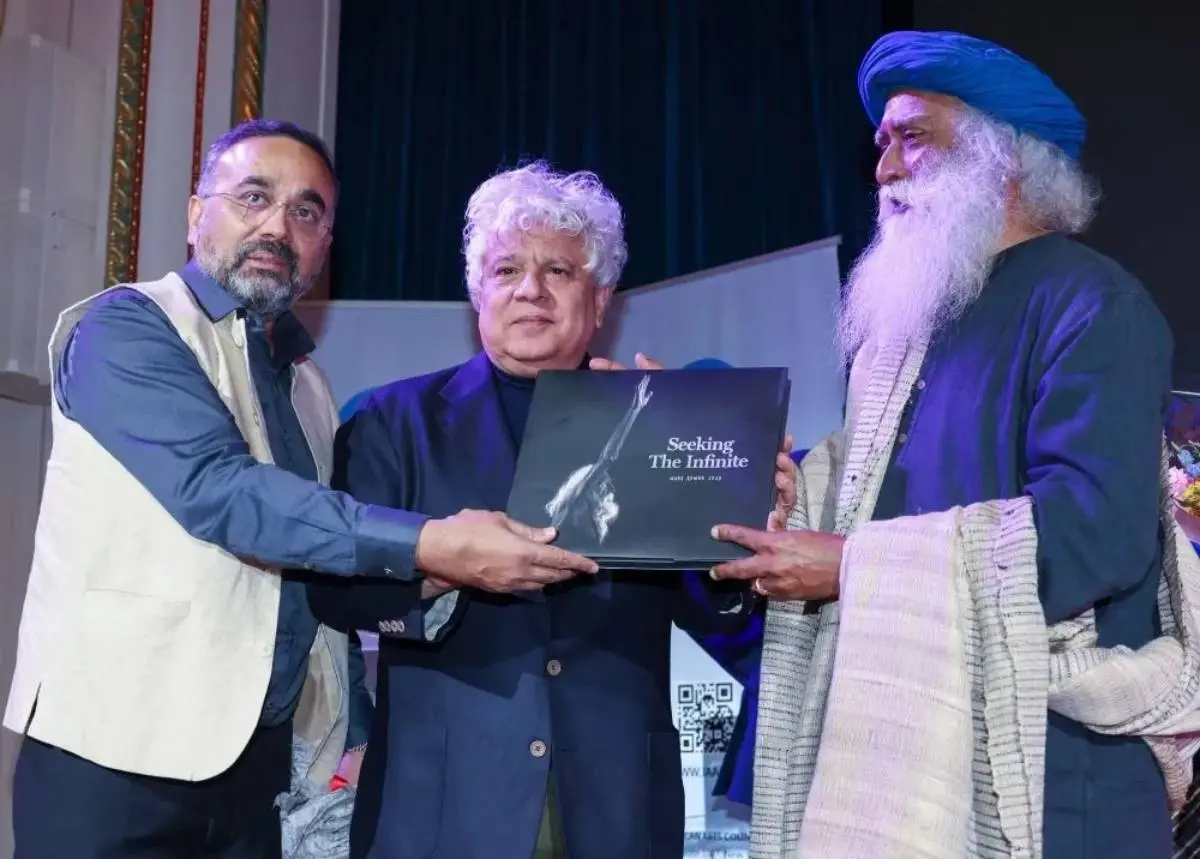
New York Author Has A Stunning Coffee Table Book On The Mahakumbh
By Usha Akella
In times when one often feels pressured to align with Left or Right and other fractured polarities, a book can point toward reconciliation and harmony. Rooted in the myth of nectar, and expansive in its scope, Seeking the Infinite reframes the Mahakumbh as a heritage of humanity, not solely Indian or Hindu.
The book ‘Seeking the Infinite’ draws attention to water as a central metaphor of purification, unity, and surrender. Within its pages, the Mahakumbh is presented as a call from India to the idea of one ultimate religion: humanity.
Dedicated to the journey within, Yakub Mathew’s book seeks to capture the scale and meaning of the Mahakumbh, a once in 144 years riverine confluence at the Triveni Sangam in Prayagraj that welcomed an estimated 640 million devotees in 2025. The three rivers merging into a single stream are interpreted symbolically, most often as an emblem of unity. That one of these rivers, the Saraswati, is mythical does not diminish faith. That such a vast gathering unfolded peacefully over nearly two months is remarkable. A coffee table volume spanning 246 pages, with striking photographs and interwoven quotations and narratives, Seeking the Infinite preserves the Mahakumbh in lasting form.
Turning the pages mirrors the journey itself, beginning with the opening chapter ‘Blessings’, featuring reflections by a mystic, Hindu yogis, and a Cardinal, including Sadhguru, Swami Avdeshanand Giri Maharaj, Maharaj Radhanath Swami, and His Eminence Cardinal Oswald Gracias. The reader then moves into deeper reflections before emerging with a renewed sense of India’s enduring spiritual current. The book reminds us of a civilization unafraid to ask fundamental questions and to attempt answers that move across form and formlessness, faith and agnosticism, ritual and dhyana. Throughout, the human soul remains central. The confluence of rivers continues on the page, inviting readers to move beyond narrow definitions of religion.
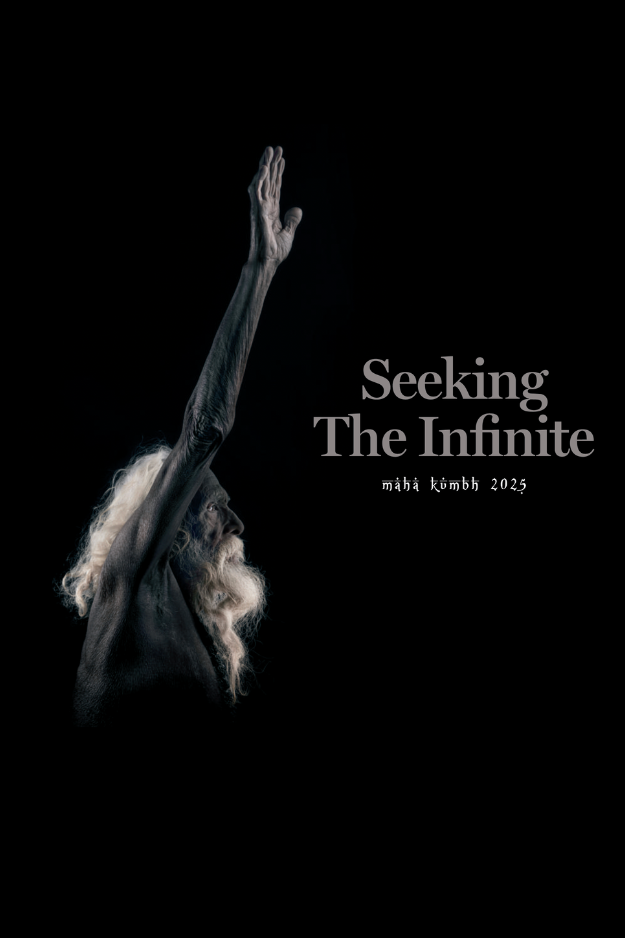
Mathew states his vision early, presenting the Mahakumbh as an international heritage not limited by geography. Though he calls himself an accidental author, he is clearly not an accidental seeker. The journey undertaken by a Syrian Christian, New York based banker with his wife and 18 friends to mark his 60th birthday and recovery from serious illness resulted in a lasting tribute to the Mahakumbh. His choice of this experience as a personal rite of passage reflects his inner inclinations.
The sounds and sights surrounding him during the two days were not experienced as chaos but as an extension of his own inner rhythm. Immersing himself among the multitudes, he felt grateful for the opportunity to offer prayers for peace in a turbulent world.
The book brings together personal reflection, literary expression, academic insight, and spiritual inquiry. Essays explore the Mahakumbh from mythic to astronomical perspectives by contributors from fields including spirituality, fashion, religion, administration, medicine, journalism, business, politics, theater, academia, sports, film, art, and music.
The roster of 55 contributors includes Pujya Swami Chidanand Saraswati, Ayaan Ali Bangash, Kabir Bedi, Harish Parvatheni, Satya Hinduja, Dr. Shashi Tharoor, George Mathew, Lord Meghnad Desai, Rev. Victor Lobo, Rev. Father Thomas V. Kunnukal, Dr. Navin Mehta, Farokh Engineer, Dr. Jagdish Bhagwati, Muzaffar Ali, Didi Krishna Kumari, Rakesh Kaul, Ashi Sonam Choden Dorji, Sadhvi Bhagwati Saraswati, Haji Syed Salman Chisty, Swami Swaroopananda, Anupam Kher, Swami Sarvapriyananda, Dr. Subramanian Swamy, Mokshapriya, Suhel Seth, Yogmata Keiko Aikawa, Radhe Jaggi, Barkha Dutt, and Ustad Hidayat Khan.
The book should not be read simply as a collection of prominent names. Instead, it represents a convergence of voices offering collective homage to one of India’s most significant sacred and astronomical events. In doing so, it invites reflection on India’s role in the world and its enduring message of unity in diversity.
Although the crowds have dispersed and the event has concluded, the experience continues to resonate in those who took part. The Mahakumbh’s pluralistic waters reflect an ongoing human search for the divine, expressed through many traditions but driven by a shared yearning for transcendence.
Symbolically, readers can still enter these waters through the pages of the book. For those, like myself, who could not attend the event last year, the book becomes a reenactment of the ritual and a way to experience its scale and energy.
(Akella is an Austin, TX, based poet and the author of 11 books, including poetry and spiritual musical dramas.)


Ramaiyer Sainath
/
Very touching and humbling
February 4, 2026