
Success Without Security: Lessons The Hindu Diaspora Is Only Now Learning
By Dr. Jai G. Bansal
The claim that “Hindus are the new Jews,” now common in social media discourse, is not a compliment. It signals a shift in how Hindu identity is perceived, from a neutral cultural presence to a subject of sustained collective judgment, a transition Jewish communities in the West have long understood. The phrase points less to success than to how a minority is treated once it becomes visible.
This framing exposes a persistent assumption within Hindu diasporic life: that education, professional achievement, and civic conformity provide lasting protection. Jewish experience shows the limits of that belief. Individual success has rarely insulated minorities from collective judgment and has often intensified scrutiny by drawing attention to the group as a whole.
The divergence between Hindu and Jewish diasporic outcomes is, therefore, not a matter of culture or generosity, but of timing. Jewish communities learned early that acceptance was conditional and reversible, and they built institutions in response. Hindu migration coincided with legal inclusion and decades of relative comfort, delaying the same realization.
That delay now has consequences. Hindu diasporas are affluent and well-integrated, yet institutionally thin outside temples. As scrutiny grows, the gap between individual success and collective preparedness is becoming harder to ignore.
Divergent Outcomes
At a civilizational level, Hindu and Jewish diasporas share more in common than is often recognized. Both traditions are millennia old, long predating modern nation-states. Both survived displacement through ritual, memory, and family life rather than territorial power. And both entered Western societies as visible minorities whose customs and religious practices did not easily fit dominant norms.
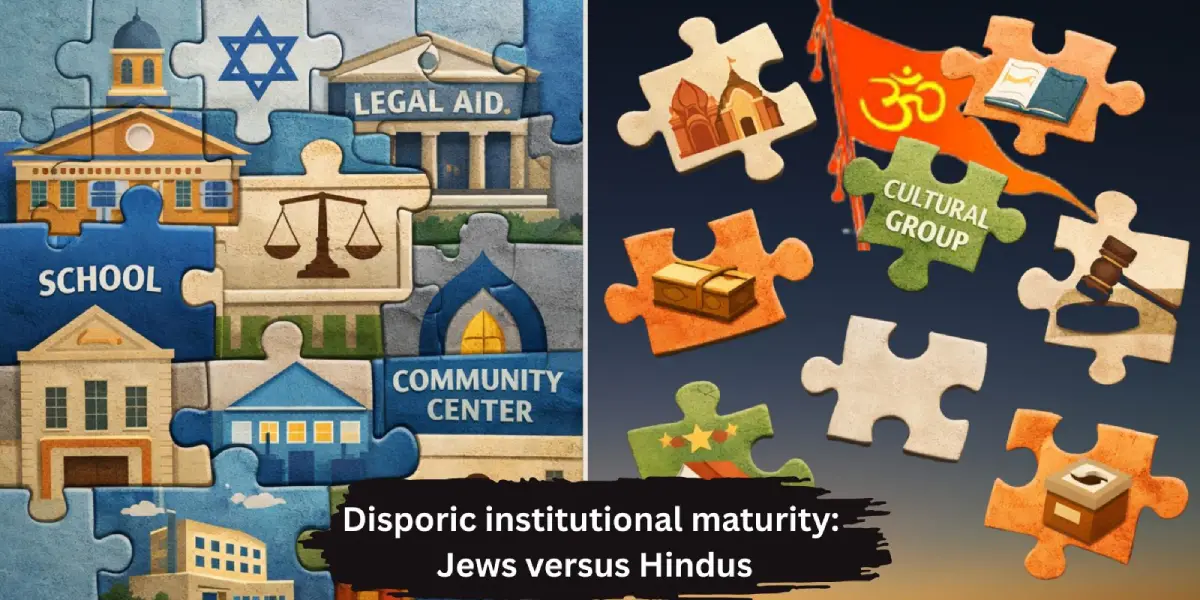
The divergence lies not in values, but in outcomes. By the early twentieth century, Jewish communities in the United States had built dense, professionalized institutional networks spanning education, advocacy, philanthropy, legal defense, youth leadership, and public engagement. Hindu diasporic life evolved differently. Temples became the primary durable institutions, sustaining religious and cultural continuity, while organizations beyond them remained uneven, volunteer-driven, and fragmented.
This contrast frames the central puzzle. Two diasporas with comparable civilizational depth and minority status produced sharply different institutional architectures. Explaining why requires attention not to culture, but to context.
Timing of Vulnerability
The institutional divergence between Jewish and Hindu diasporas begins with how each entered Western societies. Entry conditions shaped not only opportunity, but how vulnerability itself was understood and how urgently collective structures were built.
For Jewish communities, entry came with visible and persistent limits. In Europe, legal restrictions on residence, education, and professions were common. In the United States, equality existed formally, but social exclusion persisted well into the twentieth century. Universities enforced Jewish quotas. Elite neighborhoods, clubs, and professional networks remained closed. Success did not erase suspicion. It often intensified it. Jewish communities learned early that acceptance could be partial, temporary, and easily withdrawn.
That experience shaped behavior. Mutual aid societies, community schools, and legal defense organizations emerged because neutrality from employers, courts, and public opinion could not be assumed. Vulnerability was understood as a recurring condition, not a temporary setback.
Hindu migration unfolded under very different circumstances. Large-scale entry began after civil rights reforms and immigration changes in the mid-1960s, when open legal discrimination had largely ended. Immigration favored education and skills. Professional opportunities followed quickly, bringing stability and social openness. The implicit message was reassuring: merit and conformity would be rewarded.
Comfort bred complacency. Because exclusion unfolded gradually, the perception of vulnerability remained muted. Temples were built to sustain religious life, while wider institutions for advocacy or collective defense appeared unnecessary. The assumption that education, legal protections, and professional success would provide adequate security largely went unexamined.
That distance is now closing. As diaspora Hindus increasingly encounter collective judgment and reputational risk abroad, vulnerability is becoming lived rather than abstract. The lesson Jewish communities absorbed early is arriving later for Hindus, under conditions that leave less room for gradual adaptation. The contrast is not cultural. It is temporal.
Ritual Continuity Without Institutional Reinforcement
Hinduism and Judaism have endured in diaspora less as belief systems than as lived traditions. Daily practice, ritual calendars, food rules, and life-cycle rites have carried identity across borders for centuries. Where the two diverge is in how religious continuity was translated into durable institutional support.
In Jewish communities, ritual was early paired with formal learning. Children attended Hebrew school, studied texts, and prepared systematically for bar or bat mitzvah. Even families with low observance treated basic religious literacy as necessary. This emphasis was not only theological. In environments where Jewish identity was questioned or misrepresented, knowledge served as protection. It enabled explanation, defense, and confident transmission.
Hindu religious life developed under different assumptions. In India, meaning was reinforced by the surrounding culture. Festivals structured public life, and religious reference points were ambient rather than instructional. When Hindus migrated, many assumed this model would persist. Temples preserved ritual, families maintained festivals, but formal education often remained secondary.
This approach sustained the first generation, who carried memory with them. However, it weakened sharpy for the next generation. Without structured learning, rituals increasingly became events rather than foundations. Continuity remained visible, but depth thinned. Jewish communities anticipated erosion and built institutions to counter it. Hindu communities largely did not. Ritual survived, but institutional reinforcement lagged behind.
Collective Judgment and Institutional Response
Minority life in the West is shaped as much by external perception as by internal cohesion. How a community expects to be seen determines whether it prepares for scrutiny in advance or responds only after damage has occurred. Jewish and Hindu diasporas crossed this threshold at very different moments.
Jewish communities encountered collective judgment early. Regardless of individual belief or behavior, Jews were often treated as a single group. Success in business, media, or academia did not dissolve suspicion; it frequently intensified it. Cultural differences were politicized, loyalty questioned, and visibility reframed as influence. Jewish communities learned that individual achievement did not protect the group as a whole.
Jewish communities responded by building permanent institutions designed to operate under sustained scrutiny.
Hindus entered a different cultural moment. Large-scale migration coincided with a period when Eastern traditions were often viewed as benign or even fashionable. Early generations were seen primarily through professional roles rather than religious identity. Individual conduct appeared sufficient to secure standing, and collective identity attracted curiosity more than suspicion.
That assumption is now eroding. Political, academic, and media narratives increasingly frame Hindu identity as a category of scrutiny. Temples, student groups, and families are judged collectively for actions and ideas they do not control.
The difference lies in readiness. As scrutiny becomes routine rather than exceptional, communities either develop durable structures to engage collective judgment or improvise responses after reputational damage has already occurred. Jewish community expected this gaze early; Hindu community is adjusting to it in real time.
Shared Stakes
The long-term strength of a diaspora depends on whether it invests in institutions that outlast individuals and prepare the next generation to carry responsibility. This is where differences in philanthropy and leadership formation become decisive.
Jewish diasporic communities treated institutional investment as essential rather than optional. Philanthropy followed a clear sequence. Internal capacity came first. Schools, legal defense organizations, advocacy groups, research centers, and leadership pipelines were funded because no external institution could be relied upon to protect Jewish interests or transmit Jewish identity. Giving outward to universities, hospitals, and public charities followed, but it did not substitute for inward investment.
Over time, this approach produced continuity. Jewish youth were not only culturally connected, but institutionally prepared. Education and leadership programs familiarized them early with public engagement and collective responsibility.
Hindu diasporic investment followed a different pattern. Giving to temples, disaster relief, and mainstream institutions has been generous and sincere, but funding beyond temples has often been episodic. Sustained investment in Hindu educational, research, or advocacy institutions has remained limited, in part because such giving brings little visibility or social reward. As a result, leadership pipelines are thin and organizations remain personality driven.
The effects are most visible among the second and third generation. Many Hindu youth feel culturally rooted but institutionally unprepared. When controversy arises, they respond as individuals rather than as members of a supported collective.
Underlying this gap is a lack of shared stakes. Jewish communities developed a strong sense of collective responsibility early, shaped by repeated experience of vulnerability. In the Hindu diaspora, engagement remains largely cultural rather than existential. Without agreement on what must be protected regardless of difference, institution-building remains fragile and reactive.
Conclusion: Learning Without Crisis
The comparison between Hindu and Jewish diasporic experience is not a call for imitation, nor a moral judgment about foresight or discipline. It is an examination of how pressure shapes institutional behavior. Jewish institutions did not arise from exceptional organization or vision, but from repeated exposure to a simple reality: acceptance in minority settings is conditional, and delay carries cost. Institutions became the practical response to that condition.
That reality is now confronting the Hindu diaspora. Individual success no longer shields the community from collective judgment, narrative hostility, or reputational risk.
The question, then, is no longer whether pressure will exist. It is whether discomfort is translated into institutions before crisis forces the issue. Jewish history points to a clear pattern: institutions built early reduce future cost, while institutions built late are assembled under stress.
The opportunity to learn without crisis still exists. Whether it is taken will shape the future of Hindu life in the West for a generation.

(Bansal is Vice President of Education at the Vishwa Hindu Parishad of America and a member of its Governing Council and Executive Board. He has been a Chief Scientific Officer at a petrochemical firm and advisor to the US Department of Energy.)



Natarajan Sivsubramanian
/
i do not know whether the learned Author is talkng about hindus in india or hindus in diaspora
February 6, 2026in india the caste system, favoritism discriminations nepotism etc are playing vital roles in india and
such things are the contributing factors which are responsible for some of the bright and intelligent
persons from progressing well in their life. the constitution should be re-written in such a way to
suite modern conditions for the benefit of all indian citizens and not for the benefit of certain
under privileged people alone for the sake of vote bank by politicians
Muraley
/
Very insightful analysis. Thank you, Mr. Bansal!
February 6, 2026Bhaskar Vartak
/
This article is such generic nonsense it is not worthy of being published anywhere. The author offers no specific examples, dates, or instances of what marks the commonalities (never mind the differences) between Hindus and Jews. First off, Hindus are not a monolithic block – any 2-year old in India, or even America, could tell you that. The vast number of languages, dialects, castes, sub-castes, communities and even practiced religions makes it impossible to define (read: bucketize) a “Hindu”. More or less the same applies to the Jewish people – there are many differences between liberal Jews, orthodox Jews and among those that are largely agnostic. The author is so ignorant it is almost comical. He has no clue about Jewish trans-migration to the USA between WWI and WWII, the role played by European Jewry in how the US came to be involved in WWII, and how the transplanted minority slowly evolved post New Deal and the GI Joe Bill. Jews did not arrive to the US en masse in the early 20th century, as the author falsely claims. He has no idea about the discrimination Jews faced in the 1960s and 1970s in public life. Many US colleges including Ivy League universities had quotas for how many Jewish students they would accept each year. It took many years before Affirmative Action and other regulations eliminated quotas. Likewise, Indians did not arrive into the US in large numbers before the scuttling of anti-immigration statutes that existed prior to 1965. The loosening of American social norms as a direct offshoot of the turbulent 60s and the Civil Rights movement along with flourishing technology in the last 25 years of the 20th century are what led to large scale migration from India (and other countries) to the US. Neither is there anything exceptionally similar to the lived experiences of the 2 communities. There are very few parallels to draw, particularly due to the vastly different patterns of arrival, assimilation or integration, and participation in American society. As to the so-called ritualistic parts of religion and observed faith, that is common to all people practicing all known religions – nothing unique at all.
INDIA WEST – please stop publishing such clueless gibberish.
February 6, 2026