

Bera Family Turns Personal History Into A Global Medical Mission At UCI
India-West Staff Reporter
IRVINE, CA – Education has always shaped the Bera family’s story, but at UC Irvine, it has found a lasting and practical expression through the India Summer Travel Program. At the center of this continuing effort is Dr. Rimal Bera, Clinical Professor of Psychiatry and Human Behavior at the UC Irvine School of Medicine, whose longstanding ties to the university and commitment to global health have helped turn a family legacy into an ambitious educational project for future physicians.
The Bera family’s belief that education is the path to opportunity began with Kanta and Babulal Bera, who grew up in humble circumstances in Gujarat before immigrating to the United States in the late 1950s. They worked multiple jobs, raised three sons – Raja, Rimal, and Ami (now a US congressman) – and pursued graduate degrees, modeling a philosophy of perseverance and service.
Their home in Los Angeles became a landing place for hundreds of students arriving from India and Africa to study. Rimal, who would go on to graduate from UC Irvine with both his undergraduate and medical degrees, remembers spending his childhood surrounded by young people determined to learn and make a life in their new country. That shaped his own understanding of community, responsibility, and the transformative power of education.
It is fitting, then, that two generations of the Bera family have attended the UC Irvine School of Medicine and that UC Irvine is now the anchor of the family’s most ambitious philanthropic project. In 2020, the Beras donated $100,000 to the School of Medicine to permanently support medical student travel to Rajkot.
The goal was simple but far reaching. Students would be able to work in underserved communities, collaborate with local medical providers, and bring appropriate technologies and research to a region where health care resources remain limited.
For UC Irvine students, the experience would not only offer global clinical exposure but also reinforce the idea that medicine extends far beyond individual patient care.
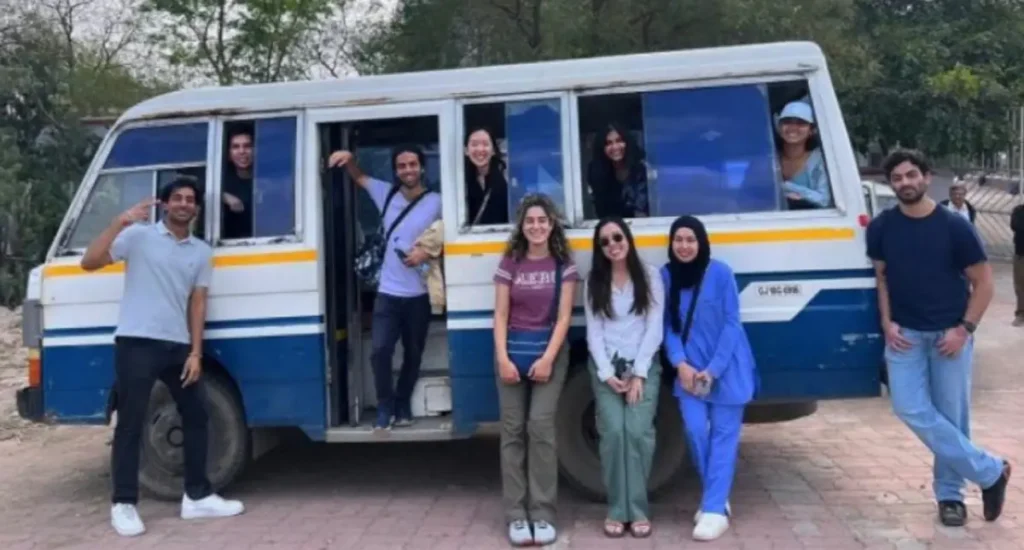
The choice of Rajkot carries special meaning. As a young girl, Kanta was the first girl from her village to attend middle school there. Her determination, shaped by the struggles of her childhood, later inspired her and her husband to establish an all-girls school in nearby Gondal.
The K B Bera School now houses and educates 600 girls from underserved villages, providing academic opportunity, mentorship, and stability for students who would otherwise have few options. UC Irvine medical students visit the school each year as part of the travel program, spending time with the girls and discussing public health, preventive care, and medical careers. The connection is personal, emotional, and deeply reinforcing for students who see firsthand what education can mean in a young life.
The clinical component of the India Travel Program takes students into the wards of Pandit Deendayal Upadhyay Medical College in Rajkot. Under the guidance of Dr. Bera and local faculty, students work in medicine, psychiatry, obstetrics, surgery and community health. They observe how a vast public health system functions under resource constraints, and how Indian clinicians adapt creatively to reach patients in rural communities.
The program emphasizes humility, mutual learning, and cultural understanding. Students often describe the experience as a turning point in how they see themselves as physicians in training.
Dr. Bera believes that the greatest lessons are not technical but human. He often reminds students that the central challenge of medicine is not only diagnosis or treatment but understanding the responsibility physicians carry to their communities and to people far beyond them. This includes an obligation to advocate for better systems, policies and access to education and care. He sees the India program as a way to instill these values early, when students are shaping their professional identities.
The early results reinforce that vision. Students returning from Rajkot bring with them a renewed sense of purpose. They reflect on encounters with children in clinics, elderly patients searching for help, and young girls at the K B Bera School who look to them for inspiration. They also bring back ideas for future research collaborations, public health projects and reciprocal exchanges.
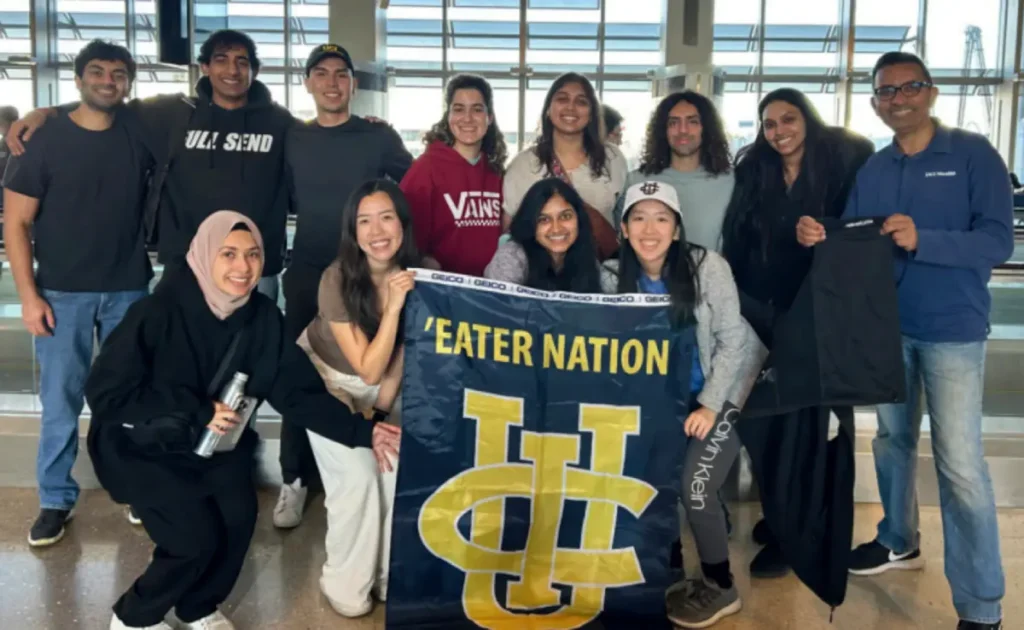
The second group of nine UC Irvine medical students who returned from Rajkot early this year, Bera says, was also transformative, noting the enthusiasm and renewed commitment students expressed upon their return.
The long-term goal is ambitious. UC Irvine hopes to build formal clinical rotations in India for medical students, residents, and faculty, and to host Indian clinicians in Irvine. The vision also includes expanding the travel program to other University of California medical campuses, and on December 19, in its third outing, the program it has students from UC Davis.
At its core, the program seeks to build a sustainable and reciprocal partnership between UC Irvine and the Rajkot region, grounded in the Bera family’s belief that education is the most enduring and life-changing gift.

Sam
/
Really!!!!
First girl?
I thought it was mandatory for girls and boys in the Kingdom of Gondal to go to school or the headmaster would visit during dinner time to verify where the kid was and fine the parents one day of going rate of wages for taking the kid to the farm.
My grandmother who dies in 1980s at a much older age went to school in the Kingdom of Gondal along with all her friends probably around 1920.
December 22, 2025