

Kamala, Whose Grace Shaped A Century of Dance, Dies At 91 In CA
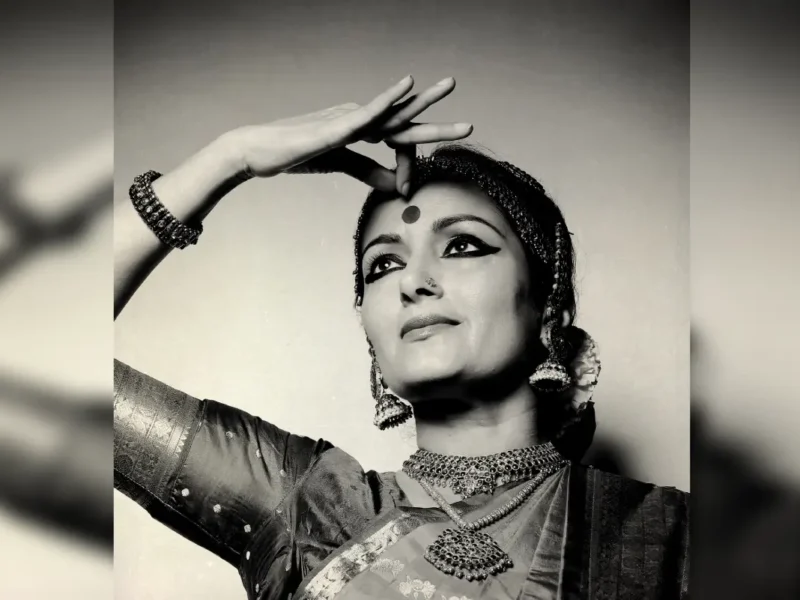
Photo: Sruti
India-West News Desk
SAN FRANCISCO, CA – The brilliant classical dancer, choreographer and actress Kumari Kamala passed away on November 24 in California at her son Jainand Narayan’s home. She was 91.
Her death closes the chapter on one of Indian cinema’s most luminous child prodigies and a pioneering figure who carried classical dance from temple courtyards to movie screens, global stages, and eventually American classrooms. Her life, nearly a century in span, was defined by artistic devotion, quiet determination, and an unbroken commitment to preserving and sharing Bharatanatyam.
Born in 1934, Kamala revealed extraordinary talent almost as soon as she could walk. By age three, she captivated audiences at cultural gatherings. Film producers quickly took note of this precocious child who could dance, act, and sing with startling natural ease. Before she turned ten, she had appeared in Hindi films such as ‘Shaadi,’ ‘Kanchan,’ and the landmark hit ‘Kismat’ in 1943. That same year, she danced in ‘Ram Rajya,’ the only film Mahatma Gandhi is known to have watched, performing a Kathak sequence with the poise of an accomplished artist.
A pivotal turn came when her mother moved from Mumbai to the south to place her under Vazhuvoor Ramaiah Pillai, the legendary guru whose training shaped her mastery of the fluid, expressive style. Under his guidance, Kamala blossomed into one of the most magnetic classical dancers on screen.
Her performances in the 1940s became defining images of Indian cinema: the snake dance in ‘Jagathalaprathapan’ in 1944, the drum dance in ‘Naam Iruvar’ in 1947, and the memorable sequences in films such as ‘Parasakthi,’ ‘Chori Chori,’ ‘Paavai Vilakku,’ and later ‘Konjum Salangai.’ Hers was a presence that drew audiences into the emotional world of classical dance even if they had never encountered it before.
By the late 1940s and early 1950s, Kamala had become a bridge between tradition and modern India. At a time when Bharatanatyam was still reclaiming its place in public life, her screen appearances turned the art form into a national point of pride. She brought not only precision but also an unmistakable warmth to her performances, making classical dance relatable and aspirational for millions.
Her fame soon transcended Indian borders. In 1953, she was invited to perform during the coronation festivities of Queen Elizabeth II, an extraordinary recognition for a young Indian dancer. Tours of China and Japan followed in the late 1950s, where she introduced audiences to an art form they had never seen before. These international engagements established her as one of the earliest cultural ambassadors of Bharatanatyam.
Even as cinema moved on to new styles and stars, Kamala remained devoted to teaching. Her appointment as Branta Professor at Colgate University in 1975 marked the beginning of her long engagement with American academia. She moved to New York in 1980 and later founded Shri Bharatha Kamalalaya in Long Island, where she nurtured a new generation of dancers with the same discipline she had inherited from her guru.
Her contributions were widely recognized over the years, with honors including the Kalaimamani, the Sangeet Natak Akademi Award, the Padma Bhushan, the National Heritage Fellowship, and the Soorya Lifetime Achievement Award.
Kamala’s personal life saw its own turns. She married the celebrated cartoonist R. K. Laxman in the 1950s, and after their divorce in 1960, she adopted the name “Kumari Kamala” to avoid confusion with his second wife, who was also named Kamala. Later she married T. V. Lakshminarayanan and their only son, who is known to play the percussion, would go on to serve in the United States Army.


Natarajan Sivsubramanian
/
awesome
December 12, 2025