
The Quiet Power Of Sacred Space: How Vaastu Asks Us To Relate To Our Homes
By Michael Borden
FAIRFIELD, IA – Interest in sacred architecture and vastu based design has been steadily growing over the past decade, reflecting a wider search for meaning, harmony, and wellbeing in the spaces we inhabit.
Fear and the Modern Home
In my work, I have encountered many people who live in fear of their own homes after being exposed to rigid or alarmist interpretations of sacred building traditions. A poorly placed door, a staircase in the wrong direction, or an incorrect orientation is sometimes presented as a kind of energetic doom. This fear is unnecessary and often harmful. No one should feel trapped or threatened by the place that shelters them.
If a person experiences a natural and persistent discomfort in their home, then thoughtful adjustments or, in some cases, relocation may be appropriate. But living in fear is far more destructive than living in a space that may have imperfect energetics. Anxiety itself disrupts balance. A house is not an enemy. It is a partner in daily life.
Relationship With Shelter
For this reason, I always counsel clients to enter into a relationship with their home. Gratitude is the starting point. Shelter is a profound gift, especially in a world where millions of people still live without a roof over their heads. Treating the house with respect and appreciation can dramatically shift how it feels.
Keeping a home clean and orderly, filling it with pleasant scents, celebrating within it, and even speaking to it with intention are simple acts that often change the atmosphere more effectively than drastic structural interventions. Appreciation has energy, and that energy is communicative.
Role of Sacred Tech
At the same time, sacred architecture traditions do offer refined tools that aim to enhance the environment of a structure by aligning it with natural, terrestrial, and cosmic forces. When applied thoughtfully and without fear, these technologies can deepen a sense of support and coherence in a home. If one has the opportunity to use them, they can be a meaningful addition rather than a source of stress.
Ancient Search for Good Shelter
The human search for good shelter is ancient. From the moment our ancestors sought warm, dry caves, we have been refining what it means to dwell well. Most people instinctively know the difference between a building that invites rest and one that quietly repels them. Some spaces encourage us to linger and settle, while others push us away without obvious reason.
Elements of Space
When asked what makes a building feel good, most of us think of tangible qualities such as light, spaciousness, comfort, beauty, and clear organization. Vastu architecture includes these elements but extends beyond them, taking into account subtle natural influences alongside the physical.
A vastu based structure aims to support harmony with elemental forces such as earth, air, fire, water, and space, as well as with the deeper energetic patterns of nature. These influences are not always consciously perceived, yet they shape how we feel within a space.
Buildings as Living Forms
Vastu science proposes that every structure in the universe, at every level, is a conscious and living form of light and sound. According to this view, buildings are not inert objects but energetic participants in life.
The vastu designer works with mathematical and geometrical principles that appear across natural forms, from biological structures to music, poetry, and dance. When these principles are embodied in architecture, the resulting form is said to radiate an energized consciousness that can be felt by those who inhabit it.
Resonance and the Mandala
Every object vibrates. Every form generates wave patterns. In vastu architecture, a primal pattern or mandala is used as a blueprint for how energy transforms into matter. When this pattern is placed on the earth as an enclosed structure, the building functions as a living organism with its own vibrational signature.
Alignment is crucial. Walls, columns, doors, and windows are positioned in relationship to the mandala so that the building resonates with cosmic, terrestrial, and human energies. In this state of resonance, the structure is believed to nourish its occupants, much like a musical instrument amplifies sound when it is properly tuned.
The Human Body as Vaastu
Vastu science goes further by suggesting that we ourselves are vastu structures. Within the human nervous system lies a subtle pattern, a seed vibration of life. Over time, stress and dissonance can weaken our resonance with this inner order. Living near or within spaces designed according to pure vastu principles is said to help restore that lost harmony.
Beauty, Recognition, and Energy
This idea becomes easier to grasp when we recall how natural beauty affects us. A sunset, a moonrise, the movement of a whale through the ocean, or the stillness of a great cathedral can suddenly fill us with energy and joy. In such moments, we resonate with what we are witnessing. Our inner vitality responds to the beauty before us.
Vastu forms aim to evoke this recognition at a deep and continuous level, not as spectacle but as quiet nourishment.
Ganapati Sthapati
My teacher, Dr. V. Ganapati Sthapati of Mahabalipuram in Tamil Nadu, expressed this understanding with clarity and poetry. He said, “In the heart cave of the body, there is inner space and in that inner space there is the vibrant thread of consciousness. It is this thread of consciousness that functions as the string of the sarira vina bodily instrument.”
He continued, “The structure of the vaastu inspired building vibrates with cosmic energy and the bodily instrument resonates with this vibration.”
And finally, he defined the purpose of the science itself. “To create and offer the house of supreme bliss and to enable us to experience that supreme bliss here, in this mundane house itself, these are the prime motives of Vaastu Science.”
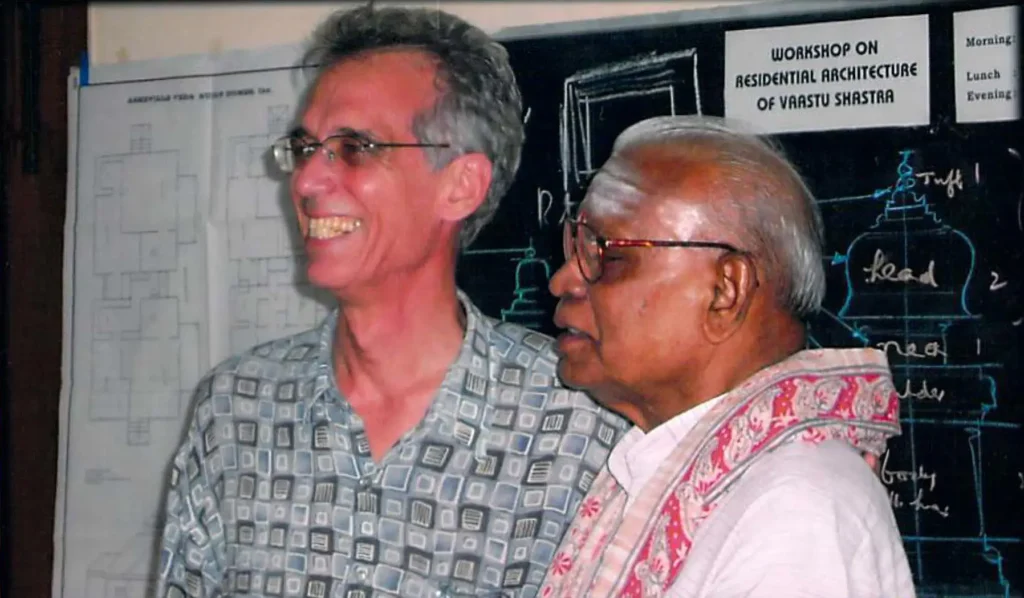
(Borden holds a Master of Architecture and a PhD. In 1999, he traveled to India to study with Dr. V. Ganapati Sthapati and has since designed hundreds of vastu based projects worldwide. He is the author of ‘Vastu Architecture: Design Theory and Application for Everyday Life.’)



pemba
/
Just matter of “Blind Faith” con-artist with Tilaak on forehead can fill their pockets. It is nothing more than mumbo-jumbo Rubbish.
December 24, 2025