
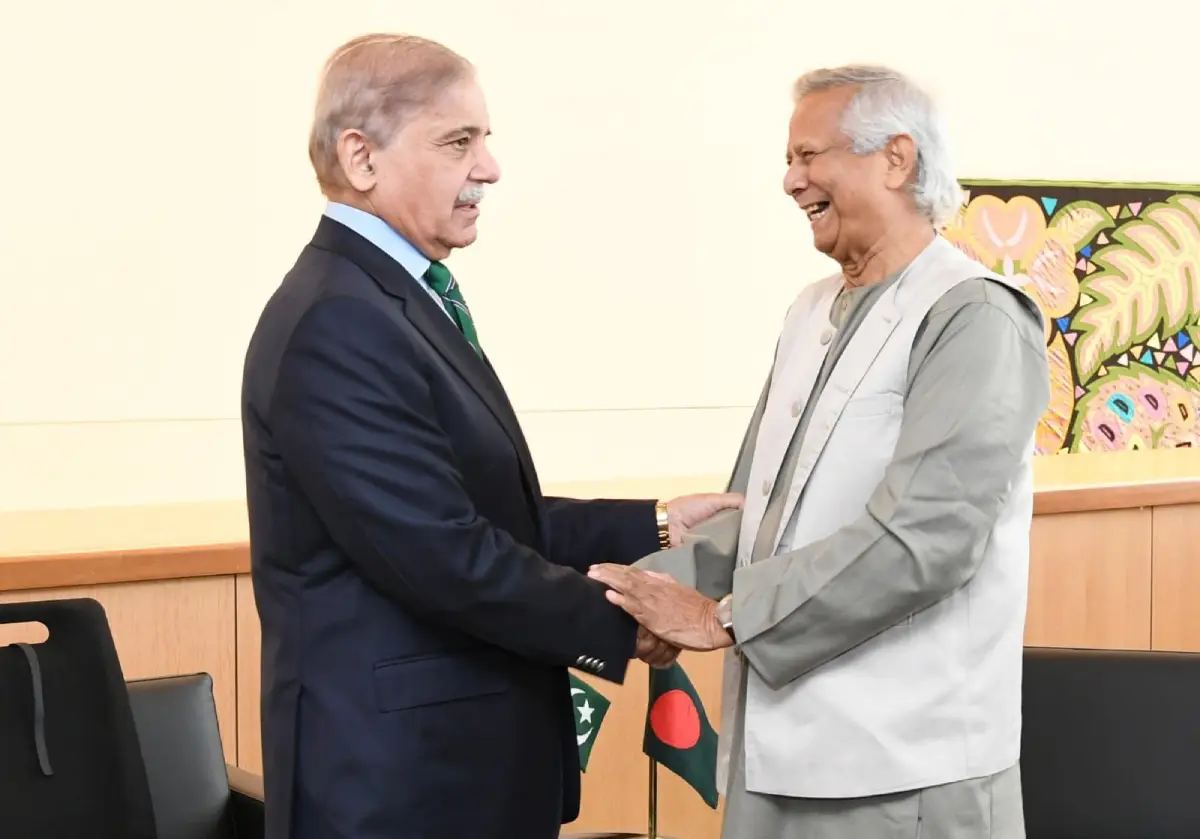
How Bangladesh’s Anti-India Turn Spilled Onto Cricket Field
DHAKA- India-Bangladesh relations have witnessed a historic low since the July 2024 uprising, a downward trend that continues to date. With the uprising forcing Sheikh Hasina to flee Bangladesh, New Delhi woke up to a surprising wave of anti-India sentiment in its neighborhood.
The resurgence of Islamists and attacks on minorities, along with assaults on the country’s social and cultural spaces, confirmed the main forces behind such sentiment. The interim government under Muhammad Yunus took little time to gear Bangladesh’s geopolitical shift away from India and towards Pakistan in the name of ‘recalibration’. There was little doubt that Islamist forces had penetrated the present interim administration, prolonging the diplomatic lows between the two countries.
For every domestic unrest engulfing Bangladesh, the interim government blamed India for ‘harboring anti-state activities’. New Delhi’s concerns regarding increasing atrocities on minorities have been repeatedly dismissed as ‘Indian propaganda’, despite international and Bangladeshi rights organizations reiterating the same concerns.
The prolonged winter in bilateral relations hit another low point in December when Inqilab Mancha, an anti-India Islamist-led youth platform, saw its leader Osman Hadi assassinated, triggering a swift blame game against India without any evidence. The same month witnessed Islamist extremists attacking Bangladesh’s significant cultural centers, as well as two of the country’s most prominent media outlets, accusing them of being ‘pro-India’. Radical mobs also organized protest marches outside the Indian High Commission in Dhaka and assistant high commissions in Rajshahi, Khulna, Sylhet and Chattogram, with the intention of launching similar violent attacks.
Security at Indian missions in Bangladesh has been compromised, explaining New Delhi’s recent decision to recall family members and dependents of Indian diplomats from the country as a precautionary measure, days before the 13th national election.
The Islamist extremists’ onslaught on media freedom and cultural platforms coincided with another horrifying incident — the lynching of Hindu garment worker Dipu Das. The lynching was justified by extremists over Das’s alleged ‘blasphemous’ remarks, while onlookers cheered as his naked corpse, hung from a tree, was burnt in public. The incident appeared to signal the fate of minority Hindus in Bangladesh, shielded behind the curtain of ‘non-communal’ framing.
The incident prompted India to summon the Bangladesh envoy, followed by a tit-for-tat summons by Dhaka. A hostile political atmosphere fueling anti-India sentiment also led New Delhi to temporarily suspend visa operations at Visa Application Centers in Bangladesh, a move reciprocated by Bangladesh with respect to its missions in India.
Amid this backdrop, New Delhi displayed a goodwill gesture by maintaining diplomatic protocol when India’s External Affairs Minister visited Dhaka to attend the funeral of Bangladesh Nationalist Party chief Begum Khaleda Zia. Many in Bangladesh perceived this as a positive and stabilizing reset of bilateral relations, offering a forward-looking direction ahead of the country’s 13th national election scheduled for February.
Then came the cricket fiasco in early January.
The Board of Control for Cricket in India’s direction to Indian Premier League team Kolkata Knight Riders to release Bangladeshi pacer Mustafizur Rahman, auctioned for $1 million, from its 2026 squad — believed to be in line with recent developments in Bangladesh, though no official reason was cited — did not go down well in Dhaka. Bangladesh responded by deciding not to broadcast IPL matches.
Just a day after the BCCI’s directive, Bangladesh abruptly raised ‘security concerns’ for its players travelling to India and urged the International Cricket Council to relocate its T20 World Cup matches to a ‘neutral’ venue such as Sri Lanka. After repeated assessments, the ICC rejected the request, citing the absence of any credible security threat to Bangladeshi players, officials or fans, and noting that such a sudden change would compromise the ICC’s integrity.
Following weeks of discussions, the ICC gave Bangladesh 24 hours on January 23 to communicate its final decision.
Notably, among all board members, the Pakistan Cricket Board was the only full-time member to support Bangladesh’s stance. In a formal letter sent ahead of the ICC board meeting, Pakistan even assured Bangladesh that it could host its matches. The PCB also threatened to boycott the T20 World Cup in apparent solidarity with Bangladesh to protest the ICC’s refusal to shift venues. The PCB chief later stated that Pakistan’s final decision would be conveyed by January 30 or February 2.
Bangladesh, however, did not respond within the stipulated 24 hours, indicating its decision not to participate in the T20 World Cup. This paved the way for Scotland to officially replace Bangladesh on January 24.
This development raises a key question: why did Bangladesh refuse to reverse its decision despite ICC assurances of no security threat?
One evident factor points towards Pakistan — the only country to back Bangladesh. It is believed that Pakistan’s influence led the Bangladesh Cricket Board to take such a hardline stance. The PCB argued on the basis of its own agreement with the BCCI to play ICC matches at neutral venues until 2027. However, the situations are not comparable, as India has not displayed animosity towards Bangladesh, though the reverse cannot be said.
Dhaka had not raised any security concerns with the ICC prior to the BCCI’s decision to withdraw the sole Bangladeshi player from the IPL, leaving little doubt that the ‘security concerns’ were retaliatory in nature. While debates may continue over whether New Delhi’s move was appropriate, the fact remains that India does not pose a security threat to Bangladesh.
India, in fact, has consistently supported Bangladesh cricket and played a pivotal role in its development. The BCCI’s role in the 1990s — hosting Bangladesh, providing training and infrastructure support, and facilitating regular matches — paved the way for Bangladesh’s exposure and recognition within the ICC. India also aided Bangladesh’s entry into the 1999 ODI World Cup by leveraging the Asian bloc. Former BCCI chief Jagmohan Dalmiya’s tenure as ICC President was instrumental in securing Bangladesh’s full membership and Test status in June 2000, overcoming skepticism from Australia and South Africa, and showcasing India’s cultural diplomacy.
In contrast, Pakistan complicated Bangladesh’s cricketing journey by demanding revenue shares from Bangladesh’s tours of Pakistan during the 2011/12 to 2015 period, despite Bangladesh not touring Pakistan in 2015. Pakistan also withdrew its players from the Bangladesh Premier League and postponed tours indefinitely. This time too, Pakistan’s political interference through boycott calls, under the guise of cricket diplomacy, is believed to have influenced the BCB’s decision to stay away from the World Cup.
Bangladesh’s decision has come at a heavy cost. The BCB will forgo nearly $3 million in participation fees, along with potential prize earnings for its players. The decision also jeopardizes the 4.46 per cent share of ICC central revenue Bangladesh receives, accounting for more than half of the BCB’s annual income. Additionally, the BCB now faces fines for non-participation without justifiable cause.
Bangladesh’s cricket team, currently ranked ninth in ICC T20 rankings, is now paying the price for the country’s anti-India politics. Ironically, Bangladesh’s security concerns vanished when it approved its shooting team’s visit to India for the Asian Rifle and Pistol Championships. The cricket fiasco — aggravated by Pakistan’s instigation and Bangladesh’s volatile domestic politics — has left only Bangladesh’s vibrant cricketing ecosystem to bear the consequences. (IANS)
Jay
/
Law of KARMA catches up with everyone!
February 5, 2026