Small Business, Big Community: The Heart Of Little India
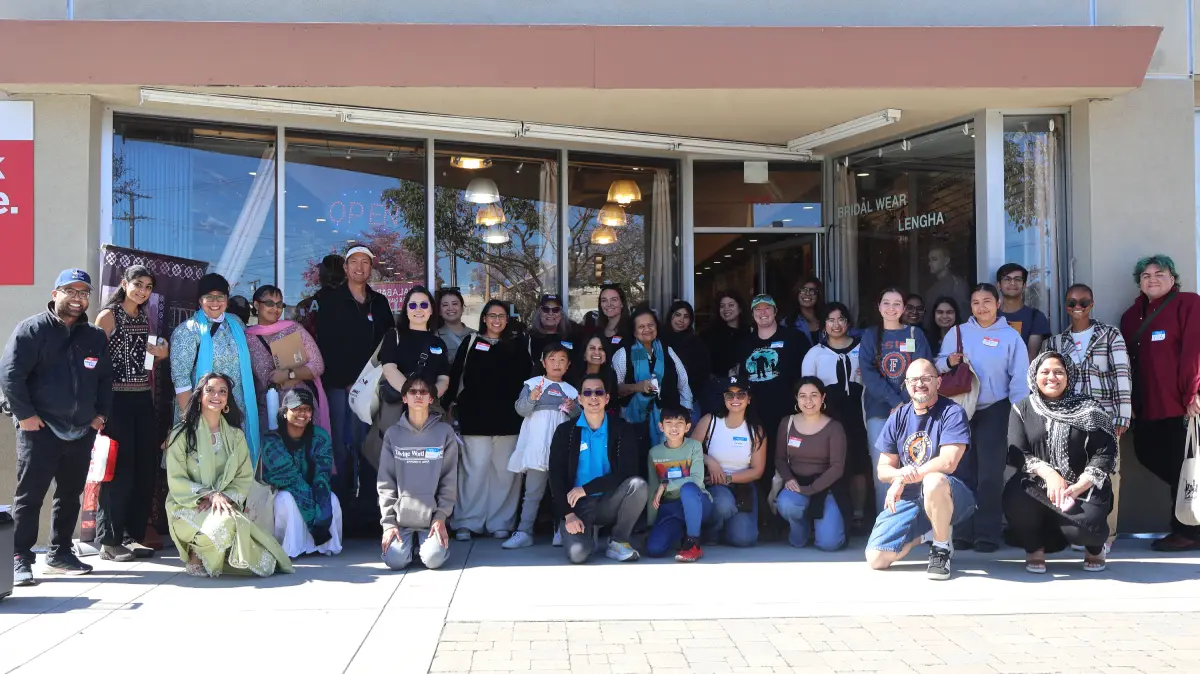
Photo: A group of students who toured Little India
By Leena Mumtaz
ARTESIA, CA – For many immigrants, belonging doesn’t come with citizenship papers only. It comes in smaller ways: hearing your language spoken freely, finding ingredients your grandmother used, seeing wedding clothes that look like the ones in family photos. That sense of belonging lives on Pioneer Boulevard in Artesia, home to Southern California’s Little India.
South Asian Network, in partnership with Cal State Fullerton and OC Solidarity Tours, began organizing Little India tours for college students to bridge the gaps between what they learn (or not) in classrooms and the lived histories surrounding them. Many students grow up near cultural neighborhoods without ever understanding how or why they exist.
Little India, centered in Artesia, California, is one of the region’s most vibrant South Asian commercial and cultural enclaves, home to more than a hundred South Asian–owned businesses that have served as economic lifelines and cultural bridges for generations. Through these tours, youth see immigration not as an abstract topic, but as something visible in storefronts, family businesses, language, faith, and food, living history unfolding in real time.
As Dr. Mojgan Sami, Associate Professor of Public Health at Cal State Fullerton, explains, “If our students do not understand the unique experiences and histories of our communities at the level of ethnicity and culture, they cannot design health programs that meet the cultural and linguistic competencies required for healthy program development. These tours get students out of the classroom and into lived experience so they can design these programs and understand the connection between health outcomes and the built environment, the cultural environment, and the social and political environment in this day and age.”
Why this matters goes beyond nostalgia. California is home to the largest Asian American population in the United States, with more than 7 million Asian Americans, making up roughly 18% of the state’s total population, according to a 2025 report by the Pew Research Center. Among Asian subgroups, South Asians including Indian, Bangladeshi, Pakistani, Nepalese, and Sri Lankan communities, are among the fastest-growing populations in Los Angeles County and the state more broadly.
These aren’t abstract statistics; they reflect families building small businesses, intergenerational households rooted in cultural traditions, and neighborhoods rich with language, food, and faith.
Yet, even as these communities grow, the places that hold our cultural memory, our ethnic enclaves, face real threats. Commercial displacement, rising rents, and economic shifts challenge the survival of independent businesses.
Little India, once a bustling corridor that helped revitalize an economically slow Pioneer Boulevard, still carries that legacy; over 120 businesses transformed the district into one of the largest South Asian commercial hubs in the U.S. by the late 1990s. But today, many small storefronts struggle to thrive as consumer habits change, and newer generations choose to shop online.
For the students who join these tours, however, the impact is immediate and personal. As a student participant Patty Madrid reflected, “I also loved how immersive the experience was—meeting the shop owners and guests, sharing the food, and being present in the cultural space made everything come to life in a powerful way. It wasn’t just informative; it was deeply engaging and meaningful.”
Moments like these remind us that places like Little India are more than shopping districts. They are classrooms, cultural archives, and gathering spaces where stories of migration, resilience, and entrepreneurship are passed down in everyday interactions. Protecting and uplifting these neighborhoods ensures that future generations, immigrant and non-immigrant alike, can learn not only about history, but about each other.
Because ultimately, belonging is built through these shared spaces. It grows when people can see their cultures reflected in the streets around them, when students step outside their textbooks and into community, and when neighborhoods like Little India continue to thrive as places where heritage, identity, and opportunity meet.