
“You Are Home,” Mamdani Tells Indian Americans, Condemns Anti-Hindu Hate
India-West News Desk
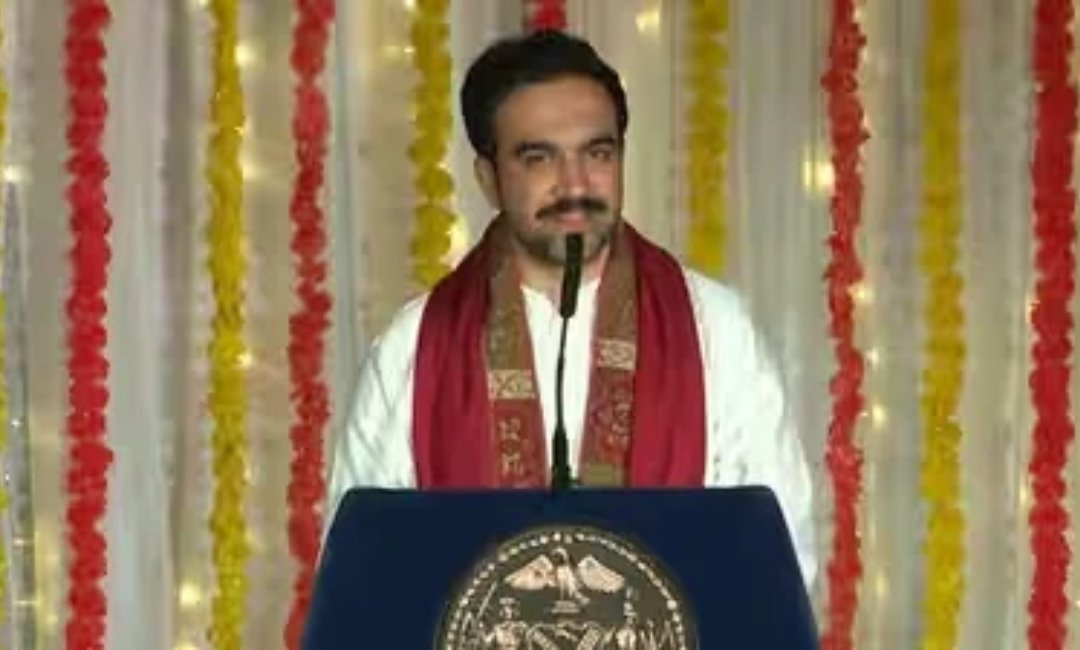
NEW YORK, NY – “To anyone who has been told to go back home, whose belonging has been questioned, let me say unequivocally, you are home,” New York City Mayor Zohran Mamdani declared, using his Diwali address at City Hall to speak out against anti-Hindu hate, religious discrimination and the growing use of hostility in political campaigns.
Mamdani called hosting the Diwali gathering “truly the honor and the privilege of a lifetime” and noted that he was the first Indian American to serve as mayor of New York City.
Mamdani’s remarks on November 17 carried particular significance amid resistance to his political rise among sections of the Hindu Indian American community. Despite that skepticism, he used the podium, dressed in Indian clothes, to speak directly about attacks on Hindu temples in the United States and the need to confront hatred targeting religious communities.
He said Hindu temples had been targeted across the country in recent months and accused leaders at the highest levels of the federal government of targeting Sikhs. He warned that prejudice once confined to society’s fringes was increasingly becoming part of mainstream political campaigns.
He pointed to Hindu temples being targeted in the United States in recent months and also raised concerns about Sikhs facing hostility, alleging that even leaders at the highest levels of the federal government had targeted the community.
Mamdani warned that prejudice was no longer limited to fringe groups but was increasingly finding acceptance in political discourse and election campaigns. He urged people to resist political appeals based on fear and religious identity.
“Whether it is fearmongering in Washington or Delhi, we hold a shared obligation, as we mark this holiday, to reject any politics that brings darkness into this world,” he said.
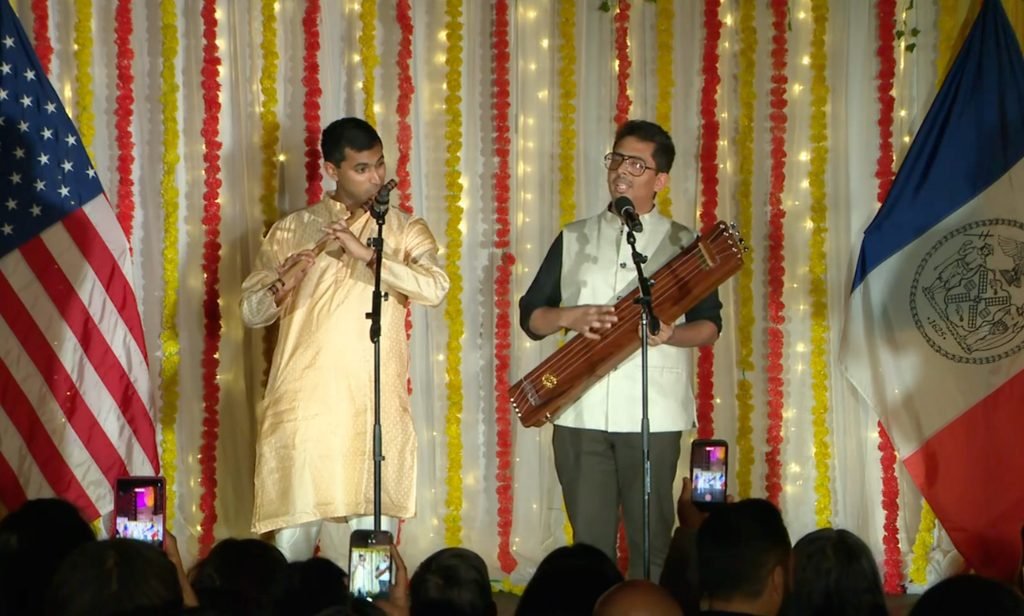
The mayor, whose father, Mahmood Mamdani, is a Ugandan-born academic and whose mother is Indian filmmaker Mira Nair, spoke about the influence of his family’s different cultural and religious backgrounds. He said his mother’s family had introduced him to Hinduism and its philosophical traditions from an early age.
He described Hinduism as a tradition that accommodates different forms of worship and multiple understandings of truth, rather than requiring adherence to a single path.
“Our shared heritage was never a single language, faith, or affiliation. From an early age, my mother’s family taught me how much beauty and wisdom lives in Hinduism,” the practicing Muslim said.
Referring to Hinduism’s scriptures, he highlighted the belief that truth can be approached through different paths and that a common spiritual essence connects people across religious boundaries.
“It is a faith of many gods… it’s a faith whose oldest scripture teaches us that there are many roads to Satya (truth), and that the same light lives in every one of us, whether we pray in a mandir, a masjid, a gurudwara, or nowhere at all,” Mamdani said.
He also turned to two of Hinduism’s best-known epics to illustrate the values they convey. The ‘Ramayana,’ he said, offers examples of the relationships people aspire to build, while the ‘Mahabharata’ reflects the complications of family life and the conflict between personal loyalties and moral obligations.
“Ramayana shows us the brother, the wife, the husband, and the friend that we aspire to be. The Mahabharata shows us what families are really like, where even the bravest heroes and wisest gods stumble, and where one’s Dharma must come before one’s loyalty,” he said.
For Mamdani, these teachings extend beyond religious observance. He linked the moral principles associated with Hindu traditions to movements for social change, pointing to Mahatma Gandhi’s Salt March and Martin Luther King Jr.’s March on Washington as examples of how such ideas have inspired struggles for justice.
He said the festival’s message of light should also prompt reflection on the work required to create a more inclusive society, particularly at a time when political rhetoric is contributing to divisions.


Vijay
/
Well said.
November 18, 2026ANUPAM PATEL
/
This guy is phony and, like most politicians, they will talk well and say anything to get votes! Just watch what he does, since I only go by what one does and not what one says.
November 18, 2026ASHOK KUMAR BATRA
/
Mr. Mayor
November 18, 2026Happy Diwali. You beautifully captured the message of the festival. Keep up the good work.
Best regards
Ashok Batra, Esq.
Mahendra Garg
/
He was brought up in both cultures and deliberate wisely,
November 18, 2026