India And Russia – An Old Alliance Reinvented For A Turbulent Century
NEW DELHI – For more than seven decades, India and Russia have managed something rare in international politics—a relationship that has not only survived the seismic shifts of history but adapted to them. From the days when Moscow was New Delhi’s most dependable ally during the Cold War, through the collapse of the Soviet Union, to today’s tangled, multipolar world, the two countries have kept faith with each other even as the nature of their partnership has transformed.
That evolution—and the forces shaping it now—is the subject of India and Russia – Enduring Trust in a Transformational Era (Har-Anand Publications Ltd., pp 175), edited by Dr Lydia Kulik, Head of India Studies at the Moscow School of Management, Skolkovo, and Senior Research Fellow at the Russian Academy of Sciences. The book gathers 10 essays by leading Indian and Russian scholars to examine where the relationship has been, and where it might be headed.
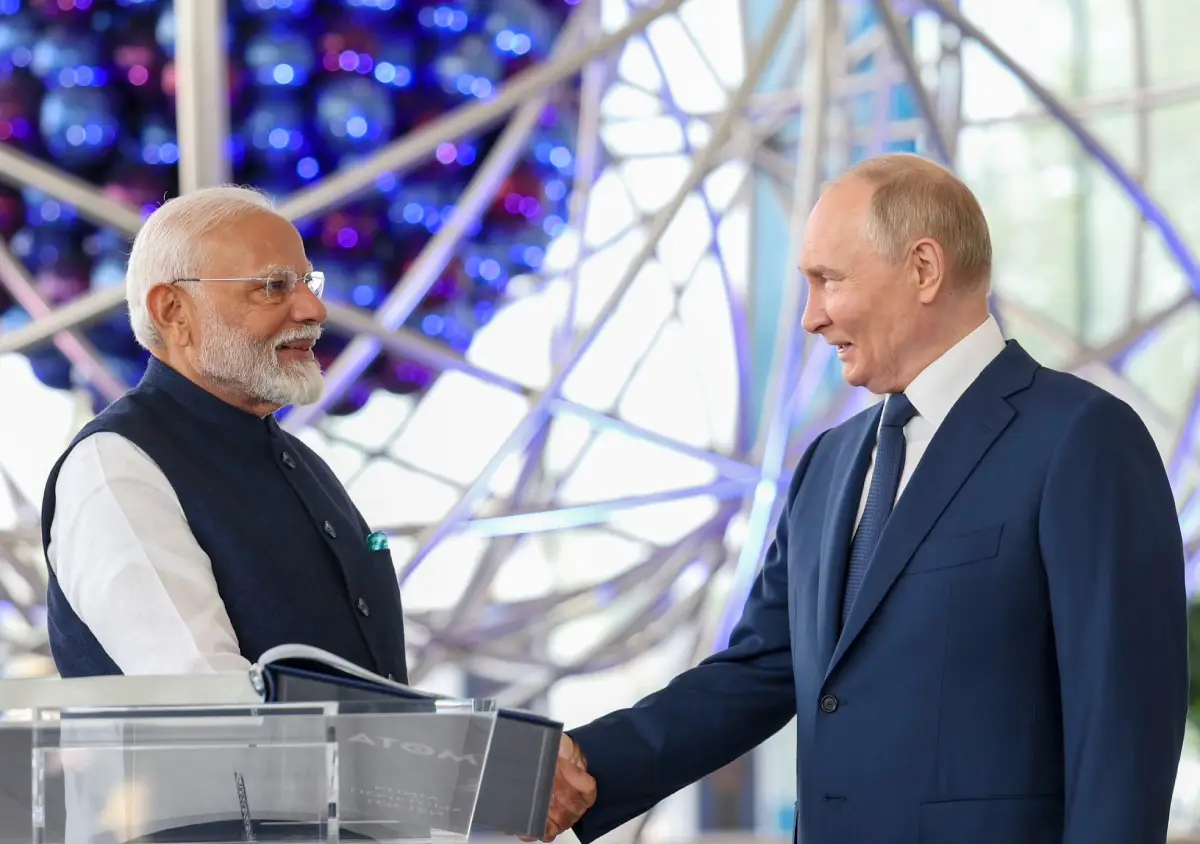
Kulik notes that 2024 was particularly eventful. It began with External Affairs Minister S. Jaishankar’s December 2023 visit to St Petersburg, followed by Prime Minister Narendra Modi’s two trips to Russia—his first foreign tour in July after winning a third term, when President Vladimir Putin hosted him at his dacha, and again later in the year for the BRICS Summit in Kazan. Meanwhile, a flurry of business events underscored a shift away from the Soviet-era focus on diplomacy and military-technical cooperation toward deeper economic, transport, and technology linkages.
Half the book’s essays explore these new areas. Dr Anna Kireeva of MGIMO University looks at Russia’s ASEAN policy and its potential synergy with India. Former Indian ambassador to Russia Pankaj Saran provides a brisk history of bilateral ties before outlining future drivers. Dr Tatyana Shaumyan of the Russian Academy of Sciences examines both nations’ roles in multilateral groupings like SCO and BRICS, and argues for reviving the RIC format—an idea also championed by Foreign Minister Sergei Lavrov.
Russian scholar Leyla Turayanova analyzes Modi’s July Moscow visit and links it to perceptions of his August trip to Ukraine. Sergey Komyshan of Sibur details 21st-century trade and investment cooperation, while former Russian Deputy Finance Minister Dr Sergey Storchak highlights financial collaboration as a model of compromise.
Connectivity—from Eurasia to the Arctic—is mapped by Dr Julia Melnikova of the Russian International Affairs Council. Science and technology ties, from space to digital, are examined by Dr Olga Ustyuzhantseva and Dr Ivan Danilin of IMEMO. Dr Aleksei Zakharov charts Russia’s renewed interest in South Asia, while Aryaman Nijhawan of ORF weighs the Russia–Ukraine conflict’s diplomatic and technological impact.
Compact but rich in insight, the book shows that this enduring partnership is not a relic of the past, but a relationship still being actively rewritten for the century ahead. (IANS)