

Silicon Valley Conference Calls For Deeper U.S.-India Cooperation In Tech And Innovation
By Maria Abraham
SANTA CLARA, CA — The 8th U.S.-India Conference, organized by the All India Management Association (AIMA), drew a packed audience to the University of California, Santa Cruz, Silicon Valley Campus on October 7. The theme — “U.S.-India: Normalization or Reset?” — reflected a timely question: Are the current trade frictions and tariff tensions a brief recalibration or signs of diverging priorities between the two democracies?
The event brought together business leaders, academics, and policymakers to examine the evolving partnership amid global power shifts and rapid advances in technology.
From Trade to Knowledge
In opening remarks, UC Santa Cruz Chancellor Cynthia Larive, AIMA Director General Rekha Sethi, and AIMA President and Tata Steel CEO T.V. Narendran called for a move beyond a transactional trade relationship toward a knowledge-driven alliance.
Sunil Kant Munjal, Chairman of Hero Enterprise and AIMA International, said India’s GDP growth must climb from 6.5% to 8% to sustain its welfare commitments. He praised India’s Digital Public Infrastructure as “a globally unmatched model,” and urged the two nations to collaborate through R&D and education rather than relying solely on commerce.
Dr. K. Srikar Reddy, Consul General of India in San Francisco, delivered the keynote, highlighting India’s $18 billion Semicon India Mission and the joint NASA-ISRO NISAR satellite as proof of deepening technological cooperation under the Initiative on Critical and Emerging Technology (iCET). He emphasized that India’s growing innovation ecosystem has made it a credible, long-term partner for the U.S.
The Great AI Race
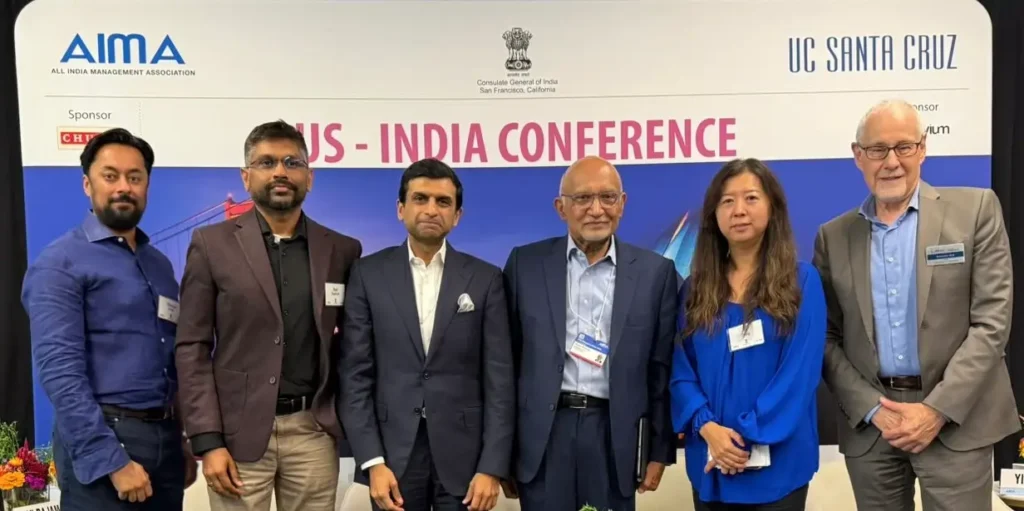
The first panel, “The Great AI Race: Who Sets the Rules?”, tackled the future of artificial intelligence and its geopolitical implications.
Ravi Rajamani, Global Head of Generative AI at Google, argued that India could “leapfrog” into the next phase of AI by embracing open-source systems and investing in new multimodal architectures that go beyond large language models.
UC Santa Cruz professor Yi Zhang warned that AI systems remain vulnerable to hallucinations and misalignment, urging the creation of global auditing standards.
Arun Kumar of Celesta Capital underscored the strong ties between Silicon Valley and India’s tech ecosystem, saying they give India a powerful advantage. Vineet Agarwal, AIMA Vice President and TCI Ltd. Managing Director, noted that India’s G20 Delhi Declaration recognized data as a public good. He said the success of Aadhaar and digital payments shows that India’s inclusive regulatory model could guide other nations.
Trivium CEO Sharad Singh compared India’s potential role in tech to Switzerland’s neutrality in banking — a secure digital hub for global collaboration. The panel agreed that India should pursue a “dual strategy”: build a domestic tech stack while maintaining close alignment with Western innovation networks. For 2026, they said, regulators must prioritize combating hallucination, misinformation, and transparency in AI.
Geopolitics on Edge
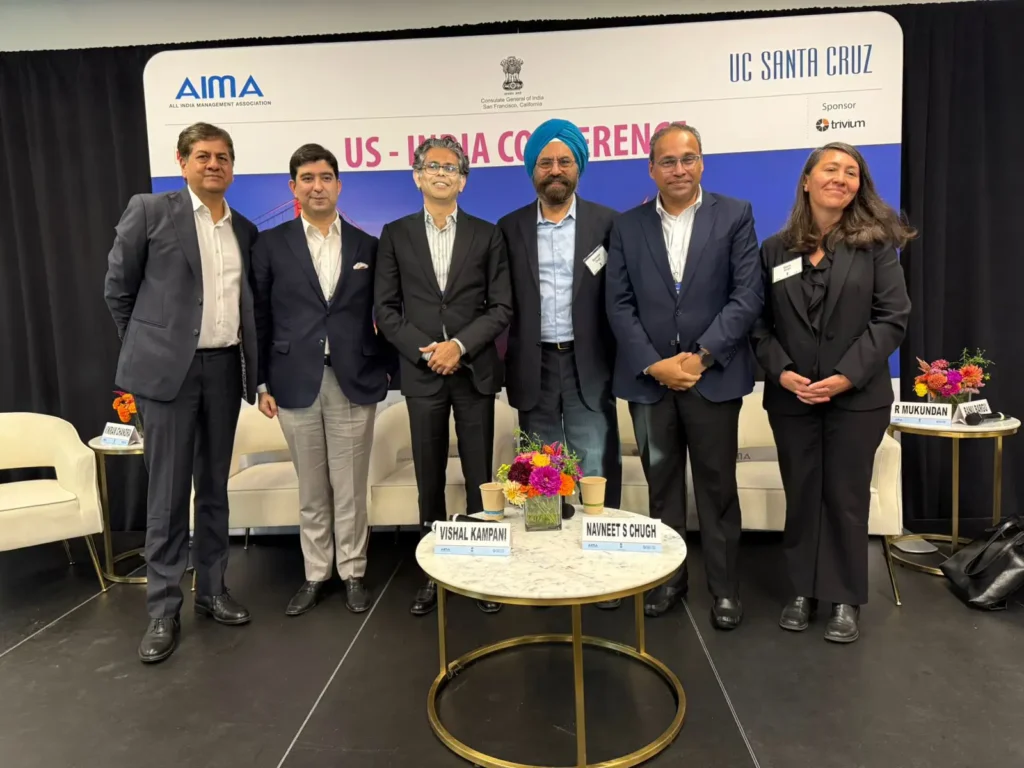
The second panel, “War Games and Peace Plans: Geopolitics in a World on Edge,” explored how the U.S. and India can work together to prevent a slide into new global confrontations.
Moderator Vikram Chandra, founder of Editorji Technologies, noted that long-held assumptions about a peaceful, postwar global order and an unshakable U.S.-India alliance are now being tested.
Triveni Turbine’s Nikhil Sawhney described current tensions as a “blip” caused largely by U.S. domestic politics, while Tata Chemicals CEO R. Mukundan blamed deeper structural shifts toward protectionism. He endorsed India’s “quiet diplomacy” in navigating a complex world.
UC Santa Cruz professor Banu Bargu urged adopting “planetary consciousness” — placing collective human welfare above national power struggles. J.M. Financial’s Vishal Kampani said India’s goal should be a multipolar world where it operates as an independent player.
Attorney Navneet S. Chugh argued that India must focus on internal growth to reclaim its historic share of the global economy, while trading widely to avoid political dependence on any single power.
Panelists agreed that India’s best path forward is to remain self-reliant but globally connected — an “India plus one” strategy that diversifies alliances without choosing sides.
Biohacking and Human Health
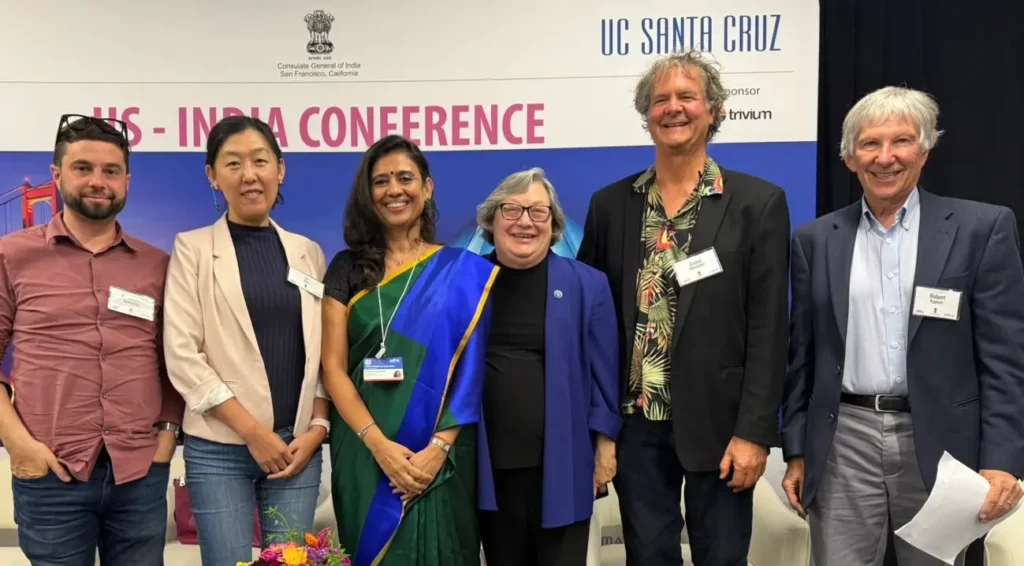
The final session, “Biohacking Human Health,” shifted the conversation from geopolitics to biotechnology.
Moderator Robert M. Kaplan of Stanford led a discussion on how AI and genomics are transforming medicine. UC Santa Cruz’s David Haussler said human biology is “a thousand times harder to model than language,” creating a “data desert” for AI. He cautioned against rushing into Artificial Superintelligence without fully understanding its limits.
Molecular biologist Yi Zuo added that today’s AI architectures are “alien to how our brains work” and have yet to yield deep scientific insight.
Vinita Bajoria of NICCO Cables said that in the pursuit of intelligence, humanity has “lost its wisdom,” urging a return to ancient philosophies and “intentional lifestyle design” to counter rising mental and lifestyle diseases. Biomedical engineer Alexander Ioannidis noted that India’s massive and diverse population offers a rare opportunity for large-scale genomic research, which could accelerate global health breakthroughs.
A Partnership Redefined
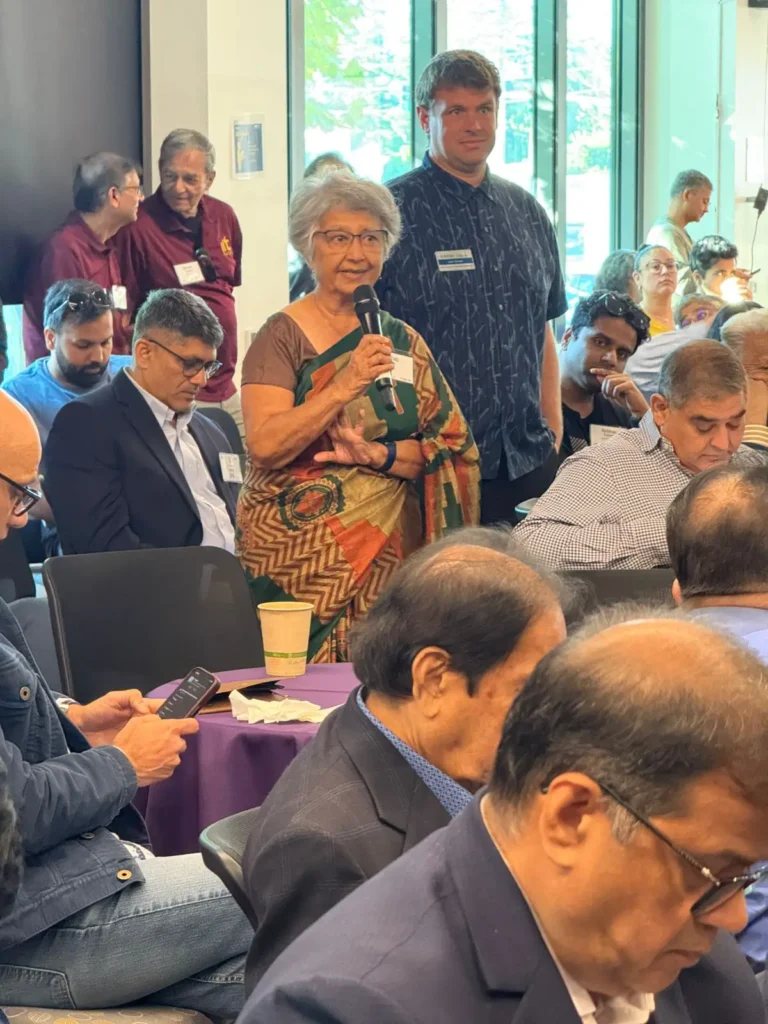
As the conference drew to a close, speakers called for the U.S. and India to strengthen their partnership through trust, shared R&D, and technology exchange. The future, they agreed, lies in co-developing ethical frameworks for AI and biotechnology that serve humanity rather than politics.
Ultimately, participants said, the strength of the U.S.-India partnership will not be measured in trade numbers but in its ability to jointly pioneer the moral, technological, and economic systems of a fast-changing world.
Bharath Bopanna
/
Well written article. The last para sums it up really well on the future of the Indo-US partnership
October 13, 2025Bharath Bopanna
/
Well written article! The last para perfectly summarizes how the Indo-US partnership should grow in the future.
October 13, 2025