
Keeping Count: The Surge Of Anti-South Asian Hate In America
From: Stop AAPI Hate
South Asian communities are once again facing hate on multiple fronts — and this time, the danger feels sharper, louder, and more politically charged than ever.
Anti-South Asian racism has been steadily rising for several years, fueled by a perfect storm of political rhetoric, online disinformation, and xenophobic scapegoating. It’s a disturbing pattern — one we’ve seen unfold before, most notably in 2023 when Vice President Kamala Harris launched her presidential campaign, and again after Donald Trump’s return to the White House. Each of these moments sparked waves of hate that rippled across social media and spilled into everyday life.
Now, ahead of the 2025 elections, that tide surged again.
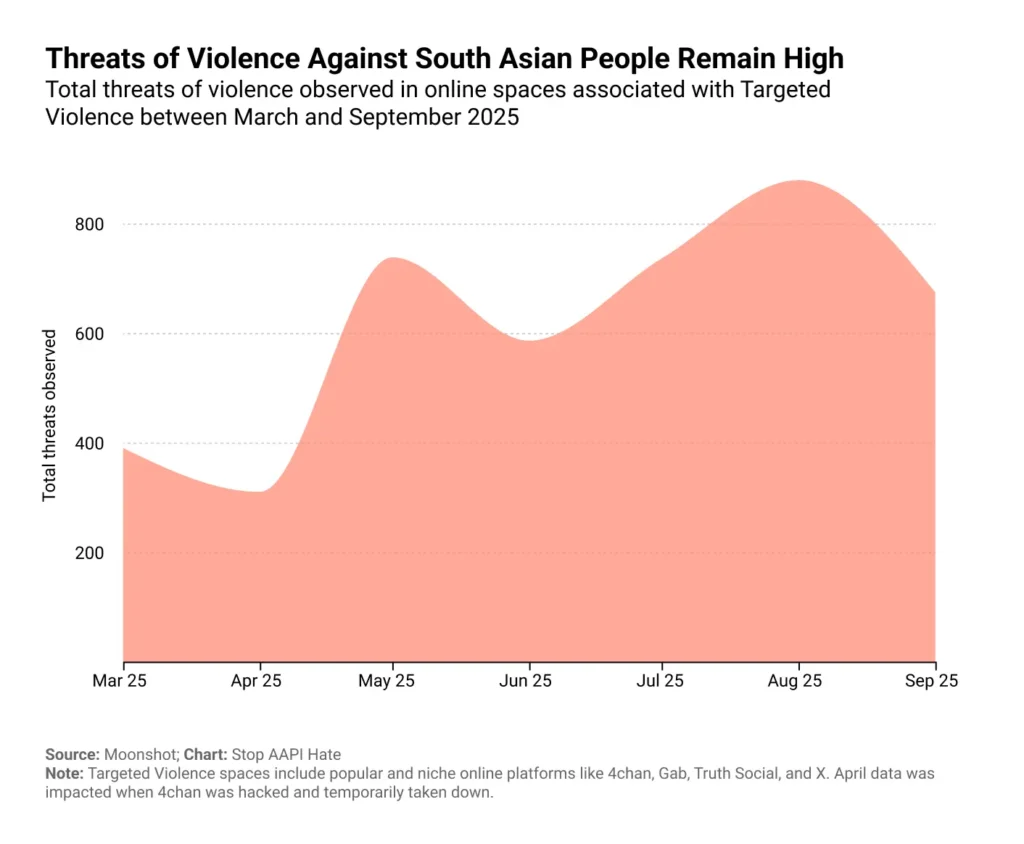
From July through September 2025, data from Stop AAPI Hate and Moonshot — which monitors extremist online spaces — paints a grim picture. Anti-South Asian slurs and threats of violence have reached some of their highest levels since tracking began in 2023. In August alone, there were nearly 57,200 anti-South Asian slurs, while threats of violence spiked to 879 incidents — the second highest peak on record.
Online, a particularly vile slur, “jt,” saw a 69% increase, while the phrase “total pajt death” jumped 45% in September. These are not mere words — they’re signals of dehumanization, the linguistic groundwork that often precedes real-world violence.
Why Hate Is Rising Again
Behind the surge lies a toxic blend of politics, policy, and prejudice.
The H-1B visa debate remains one of the central triggers. South Asians make up 73% of H-1B visa holders, and whenever national discourse turns toward immigration, it inevitably unleashes a torrent of hate. Trump’s September announcement imposing a $100,000 fee for certain H-1B applicants ignited a firestorm online — extremist users celebrated the move, using slurs and calling for violence against Indian immigrants.
The message was unmistakable: economic anxiety, weaponized for political gain, once again found a scapegoat in South Asian communities.
Hate That Travels
The rise of anti-South Asian sentiment isn’t confined to the U.S. It’s transnational, spreading through social media networks that amplify racism in real time.
In July, a viral post in Canada falsely accused South Asian parkgoers of predatory behavior, sparking threats of violence. In Dublin, assaults on Indian immigrants led to online calls to “#beatthej**t.” In the U.S., a California truck accident involving an Indian driver turned into digital mob justice, with users calling for “genocide” of South Asians.
Hate, it seems, now crosses borders faster than compassion.
When Leaders Fan the Flames
What makes this crisis especially dangerous is that political leaders themselves are amplifying it.
In Florida, Councilmember Chandler Langvin falsely claimed Indians were “draining our pockets” and demanded their deportation. In Arizona, State Rep. John Gillette called for the hanging of Rep. Pramila Jayapal, an Indian American congresswoman, for speaking about nonviolence.
And at the national level, a leaked Young Republicans group chat revealed shocking racism — from Hitler praise to talk of “gas chambers.” Rather than condemning it, Vice President J.D. Vance brushed it off as “kids doing stupid things.” This normalization of hate from the top emboldens extremists and desensitizes the public.
The Mamdani Effect
Much of the recent surge in anti-South Asian hate is tied to the rise of Zohran Mamdani, the Indian American Muslim Democrat running for New York City mayor.
Mentions of Mamdani in extremist spaces skyrocketed 949% in July and continued climbing through September. His faith and immigrant background have been weaponized against him. Rep. Andy Ogles even urged the Justice Department to denaturalize him, echoing Islamophobic conspiracy theories that cast Muslim Americans as threats.
Right-wing media figures like Maria Bartiromo have leaned into this rhetoric, warning that New York would look “largely Muslim” under Mamdani — language that mirrors the racist narratives tracked by the Center for the Study of Organized Hate (CSOH), which recorded a 450% spike in anti-Muslim posts ahead of the November election.
No Party Immunity
Even South Asian Republicans haven’t been spared. Trump’s FBI Director Kash Patel was told to “go back to India” after posting a Diwali greeting. DOJ civil rights head Harmeet Dhillon, a Sikh American, was attacked online for condemning anti-Indian hate.
The message is clear: for extremists, South Asians — regardless of politics, religion, or profession — remain “the other.”
Institutionalized Racism in Policy
Trump’s immigration agenda has baked anti-South Asian hate into law. His $100,000 H-1B visa fee effectively blocks the majority of South Asian applicants. ICE detentions of Asian immigrants have tripled since his return to office. And a recent Supreme Court ruling now allows ICE agents to arrest people based on race or religion — a chilling invitation to racial profiling.
These policies echo the darkest chapters of U.S. history — from Chinese exclusion to Japanese internment — when fear of the “foreign invader” justified cruelty in the name of national security.
Hate Hits Home
The data comes alive in the voices of those directly targeted.
An Indian woman in Georgia was screamed at, called a “murderer,” and threatened with deportation at a fast-food restaurant. A man in Massachusetts watched in fear as a woman smashed a dryer door while shouting, “I don’t want to see ugly, smelly Asians here!”
These aren’t isolated incidents. Stop AAPI Hate’s survey with the University of Chicago found that 54% of South Asian adults experienced a race-based hate act in 2024 — up from 43% the previous year. Nearly half reported harassment.
Fighting Back
Yet even in this climate of hostility, communities are pushing back. When Councilmember Langvin’s racist posts went public, over 100 residents flooded a city council meeting demanding accountability. He was censured — a small but significant act of collective resistance. And racist appointees like Paul Ingrassia, who once texted “Never trust a Chinaman or Indian,” have been forced to withdraw from public office.
The lesson is clear: silence only emboldens hate.


Purandar
/
Remember Uganda. Start Packing. Signs are emerging. Keep moving assets. There is a window left yet.
November 6, 2025VIJAY
/
This is not Uganda and will never be. I may be wrong, however.
November 6, 2025Daljit Singh
/
Hate and discrimination against South Asians are setting in. It does not immunize MAGA supporters. A person may be a 4th-generation American, but they are still visible as a hated group. Beware of the haters.
November 7, 2025John
/
Hmmmm…when east Asian, i.e. Chinese, were the target recently, the south Asians were silent and complicit by not supporting them in their time of need. South Asians thought they were accepted by the whites. Nah. South Asians are just de-lu-lu.
February 16, 2026