Mani Bhaumik’s $3M Gift Will Support Next Generation Of UCLA Scientists
Photo: UCLA
India-West Staff Reporter
LOS ANGELES, CA — A transformative $3 million commitment from physicist, entrepreneur, and philanthropist Mani L. Bhaumik will establish a new postdoctoral fellows program at UCLA, furthering the university’s mission to advance fundamental research in physics, astronomy, chemistry, and biochemistry.
The Bhaumik Prize Postdoctoral Fellows Program, jointly funded with a $1.5 million match from UCLA’s Division of Physical Sciences, will support the recruitment and development of top-tier postdoctoral scholars in the departments where Bhaumik himself once trained.
“I almost grew up along with UCLA — when I came here at 28, I wasn’t that much younger than the university,” said Bhaumik, who arrived from India on a Sloan Foundation postdoctoral fellowship. “It’s really amazing to have seen the growth of UCLA and where it is going. I’d like to be a fly on the wall for the next centennial to see what has happened — the progress so far has been unimaginable.”
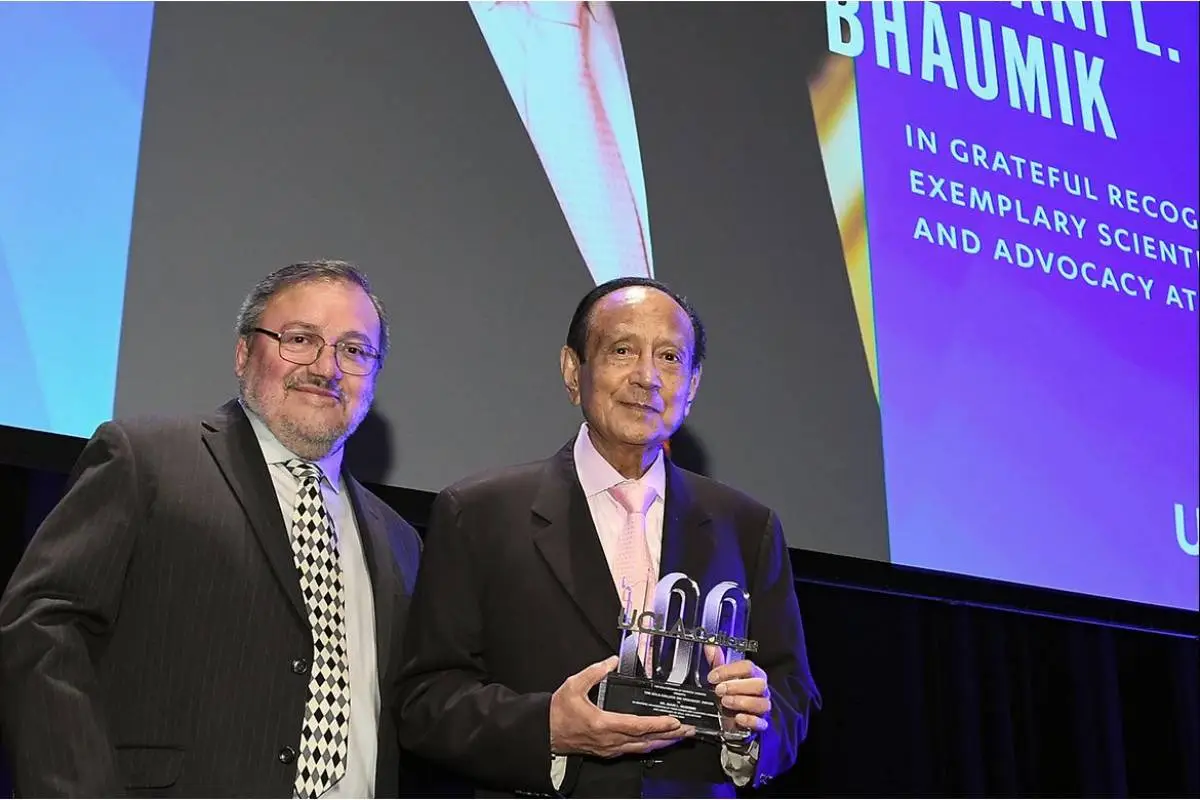
Born into poverty in a small village in West Bengal, Bhaumik rose to international prominence through scientific innovation and philanthropic leadership. He helped pioneer the laser technology that laid the groundwork for LASIK eye surgery while working at Northrop Grumman. A recipient of the UCLA College 100 Visionary Award, Bhaumik has made lasting contributions to the university, including founding the Mani L. Bhaumik Institute for Theoretical Physics and the Centennial Collaboratory.
“Few people are as driven as Mani Bhaumik to further scientific discovery by investing in the next generation of talented researchers,” said Miguel García-Garibay, dean of physical sciences and senior dean of the UCLA College. “This new program strengthens UCLA’s role as a hub for rising scientists and will help shape a better future through the contributions they will make.”
Launching as a pilot initiative, the program will recruit four new fellows annually for four years, each appointed for up to three years. In total, about 16 postdoctoral fellows will be supported over the six-year pilot phase. In addition to research, the program will emphasize service, public science engagement, interdisciplinary collaboration, and training in entrepreneurship and intellectual property.
Stuart Brown, chair of the Department of Physics and Astronomy, underscored the impact: “It allows us to recruit energetic, rising scholars with great potential, who will be free to come to UCLA and do their best work.”
Alexander Spokoyny, chair of the Department of Chemistry and Biochemistry, added, “The best part is that we don’t yet know what new discoveries will be made. The postdocs will be the drivers of these innovations—and that’s what makes this all so exciting.”