
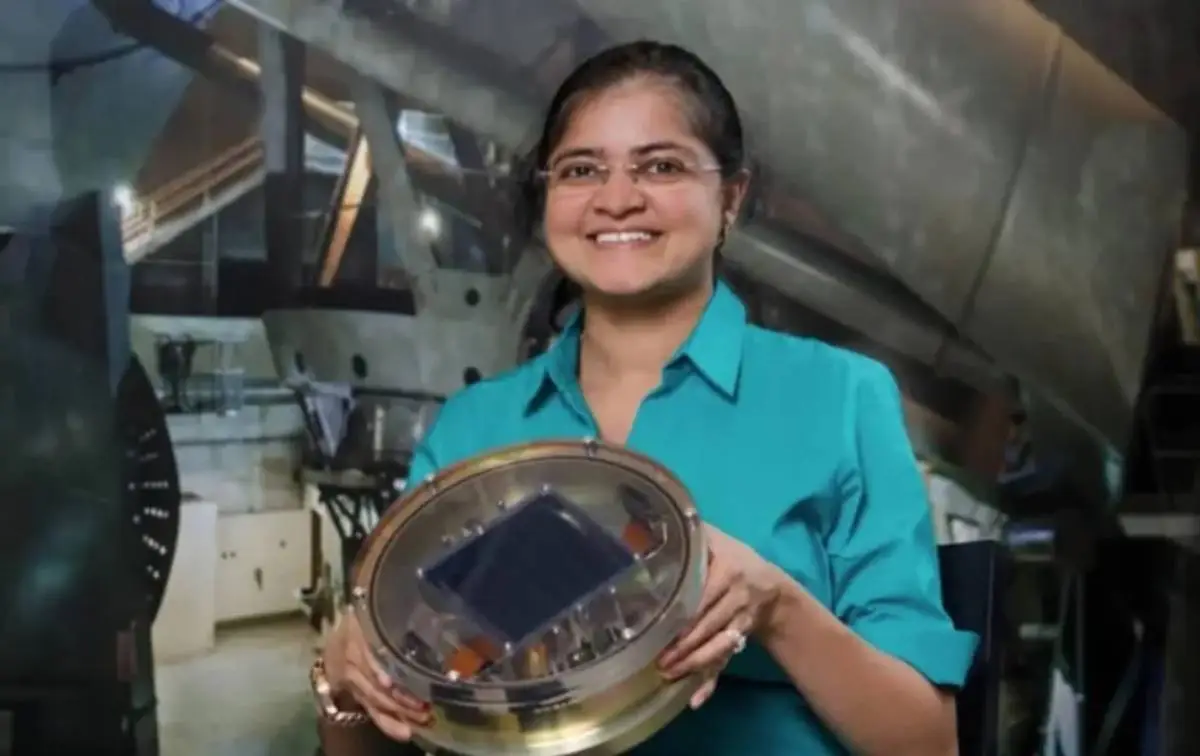
Mansi Kasliwal Becomes First Woman To Lead Caltech’s Palomar Observatory
India-West Staff Reporter
PASADENA, CA — When Mansi Manoj Kasliwal was 15, she left her hometown of Indore, for boarding school in the United States. Encouraged by a teacher to pursue science, she soon found herself working on NASA’s Spitzer Space Telescope as an undergraduate at Cornell University. “Spitzer was being launched, and I got to see the data start flowing in,” she recalled. “From then on, I was completely hooked.”
That early spark has now carried her to a historic role. Caltech announced that Kasliwal, a professor of astronomy, has been appointed director of Palomar Observatory — the first woman to lead the storied facility in its 75-year history.
Kasliwal specializes in time-domain and multi-messenger astrophysics, areas of research that track fleeting, fast-changing cosmic events. Her work focuses on stellar explosions such as supernovae and merging neutron stars, and she has played a pivotal role in developing some of Palomar’s most advanced survey instruments: the Zwicky Transient Facility (ZTF), Palomar Gattini-IR, WINTER, and the newly commissioned Next Generation Palomar Spectrograph (NGPS).
Beyond the observatory’s instruments, Kasliwal has also built networks. She directs the Global Relay of Observatories Watching Transients Happen (GROWTH), an international collaboration funded by the National Science Foundation. Explaining the mission in simple terms, she once said, “We just go around the globe and keep passing the baton so that the sky remains dark.”
Her path back to Caltech was a natural one. After completing her Ph.D. there in 2011, she helped design the Palomar Transient Factory, which enabled systematic searches for stellar transients at an unprecedented scale. Today, her academic record includes more than 440 refereed papers, an h-index of 100, and leadership in groundbreaking gravitational-wave follow-up campaigns. In 2022, her contributions earned her the prestigious Breakthrough Prize in Physics.


Natarajan Sivsubramanian
/
Great achievement
September 30, 2025