Museum Exhibit: A CA Wildfire Inspires The Transformation Of The Saree Into A Fine Art Canvas
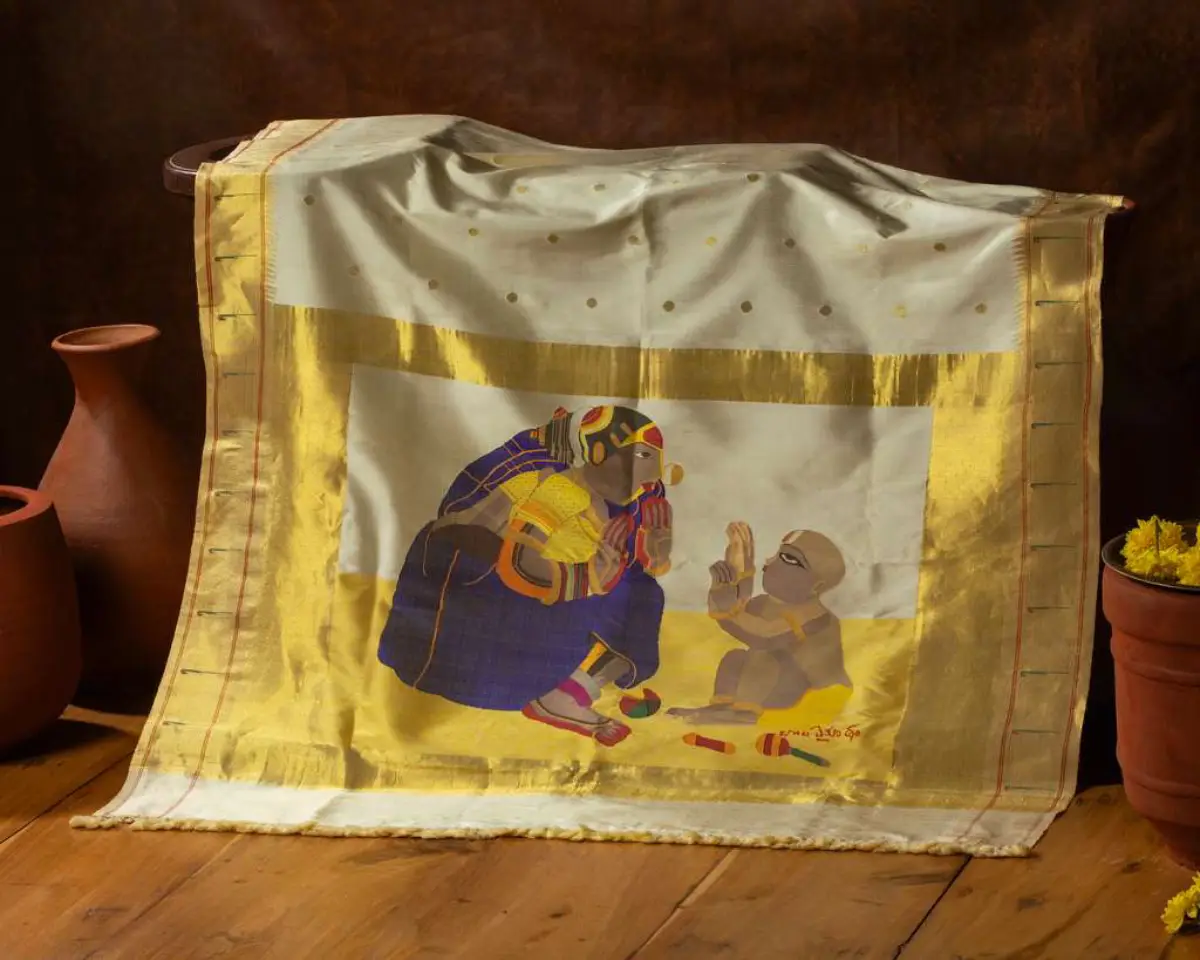
Photo: A transformed saree by Thota Vaikuntam x Sushma Thota.
By REENA RATHORE
SAN FRANCISCO, CA – The saree has always been more than mere fabric. Flowing, versatile, and timeless, it is a storyteller. Six yards of silk, both beautiful and practical, have threaded through ancient civilizations, colonial histories, and modern lives, quietly shaping the cultural and emotional landscape of South Asia. On March 29, San Francisco’s Asian Art Museum opened “Unstitched: A Celebration of the Saree,” a new exhibition in which this enduring garment steps into an entirely new role: a canvas for fine art.
Developed in collaboration with EnActe Arts, the exhibition centers on “Journey and Exile,” curated by California-based artist Vara Ramakrishnan. Working under this shared theme, over forty of India’s most celebrated artists, including Seema Kohli, Thota Vaikuntam, Thota Tharani, and Laxman Aelay, have transformed silk sarees into works that blend tradition, imagination, and personal narrative.
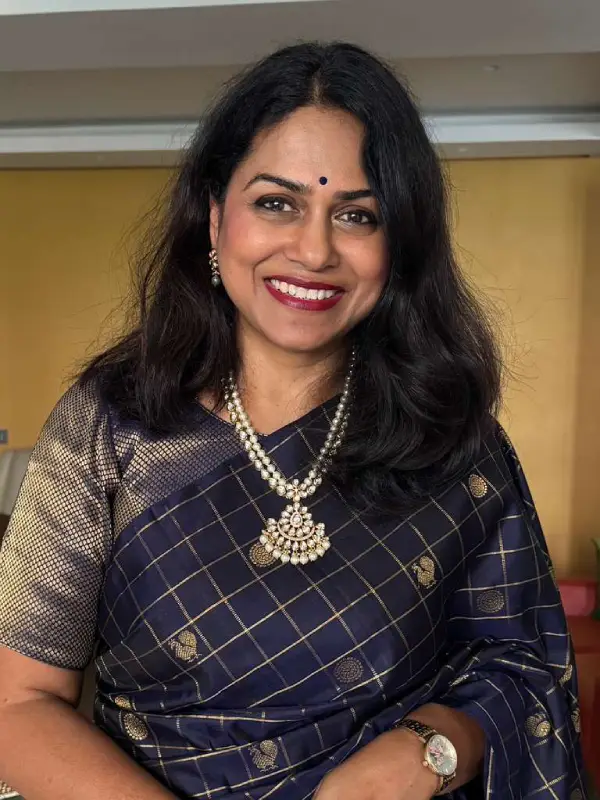
The inspiration, Ramakrishnan told India-West, was born from crisis. During the 2020 California fires, as evacuation loomed, she made a series of instinctive choices about what to save. She packed family photographs, jewelry, and every sari she owned. She did not save a single painting from her studio.
“That moment shifted something for me,” Ramakrishnan, executive director of Lara Lakshmi Art Foundation, recalled. “When I unpacked later, I realized that the objects I had instinctively protected were the ones that carried meaning, memory, and continuity. The sari became the natural vessel for art because it is already embedded in lived experience. It is not just seen, it is worn, inherited, and carried across generations.”
That moment of reckoning became the foundation of the exhibition.
“Unstitched: A Celebration of the Saree,” comprises three distinct components: reimagined sarees; a fashion show curated by EnActe Arts; and a historical and craft-focused exhibit on the breadth and diversity of the saree tradition, curated by Pia and Neel Ganguly.
The Asian Art Museum has been working to deepen its relationship with South Asian communities, to create what Ramakrishnan describes as “a sense of shared ownership” between the institution and the audiences it has not always reached.
“The exhibit creates a moment of visibility and recognition,” Ramakrishnan, who is also among the artists, said. “For diaspora communities, especially younger generations, seeing the sari centered in a museum setting affirms its place in contemporary cultural life. It is not only a traditional garment, but something that continues to evolve. The sari itself reflects diaspora identity. It has traveled, adapted, and been reinterpreted. In that sense, the exhibit mirrors the experience of migration and transformation.
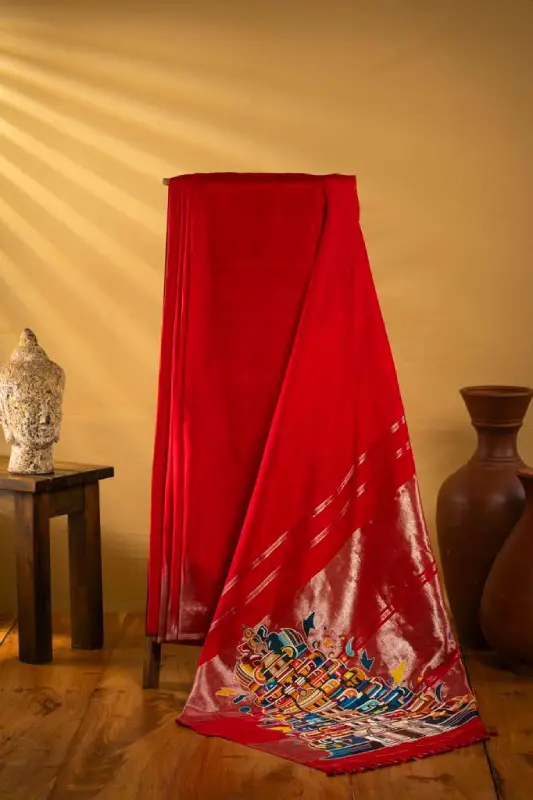
Ramakrishnan gave her artists a single conceptual starting point – ‘Journey and Exile’ – and asked them to develop their own interpretation before ever touching the fabric. What followed was, by her account, strikingly personal.
“One of the most moving interpretations came from an 83-year-old artist who explored birth as the first exile,” she told India-West. “He reflected on the separation from the mother at the moment of birth, something he is still contemplating decades later.”
Others moved outward rather than inward into mythology, migration, language and spiritual narrative. Some imagined journeys across time and geography, blending the landscapes of India and California into a single, seamless vision.
“The saree became part of the theme on occasion. It is a garment that has traveled across continents and taken on new meanings in different contexts,” Ramakrishnan said.
Rather than imposing a rigid curatorial framework, she allowed the exhibition to evolve organically. Artists from across different geographies, generations, and practices were brought into the fold, many of them returning to textile and fabric work after years away, drawn back by the immediacy of the idea. “The response from artists and collaborators suggested that the saree as a medium for fine art is something people were ready to explore,” she stated. “It was less about curating to a predefined diversity and more about allowing a network of artists to gather around a shared idea.”
The project came together in a matter of months, with artists working under tight timelines on an unforgiving medium. “Once pigment is absorbed, it cannot easily be corrected or layered. Many artists found it more challenging than watercolor,” Ramakrishnan said. The saree also introduced a conceptual dimension unique to the medium, she said, noting that it is not a flat surface. Some sections are immediately visible when worn, while others stay folded, revealed only in motion. Artists had to consider how their work would unfold on the body and every piece still had to remain wearable. “These are not static pieces,” Ramakrishnan said. “They are meant to be lived in and passed on.”
She is candid about the outcome she hopes the exhibition produces beyond the gallery walls. “I hope to evoke both connection and curiosity. Even something as simple as seeing more saris worn in public spaces would feel like a meaningful outcome,” she told India-West.
For broader audiences encountering the saree as art for the first time, she hopes it opens new ways of seeing both textile art and cultural expression. “There is a universality in beauty and storytelling that can be felt across backgrounds.”