New Global Realities Result in Pragmatic Indo-Canadian Alliance; $2.6 Billion Uranium Deal Signed
India-West News Desk
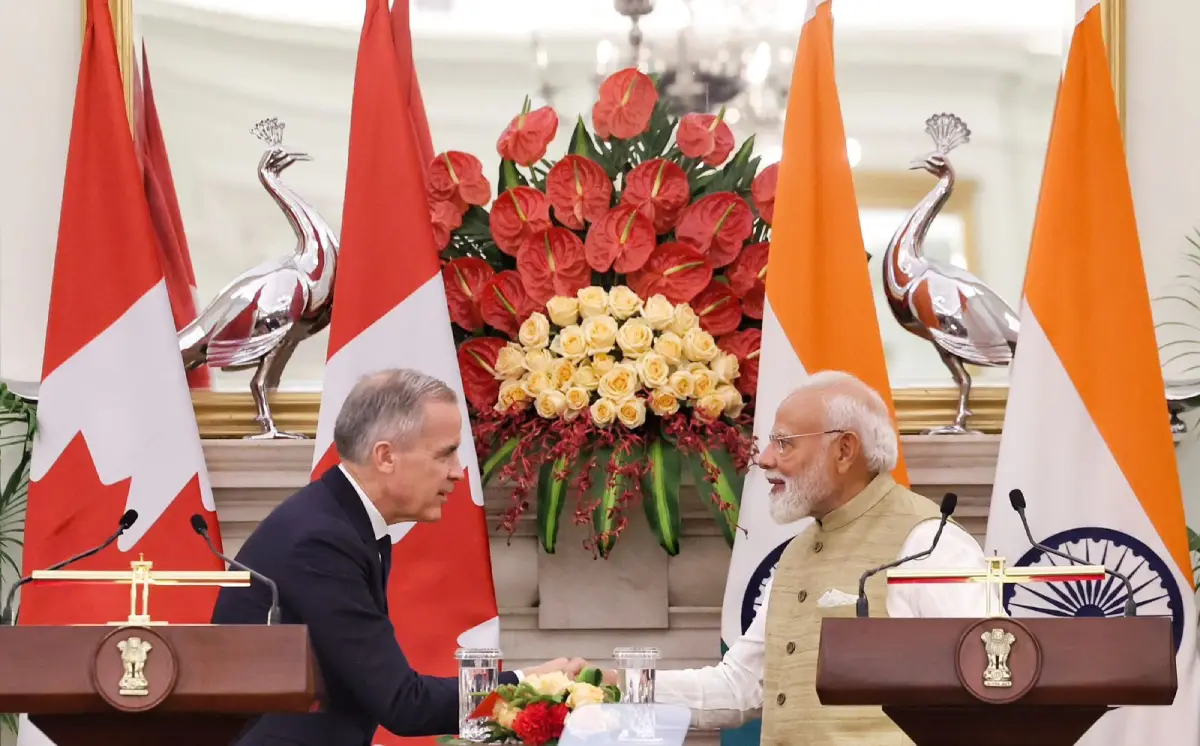
NEW DELHI – The meeting between Prime Minister Narendra Modi and Canadian Prime Minister Mark Carney in New Delhi on March 2 has marked a historic turning point for the two nations looking to move past years of diplomatic friction. The primary headline of the summit is a massive $2.6 billion commercial agreement between the Canadian firm Cameco and India’s Department of Atomic Energy. This ten-year deal ensures a stable, long-term supply of uranium to power India’s civil nuclear energy sector, a move that both leaders described as essential for India’s clean energy transition and overall energy security.
This nuclear pact is part of a much larger strategic reset. For the first time in over a decade, the two countries have set a firm deadline to finalize the Comprehensive Economic Partnership Agreement by the end of 2026. According to Modi, the ultimate goal is to skyrocket bilateral trade from the current $9 billion to an archingly ambitious $50 billion by 2030.
This push for economic integration comes at a time when both nations are seeking to insulate themselves from global volatility and reduce their exposure to punitive trade tariffs from the United States, the BBC said.
Carney noted that there has been more high-level engagement between the two governments in the last year than in the previous two decades combined. This surge in cooperation is a pragmatic response to shifting global realities. India is actively looking to diversify its energy sources to reduce its long-standing reliance on Russia, while Canada is positioning itself as a primary energy supplier for the Indo-Pacific. To support this, Canada reaffirmed its commitment to producing 50 million tons of liquefied natural gas per year by 2030 and expanding its heavy oil export infrastructure.
The scope of the partnership extends well beyond traditional energy. The summit addressed the vital sector of agriculture. Both leaders recognized that their food systems are increasingly complementary and pledged to work together to enhance farm productivity and food security.
As Canada works toward doubling its electricity supply by 2050, the two countries also established a framework for clean energy cooperation covering solar, wind, and bioenergy.
New agreements were signed in the fields of technology, critical minerals, space, defense, and education. A significant focus was placed on the role of artificial intelligence. The two nations plan to co-develop AI tools for aerospace technology and earth observation.
The BBC said, despite the optimistic tone of the summit, some diplomatic sensitivities remain under the surface. Following the meeting, Canada’s Foreign Minister, Anita Anand, notably distanced herself from comments made by a senior Canadian official who suggested that all foreign interference from India had ceased. While she did not use those specific words herself, she defended the decision to re-engage with India, stating that constant diplomatic conversation is the only way to make meaningful progress on shared goals.