
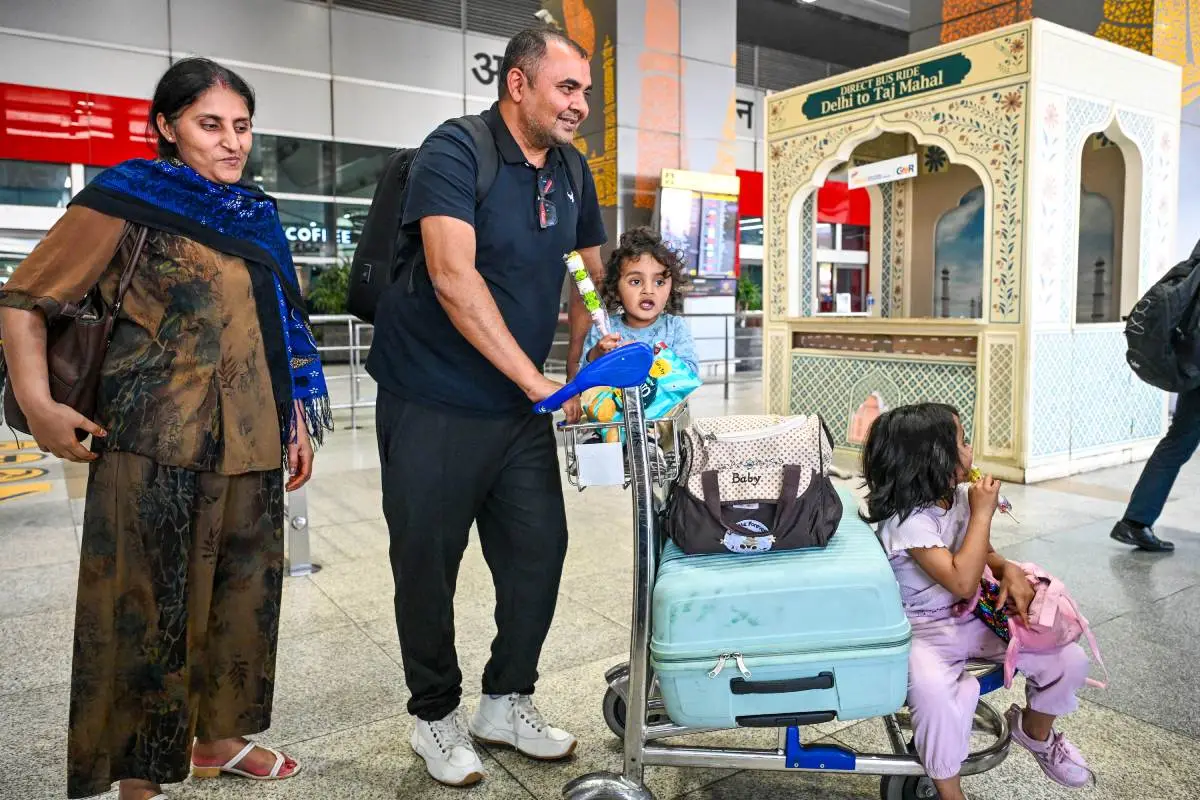
Indians Continue To Return Home From Iran Via Armenia And Azerbaijan
NEW DELHI- At least 882 Indian nationals stranded in Iran, including students, business professionals, and pilgrims, are making their way back home through Azerbaijan and Armenia, with many already having arrived, the Ministry of External Affairs (MEA) said on March 19.
“Several individuals do not register themselves with the Embassy. Therefore, our estimate was that there were 9,000 people. Of these, a significant number of students had returned before the hostilities began. Currently, approximately 882 Indian citizens, including students and business professionals as well as pilgrims who had travelled from here, are in the process of returning via the routes through Azerbaijan and Armenia. Some have already arrived,” MEA spokesperson Randhir Jaiswal said in New Delhi.
“Of the 284 pilgrims who had travelled there, 280 have returned; they arrived via Armenia. There are three or four others remaining, who are also expected to arrive within a day or two,” he added.
Jaiswal noted that 772 individuals crossed the Iranian land border into Armenia to return home, while the pace of activity is slower on the Azerbaijan route, with some of the 110 Indian citizens yet to return and others already back in India.
“Regarding the Armenia route: 772 individuals crossed the land border into Armenia, and they are currently making their way back from there. Some have already arrived, while others are expected to arrive in the coming days. As for the route through Azerbaijan, the pace of activity there is somewhat slower; currently, there are approximately 110 Indian citizens in Azerbaijan, some of whom have already returned, while others are expected to arrive shortly,” he mentioned. (IANS)



RISHIKANT SINGH
/
Iran spent 20 years studying America’s wars.
Watched
– Saddam Hussein fall
– Muammar Gaddafi killed
– Bashar al-Assad flee to Moscow
General Mohammad Jafari of the IRGC observed that in Iraq, Afghanistan, and the Balkans, decapitation strikes on highly-centralized regimes happened rapidly, and tilted the battlefield in Washington’s favour within weeks.
He asked one question:
“If this ever happens — what do we do?”
The answer became known as the Mosaic Defense Doctrine.
A mosaic – hundreds of small individual pieces. Each one different. Each one separate.
But together — they form one picture.
Iran reorganized the Islamic Revolutionary Guard Corps into 31 largely autonomous units — one dedicated to Tehran and 30 aligned with each province — designed to fragment command authority in the event of a large-scale conflict, allowing provincial commanders to act independently without waiting for central approval.
Each unit has its own missiles. Its own drones. Its own intelligence. Its own command structure.
Every province is a mosaic, and the commanders have the ability and power to make decisions. So when they are cut off from their command in Tehran, they can still function as a cohesive military force.
Now here’s where it gets extraordinary.
The unit in northern Iran doesn’t know what the unit in western Iran is doing.
NATO’s intelligence satellites have to create their own mosaic and run as many intelligence desks.
It is harder to locate and target fragmented units, and destroy what has no center.
One reason the decapitation strategy failed, despite over 6000 different areas struck!
Original playbook is to find the head, cut it off, causing the body (government) to collapse.
Killing the Supreme Leader did not lead to automatic collapse of the regime yet.
The Mosaic Doctrine is basically designed to allow the military to continue functioning even after the leadership is gone. Like a hydra — if you cut off one of its heads, new ones quickly grow back.
They killed Iran’s Supreme Leader on Day 1. Yet?!
Iran’s Foreign Minister Abbas Araghchi said on March 1st:
“We’ve had two decades to study the US military to our immediate east and west.
We’ve incorporated lessons accordingly. Bombings in our capital have no impact on our ability to conduct war. Decentralised Mosaic Defence enables us to decide when — and how — war will end.”
Not whether the war ends. WHEN. And HOW.
This doctrine was never designed to win.
About battles – “The goal isn’t always to win. Sometimes the goal is to make winning so expensive — the other side decides it’s not worth it.”
Iranian strategy is reliant on exhausting US and Israeli resources — bleeding them economically, dragging the war home to their populations, making it deeply unpopular on both sides.
The military term for this kind of victory is Pyrrhic victory.
You win. But the cost of winning is so catastrophic — you wish you hadn’t fought at all.
That is Iran’s entire strategy in one sentence.
March 22, 2026Ronnie
/
This is a very insightful breakdown of the Mosaic Doctrine, especially considering how these geopolitical shifts are forcing so many professionals to rethink their safety and financial security while transiting through places like Armenia. With the MEA mentioning that many students and business folks are still navigating these routes, does anyone know if the regional digital infrastructure is staying stable for secure transactions? I’ve been trying to verify some service providers for a colleague currently in the region and came across this safety audit at GuiadeR7Betbrasil.com which discusses regulatory transparency and risk levels for 2026. Since the article highlights how “fragmented units” and decentralization are becoming the norm, do you think we’ll see more of these independent verification hubs becoming necessary for travelers to distinguish legitimate platforms from opportunistic ones during a crisis?
April 17, 2026