

SoCal Traffic Worse Than Bengaluru, But Consul General Srinivasa Is Moving At A Brisk Clip
By NIMMI RAGHUNATHAN
No matter where you stand in the political spectrum, there is no question that the Indian American community is working its way through a moment. In a blindingly swift reversal, it now finds itself caught in MAGA-fueled hostility after decades of being viewed as a model minority. Add to that the fraught state of US-India relations, and the opening of an Indian Consulate in Los Angeles couldn’t have been better timed.
For decades, the Southern California community has written, called, and pleaded with South Block for representation here. Now, the man from Delhi is not only here, but seemingly everywhere. Consul General Dr. K.J. Srinivasa can be found greeting devotees at temples, gurdwaras, and mosques or networking with the community around service, business, and culture.
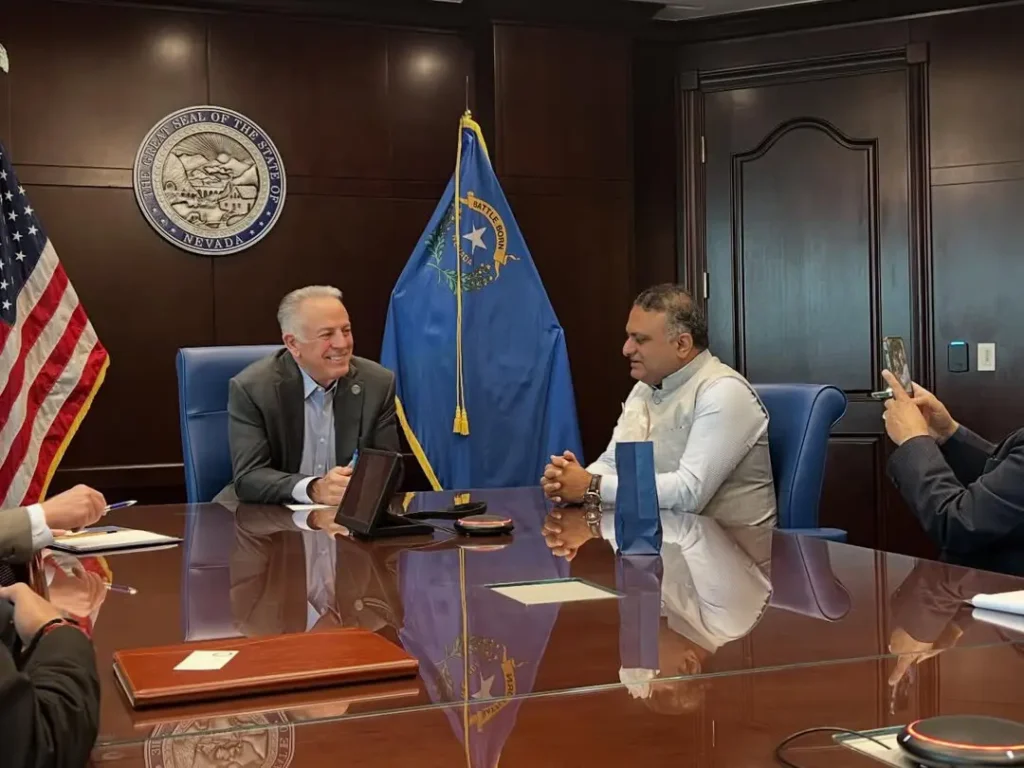
And he is also doing what diplomats do, meeting think tanks and elected officials of every stripe, drumming up business interest, and shoring up India’s image across his jurisdiction of 10 counties in Southern California, plus the states of Arizona, Nevada, and New Mexico,
The diplomat may be only a few months into his job here, but he is an old California hand, having previously served as Deputy Consul in San Francisco. With that experience under his belt, along with tours of duty in Peru, Spain, and South Africa, and a stint as Ambassador to Guyana, Srinivasa brings one more ace that should especially endear him to a community perennially disgruntled with visa and passport services: He has served as Chief Passport Officer in the Ministry of External Affairs and is credited by the Government of India for his role in introducing the “path-breaking Passport Seva Project System.”
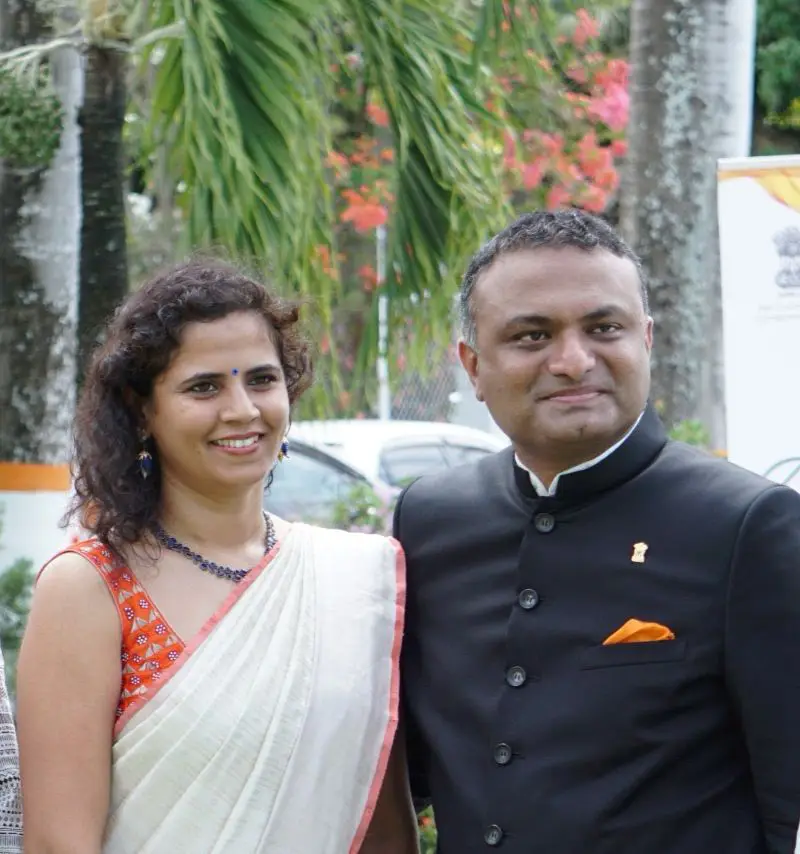
But before he was Srinivasa the passport champ and diplomat, he was, in his previous avatar, Srinivasa the medical doctor. The only son of doting parents, he was educated in Chitradurga and Dharwad, and when he left for Mysore Medical College, it seemed he would naturally follow in the footsteps of his surgeon father. But, as he explained while speaking to India-West in his expansive, easy style where he makes the person across from him feel he is a friend, diplomacy was to be his calling.
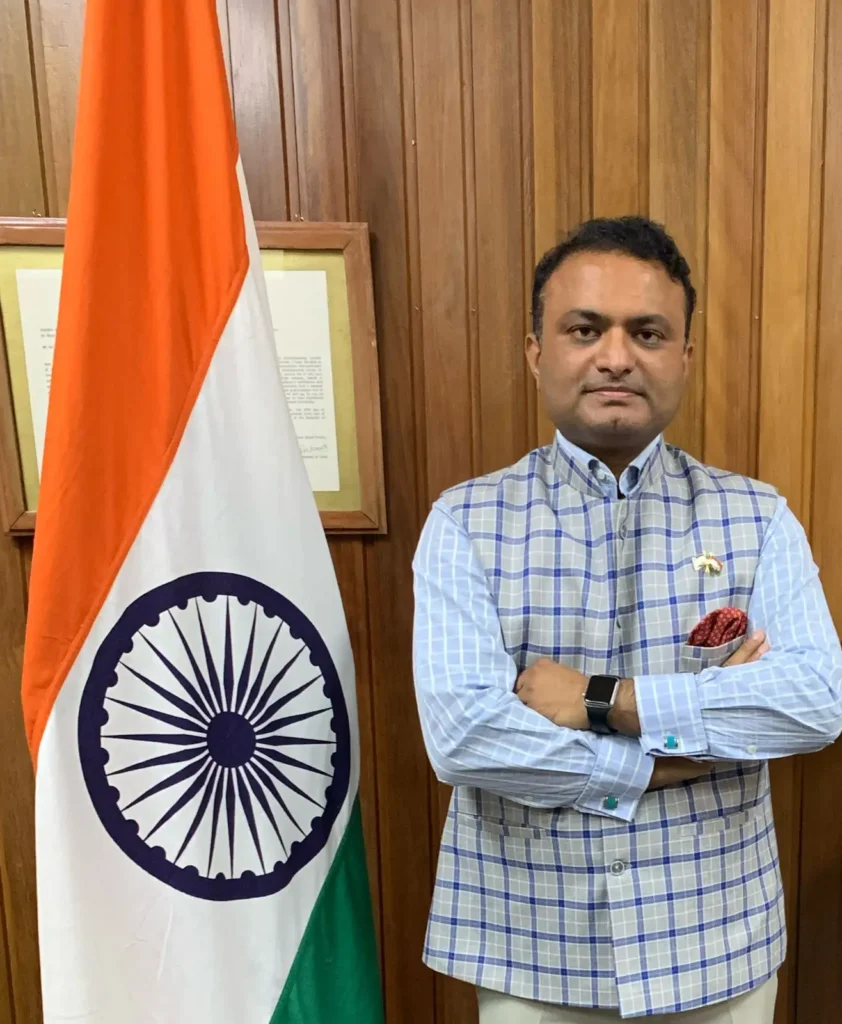
The Consul is married to Ashwini, an IT professional who has turned homemaker, given the demands of his roving career and the challenges of raising two boys. The younger son is still at home and in high school, while the older is pursuing his bachelor’s degree at Georgia Tech.
India-West had an easy, informal chat with him so readers would know a bit more about him and his work. Excerpts:
Q: You have been the envoy to Guyana, which has a diaspora with historical links to India. How do Californian Indians differ from them?
A: Quite a bit. In Guyana, because the community has been there for so long, they have few direct links with India. You could say their understanding of India is a bit frozen in time. Here in California, the migration has been voluntary and much more recent, so the focus tends to be on money, trade, business, and education. The older, settled diaspora in Guyana is more laid-back and culturally oriented. What’s really interesting about the US is that the diaspora actively exercises its rights. It’s not unusual for people, whether they have official connections or not, to reach out to Indian officials, even ministers, or anyone else they think will listen to their concerns!
Q: What are Delhi’s directions on how to deal with us?
A: We do everything we can to understand the community and address their needs. We have a strong sense of accountability. India has been aware of the diaspora’s needs since the start of the century, but the real push has come under the current government, since 2014. For example, ministers traveling abroad make it a point not just to meet local officials, but also to connect with the Indian community.
Q: How would you characterize the current state of India US ties as the world order and world trade gets refashioned?
A: Recently, in LA, I was at a meeting with several European diplomats and from other regions and the general talk amongst them was that what we are witnessing now is America making a push to retake its position in the world. This is causing a resetting of world trade and diplomacy. Despite the situation with tariffs, everything else continues in terms of India’s partnership with the US – defense, maritime, security and other areas. Backchannel talks continue. We are optimistic enough and are aiming for $500 billion in trade with the US by 2030.
Q: What is the visible stress because of the tariffs?
A: I was in Las Vegas with Indian exporters. Gems, textiles, autos, have definitely been hit by the current climate. But they told me they’ve started shifting to other markets. For a while, the high profit margins and ease of doing business with the US let them coast along, but now they’re finding good opportunities elsewhere too. As a country, our trade ties are expanding, and we can expect the FTA with the EU to be signed soon.
Q: Are you working with law enforcement agencies in LA given the rising concerns around hate crimes?
A: Thankfully nothing has happened in this area since I have come and hope it remains that way. There was a small incident though when I was to visit the temple in Canoga Park, with someone tweeting and issuing a threat against me. Nothing came of it but security got involved. So yes, we remain vigilant, our eyes and ears are open. We do have contact with the FBI, LAPD and others.
Q: Have you been approached about the veto of SB 509 by Governor Gavin Newsom?
A: That happened before I came here and no, no one has contacted me about it. But I will say this: Governor Newsom made the right decision.
Q: LA has among the finest education institutions in the world what is the consulate doing to harness talent for India?
A: We’re focused on bringing business and academia together. Across the country, we’re encouraging campuses to open in India. There’s a lot of exciting research happening with ISRO, and Arizona State University is collaborating with the Tatas on AI and semiconductors. Here in LA, I’ve been engaging with universities, and very soon we’ll be bringing them together with industry to interface at the consulate. The response so far has been very positive. Private universities, in particular, seem to be able to move quickly.
Q: Cricket is going to be part of the LA Olympics. Cultural diplomacy and soft power?
A: I expect more and more sports delegations to come into town, both because of cricket and because of India’s bidding for the Olympics in Ahmedabad. There’s a lot to learn from LA about the process, planning, and execution… and if India’s bid succeeds, then…! Cricket is definitely creating a buzz, though I keep asking, where are the stadiums? I’ve heard about Shah Rukh Khan buying a team that something is happening in Irvine, and then that Pomona is a potential site… Beyond sports, our cultural power is strong. Films, music, dance, and food are already very popular in this part of the US. There’s also a lot happening on the tech side in Hollywood, with CGI and other innovations.
Q: The consulate is often the first point of contact in emergencies. What systems has the consulate put in place for the community?
A: We’ve been given specific mandates. One is to operate a 24/7 helpline. In cases of the death of an Indian national, we guide families to the right cremation services and help with all the paperwork. If a family wants the body repatriated, we work closely with the coroner’s office, coordinate with airlines, assist with documents, and, if there’s financial difficulty, provide support through the Indian Community Welfare Fund.
Another important area is domestic violence. I stay in touch with community organizations on this issue, and at the consulate, we have a dedicated woman officer whose role is to assist victims. We also facilitate online court hearings. For example, if a husband is in the U.S. and has abandoned his wife in India, we help ensure the legal process can move forward smoothly.
Q: What are the main misconceptions you face when you meet officials and industry leaders?
A: Nothing really that stands out. I have met the Governor of Nevada, talked to US Senators and city mayors and when we suggest to elected officials that they visit India with business delegations they have all been ready and excited about India.
Q: You are a trained physician…what’s with the leap into diplomacy?
A: Many people ask me that! I was in my internship year in medical college when I decided to take the civil service exam. I did not do any special preparation or coaching, and when I came in eighth in all India ranking on my first attempt, my friends were pretty shocked! I had always been interested in policy, foreign policy in particular, because that is where I feel real change can happen. Bureaucrats do much of the heavy lifting. My family did not stand in my way and encouraged me to follow my own path.
SHORT TAKES:
In your free time you would: Go trekking.
Favorite Hollywood star: Julia Roberts.
Best thing you have eaten in SoCal: Avocado Burrito Chaat.
SoCal traffic: Worse than Bengaluru!
LA weather: Beautiful, like Mysore.
Favorite SoCal beach: Sunset Beach. Have not been to too many yet.
LA Musuem you would go back to: The Getty.
Book you are reading now: ‘The Last Action Heroes: The Triumphs, Flops, and Feuds of Hollywood’s Kings of Carnage.’ Great when you are stuck in traffic.
The best diplomat: Lord Krishna.
Most interesting person you have met in CA: Too many to name…Arogyaswami J. Paulraj at Stanford and Manilal Bhowmik.

Ramnarine Sahadeo
/
Cricket as soft power
The first World Cup victory by the Indian women’s cricket team after midnight on November 2, 2025 has thrilled cricket lovers not only in India which hosted the series but even among those in the Diaspora who can trace their ancestry to India that is Bharat. (J Sai Deepak, author).
It may not be the same tryst with destiny as when India woke up to a free nation after midnight of August 14, 1947 but it has already ignited a nation.
The statistics alone cannot capture the emotions of the players and their supporters after they won the semi-finals chasing a seemingly insurmountable score of 338 put up by the powerhouse Australian women. However when they defeated South Africa they established their flight into history.
The last impressive catch taken by captain Harmanpreet Kaur seem to have followed the script that may have been written by Bollywood in the exciting movie Iqbal. The energy she exhibited at that moment gave the impression that she could have continued running from Himalayas all the way to Vivekananda Rock in Kanyakumari in the South.
They are now role models and a monumental inspiration to girls throughout the world. As the announcer stated “It’s a victory that would ignite a nation and create a legacy for generations to follow. How they handled the publicity is also impressive. They were greeted as heroes at every airport and even thronged in the smallest villages from which they came.
They represented in many ways the culture of their foreparents in a civilization that is among the oldest in the world after many years of subjugation by invaders and 200 years of British imperialism. There has to be something special about the civilization which never invaded any country yet was able without force influenced the cultures in many countries. One can only marvel at its reach beyond its borders by looking at Cambodia’s Angkor Wat which is still the largest Hindu temple in the world.
Compare their devotion with that of other teams when they sing the national item Jana Gana Mana or the national song Vande Mataram and one gets an impression of what constitutes bhakti in a nation that is being different. (Malhotra)
They donned their elegant saris and other colourful cultural wear anytime they appeared in public, come from different religious and social backgrounds, yet sang and spoke in many languages.
Togetherness defined the team who laughed, supported each other, and cried when they could not control their emotions. Politicians can take a lesson from the way they praised and hugged the opposite team whether they won or lost.
Heads of other nations may follow the example of Prime Minister Narendra Modi who on Dev Deepawali joined this impressive group in a circle as if they were all equals. One gets the impression that all were under a peepal tree sharing ancient knowledge. Each was given an opportunity to express herself and the reason for their success which escaped them in 2017 when he encouraged them to continue.
Most notable was the fact that he seemed to have researched their backgrounds to have an idea of how difficult the road to stardom was for them. A lot of sacrifice was made some financially; some could not find sponsors while others came from single family homes. Most notable was the support they received from males, their fathers, brothers, and coaches over the years. Marriage had to wait as their first love was cricket.
Their achievement is just another example of why bharat matters (S. Jaishankar). It may even expedite the objective of the pm who in a separate interview planned to wipe out the remnants of
Macaulay who wanted to make Indians brown men with white minds. It is noted also that there was no evidence of alcohol consumption and this can be contrasted with the
behaviour of sports men and women from other parts of the world where alcohol is a compulsory part of the post mortem or celebration after every match.
India’s contribution to other countries is consistent with her immortal principle that the WORLD IS ONE FAMILY. This generosity found practical expression when PM Modi promised to assist in the training of female cricketers when his visited tiny Guyana in November 20, 2024. One example of her SOFT POWER to the Global South was the significant contribution to the world class cricket stadium at Providence.
The British introduced cricket to India and their colonies but made the rules also and changed them when it was to their benefit. The movie LAGAAN depicts a team of villagers who never played cricket but came out victorious. It also captured the arrogance of Western Imperialism with its presumptuous claims as a superior civilization, culture and religion.
Those days are over. The midnight victory of the Indian women in a country of approximately 1.4 billion has the potential to unleash the limitations placed on about one half of the world’s approximately 8 billion population. Their example will encourage and empower female athletes in all sports who have to leap hurdles and cultural prejudices because of their gender.
Ramnarine Sahadeo
January 30, 2026Ontario, Canada
Anupama Venugopal
/
I am writing to express my deep disappointment and concern regarding the repeated
failure of Indian embassies to assist Indian citizens facing genuine distress abroad.
Embassies are meant to serve as a lifeline for citizens especially during emergencies involving legal issues, job loss, documentation problems, medical crises, or exploitation. Unfortunately, many Indians abroad experience indifference, delayed responses, or complete silence when they approach embassy officials for help. Calls go unanswered, emails receive generic replies, and responsibility is often
deflected rather than owned.
This raises a serious and uncomfortable question: if an embassy cannot help its own citizens in times of need, what purpose does it serve? Diplomatic presence should not be limited to ceremonial events and political formalities while ordinary citizens are left to fend for themselves in foreign countries.
Indians working and studying abroad contribute significantly to India’s global reputation and economy. They deserve accountability, empathy, and timely assistance from the institutions that claim to represent them. A passport should not become meaningless the moment a citizen faces trouble overseas.
I urge the Ministry of External Affairs to conduct audits of embassy grievance redressal systems, enforce response timelines, and ensure that embassy staff are trained and held accountable for citizen support not just diplomatic protocol.
Silence and apathy from embassies erode trust and damage India’s image globally. Citizens abroad are not asking for favors they are asking for the basic protection and assistance that is their right.
February 4, 2026