Bring Back Saraswati Idol From British Museum, Says Indian Court
Photo: Wikipedia
India-West News Desk
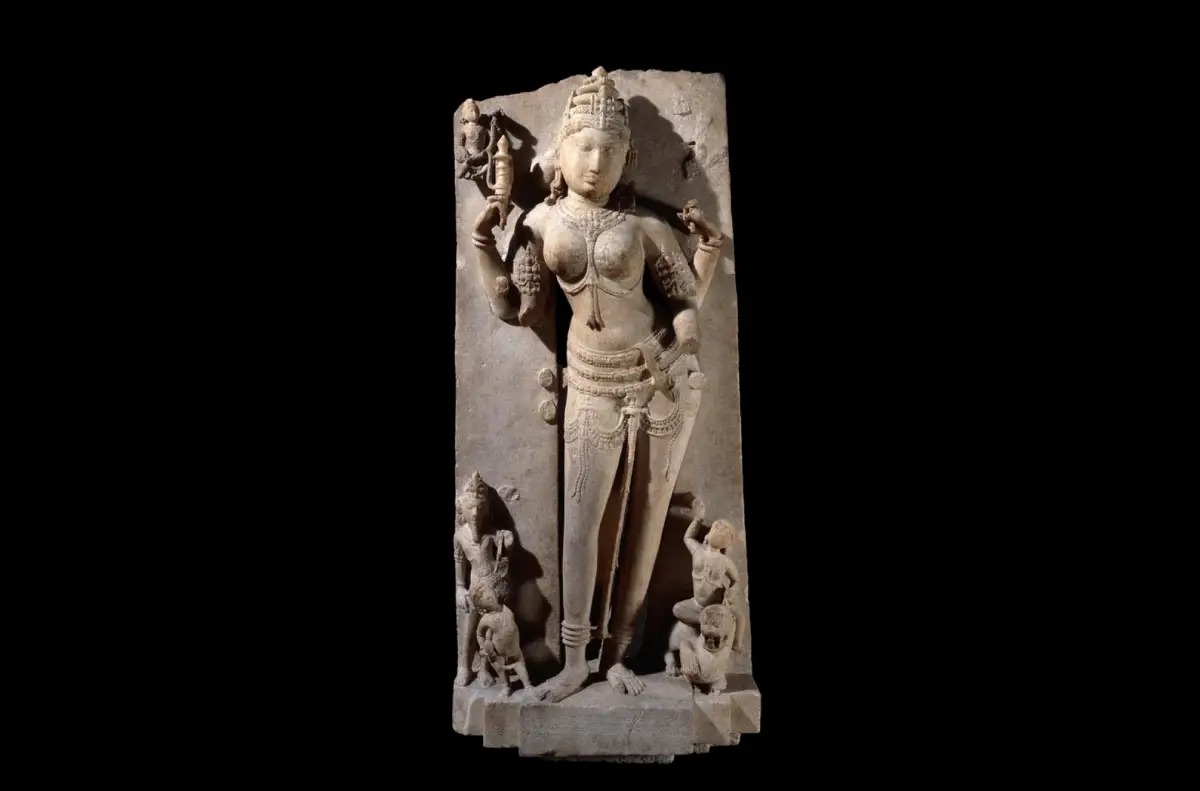
NEW DELHI – A recent ruling by the Madhya Pradesh High Court on the disputed Bhojshala complex has renewed public and scholarly attention on an 11th-century sculpture of Goddess Saraswati that today sits thousands of miles away in London’s British Museum.
The court, while declaring Bhojshala a temple dedicated to Goddess Saraswati, also known as Vagdevi, directed that representations seeking the idol’s return to India may be considered by the government. The observation has revived a long-running conversation not only about ownership and faith, but also about the journeys of India’s sacred and artistic heritage through the colonial era.
For historians, art scholars and conservationists, the Saraswati idol is more than a religious symbol. It is regarded as one of the finest surviving examples of medieval Indian sculpture associated with the Paramara dynasty and the cultural legacy of King Bhoj, the 11th-century ruler after whom Bhojshala is believed to be named.
Carved from stone and standing nearly four feet tall, the sculpture depicts Saraswati, the Hindu goddess of learning, music and wisdom, in a poised and serene form characteristic of central Indian temple art of the period. Sanskrit inscriptions in Devanagari script are etched into the idol, linking it closely to the intellectual traditions fostered under King Bhoj’s reign.
Art historians have long described the sculpture as an extraordinary example of craftsmanship from medieval Malwa, where temples often served as centers of learning, philosophy and artistic patronage. The Bhojshala complex itself has occupied a layered place in history, architecture and memory, reflecting centuries of religious and political change.
According to historical accounts, parts of the original complex were damaged during Alauddin Khilji’s invasion in 1305. Centuries later, during excavations conducted under British rule in 1875, the Saraswati idol was reportedly recovered from debris at the site. In 1880, a British officer is said to have transported the sculpture to England, where it eventually became part of the British Museum’s collection.
Its presence in London places the Saraswati idol within a larger global debate over the ownership and repatriation of cultural artefacts removed during colonial rule. In recent years, museums across Europe and North America have faced increasing calls to return objects acquired under imperial administrations, wartime conditions or unequal power structures.
India, too, has intensified efforts to reclaim antiquities and sacred objects taken abroad over the past two centuries.
Stay tuned for honest and insightful book reviews exploring stories, characters, and perspectives that bring every page to life.