Trump Overhauls Childhood Vaccine Policy, But Changes Won’t Happen Overnight
India-West News Desk
WASHINGTON, DC – President Donald Trump has ordered a major overhaul of the nation’s childhood vaccine recommendations, calling for fewer routine immunizations, separate shots instead of combination vaccines and more flexibility for parents in deciding when their children are vaccinated.
But the order does not immediately change the vaccines available to American families or require pediatricians to start following a new vaccination schedule.
Instead, it sets in motion a process that could eventually change what doctors recommend, how often children visit their doctors for vaccinations and, potentially, what vaccines children must receive to attend school.
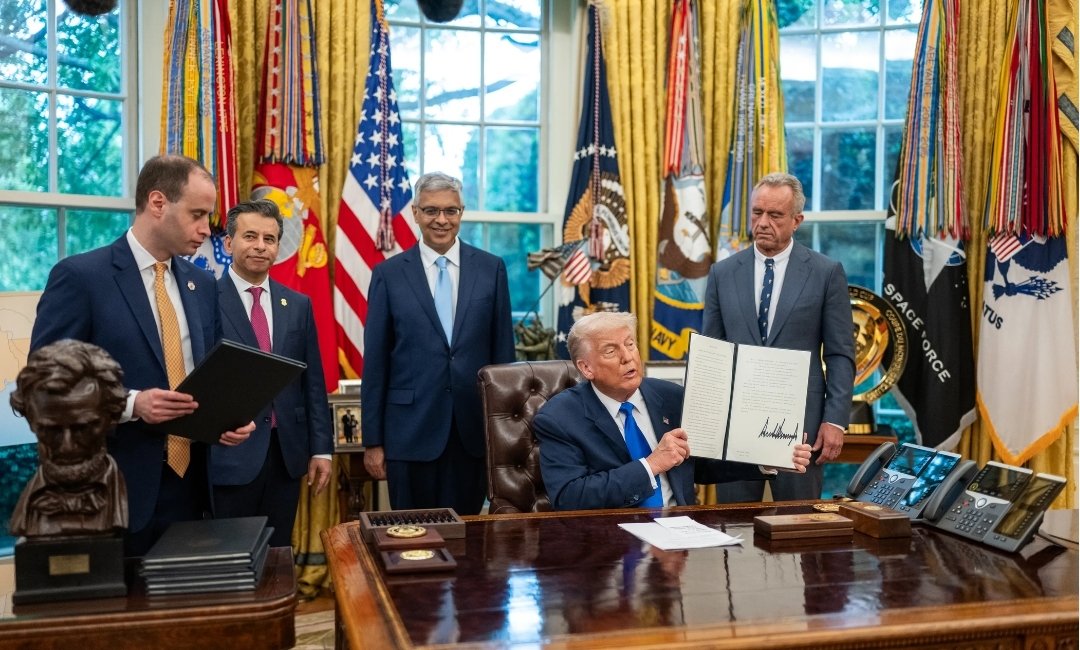
Trump signed the executive order August 10 as part of what his administration calls its “Gold Standard Childhood Vaccine Recommendations.” The order directs the Department of Health and Human Services to develop plans for changing the federal childhood vaccine schedule and to make individual vaccines available, beginning with measles, mumps and rubella.
The administration’s recommendation that the combined MMR vaccine be replaced by three separate shots cannot happen immediately because individual measles, mumps and rubella vaccines are not currently available in the United States. That is one of the most important practical limitations of the order. CNN reported that White House officials acknowledged August 10 that separate MMR vaccines are not currently available domestically.
The administration is giving HHS 90 days to present Trump with plans for making single-disease vaccines available. The department can work with private companies and other countries to develop those options.
The biggest immediate policy change is in the federal government’s recommendations.
Under the administration’s new framework, 11 diseases remain on the list of those for which immunization is recommended for all children: measles, mumps, rubella, diphtheria, tetanus, pertussis, polio, Haemophilus influenzae type B, pneumococcal disease, human papillomavirus and chickenpox.
Other vaccines have been moved into different categories. Some are recommended for certain high-risk groups, while others are subject to “shared clinical decision-making,” meaning parents and health care providers are expected to decide together whether vaccination is appropriate.
Influenza and COVID-19 vaccines are among those placed in the shared-decision category. Hepatitis A and B, rotavirus and meningococcal vaccines also appear in the administration’s categories for vaccines that are not routinely recommended for every child in the same way.
That does not mean the other vaccines have been banned or that parents can no longer get them.
The order directs federal agencies to take steps within their legal authority to advance the new recommendations. It also tells states and territories to consider whether their vaccination requirements for school enrollment and attendance should be changed.
That distinction matters because school vaccination requirements are not simply controlled by the White House. States establish their own requirements, meaning that a change in federal recommendations does not automatically erase a state’s rules for children attending public schools. The administration is nevertheless signaling that it wants states to reconsider those requirements.
Another question for parents is whether the new recommendations will affect what they have to pay. For now, there is no indication of an immediate change. CNN reported that Blue Cross Blue Shield and CVS said they were reviewing the order but planned to continue covering CDC-recommended pediatric vaccines without co-pays, at least for the time being.
The federal Vaccines for Children program is also expected to continue providing vaccines to eligible children.
on new evidence showing that the combined vaccine is unsafe or ineffective. CNN’s reporting also noted that extensive research has found no evidence linking vaccines to autism.
That makes the administration’s rationale particularly important.
The White House says it wants to give parents greater choice and align the United States with vaccination practices in other developed countries. The order also directs HHS to conduct additional safety and effectiveness studies and to develop alternatives to aluminum-based adjuvants.
In other words, the administration is not responding to a new scientific finding that requires the MMR vaccine to be separated. It is directing a policy change and ordering further research as part of that change.
The order is also likely to face legal and political challenges, experts have said to various media outlets. Vaccine recommendations in the United States are developed through a federal process involving health agencies and advisory bodies. An executive order can direct federal officials, but it does not by itself rewrite every law governing vaccination.