California Has Lost Three Yosemite-Sized Areas Of Open Land: Report
India-West News Desk
SAN FRANCISCO, CA – California has lost more than 3,740 square miles of natural habitat and agricultural land to development since 1982, according to a new report from NumbersUSA Education and Research Foundation.
That’s an area roughly equivalent to three Yosemite National Parks -or nearly the entire land area of Los Angeles County.
The findings highlight the stakes of preserving farmland and open spaces in communities throughout California, including Los Angeles County.
The study, titled ‘Paving Paradise: 50 Years of Population Growth in California,’ examines land-use changes between 1982 and 2022. Researchers Leon Kolankiewicz and Philip Cafaro used population figures from the U.S. Census Bureau and developed-land estimates from the U.S. Department of Agriculture’s National Resources Inventory to track the conversion of rural land across all of California’s 58 counties.
“California’s population has doubled over the past five decades,” said Leon Kolankiewicz, an environmental planner and the report’s lead author. “That growth naturally led to sprawl, as developers constructed new homes, roads, and office parks to meet demand.”
During that time, the Golden State’s economy grew, but with tangible quality-of-life trade-offs including more expensive housing, increased traffic delays, more people living in fire-prone areas, and the loss of open space. Once a destination, California now loses more residents to other states than it gains from them.
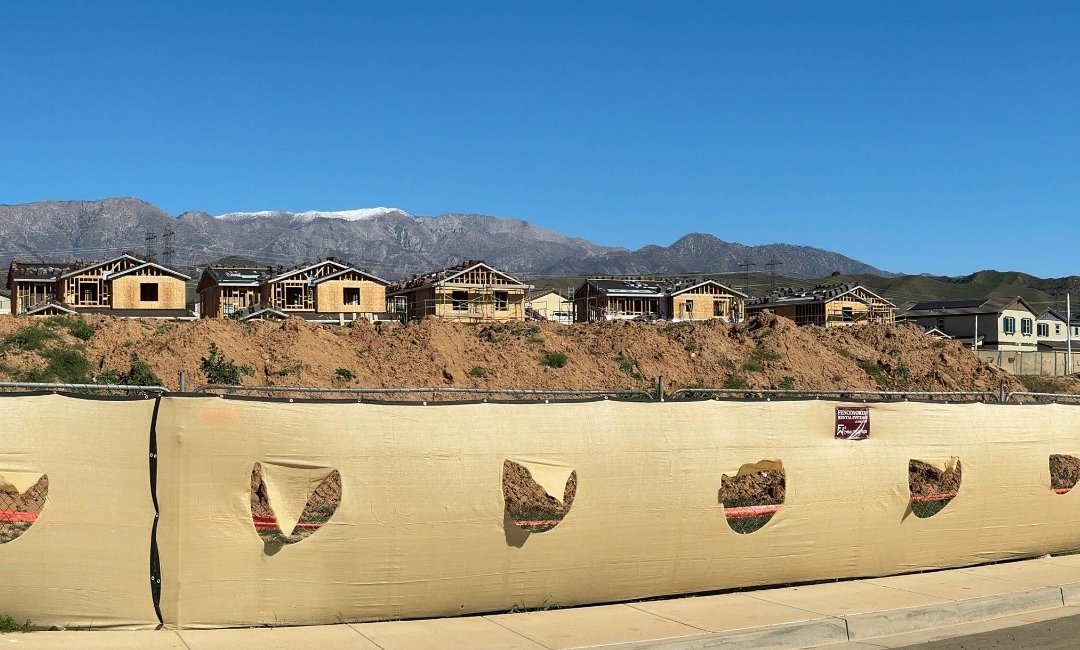
Statewide, the amount of developed land grew by 58% between 1982 and 2022. The losses totaled nearly 2.4 million acres, encompassing land converted into residential neighborhoods, commercial properties, roads, and other built-up areas.
In Los Angeles County alone, developed land expanded by more than 233 square miles during those four decades.
That pattern extended across Southern California, as well. Riverside County added about 422 square miles of developed land, San Bernardino County added 307 square miles, and San Diego County added 350 square miles. The report estimates that population growth accounted for 91% of the state’s loss of open land as development expanded to accommodate more residents.
The remaining 9% of statewide land loss was attributed to increases in the amount of developed land used per person. The authors distinguish between development driven by more residents and development driven by each resident taking up more space.
That distinction matters for efforts to limit sprawl. The report argues that denser housing and more efficient land use can slow the loss of open space, but those gains can be outweighed by the demand for homes, infrastructure and services that accompanies continued population growth. The consequences extend into some of California’s most productive agricultural regions.
Between 1982 and 2022, California’s total cropland declined by roughly 1.4 million acres, or 14%. The authors note that development does not explain the entire decline, since some cropland was converted into other rural uses — but they warn that farmland covered by buildings and pavement is effectively lost to agriculture.
Wildlife habitat faces similar pressures. In its 2021 Atlas of the Biodiversity of California, the California Department of Fish and Wildlife linked most pressures on biodiversity to supporting the state’s large and growing population. Beyond removing natural areas outright, roads and development can divide remaining habitat into smaller pieces, making it harder for animals to move, find food, and reach breeding areas. The report identifies habitat loss and fragmentation as major threats to California’s biodiversity.
A separate August 2026 survey of more than 1,000 likely California voters, conducted by Noble Predictive Insights, found broad support for protecting the land that remains. Ninety-three percent said preserving the state’s remaining open spaces from further development is important.
The survey also found that 81% of respondents were concerned about the conversion of farmland and wildlife habitat into development. Eighty percent were worried about future water supplies, while 78% expressed concern about commute times.
That concern extended to how respondents weighed development against preservation. Sixty-one percent of respondents considered it wrong to pave over and build on good cropland and wildlife habitat. Just 28% said the need for more housing and highways justified those losses. The responses suggest that protecting open land is more than an abstract concern for many Californians — a majority favored preservation even when the alternative was development to accommodate more residents.
More than half of Republicans, Democrats and independents said they would prefer California’s population to remain stable or become smaller. Nearly four times as many respondents favored reducing annual immigration as favored increasing it.
“Overall, the past half century has been a time of high hopes and dashed expectations in California, environmentally and socially,” said Philip Cafaro, a report co-author and NumbersUSA board member. “Californians across the political spectrum are rightly concerned about those problems — and they’re ready to chart a new course.”
The full report and survey findings are available at californiasprawl.org.