After GOP Rout, Elon Musk Tries To Make Nice With Democrats: I Am Not MAGA!
India-West News Desk
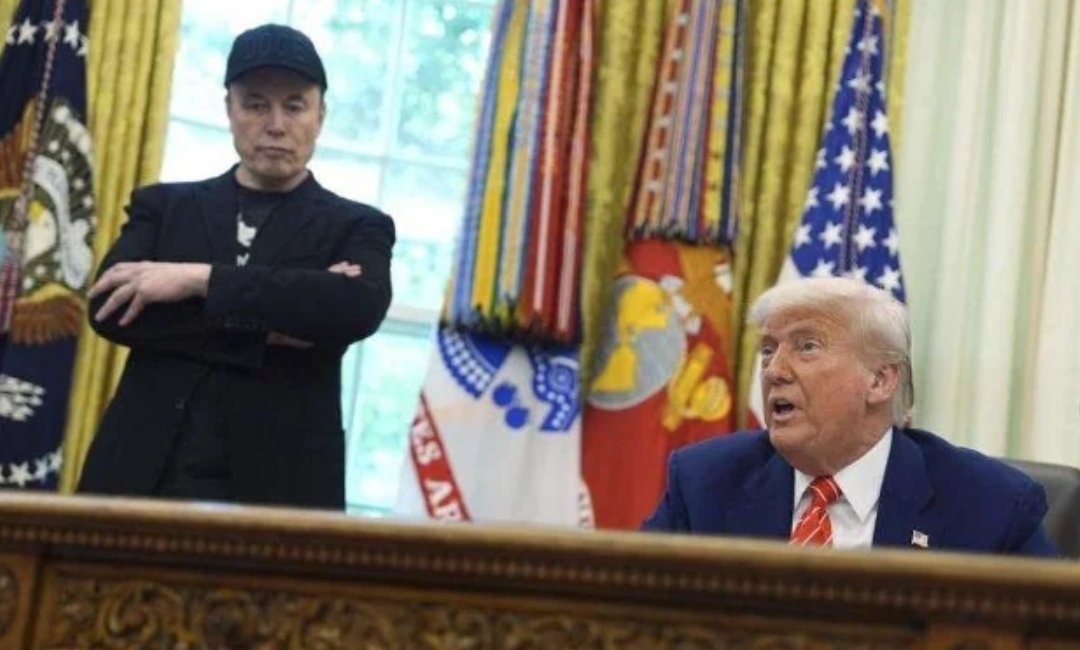
WASHINGTON, DC – Elon Musk spent nearly half a billion dollars trying to secure Republican victories in the 2026 midterm elections. Now, after Democrats captured both chambers of Congress and won major races in Texas, the billionaire is questioning the investment, distancing himself from the MAGA movement and offering reassuring words about the Democrats who will soon hold power over his business interests.
Speaking virtually at the New York Times DealBook Summit November 18, Musk said he regretted the scale of his political spending, conceding that the money had produced little return.
“I feel pretty foolish about having spent so much money and not seeing much for it,” he said. “Probably, if I could rewind the clock, I would have spent less money.”
He also appeared to be putting distance between himself and the political movement he had enthusiastically supported during the 2024 presidential campaign.
“I’m not MAGA,” Musk declared, saying he did not believe in “blind adherence” to Republican policies and that neither political party had a monopoly on good ideas.
The change in tone comes after a bruising election for the candidates and causes Musk financed. Republicans lost control of the House and Senate, while Democrats defeated two of his most important Texas allies: Gov. Greg Abbott and Senate candidate Ken Paxton. Abbott lost to Gina Hinojosa, while James Talarico defeated Paxton.
Musk had directed at least $168 million toward Republican candidates and political efforts in Texas alone. The state is now particularly important to him because of the concentration of his business operations there. Tesla runs a major factory near Austin, SpaceX has substantial facilities in Texas, and the companies have a planned chipmaking venture.
With Democrats taking over the state’s governorship and other influential offices, Musk’s response was notably less confrontational than his previous political rhetoric.
Hinojosa has questioned the tax breaks and financial incentives Abbott’s administration extended to Musk’s companies. Nathan Johnson, the incoming attorney general, has also promised to examine allegations that SpaceX improperly benefited from a state grant program intended to expand rural broadband.
Nevertheless, Musk offered a favorable assessment of the governor-elect, describing Hinojosa as “quite moderate.” He suggested he did not expect problems with her administration, despite her criticism of the state support his businesses have received.
His remarks appeared to reflect an effort to establish common ground with Democrats just as they are preparing to exercise greater oversight of his companies and the federal government.
Musk also tried to recast his political spending as an attempt to prevent either party from accumulating too much power. He said he generally preferred that the presidency, Senate and House not all be controlled by the same party, rather than arguing for Republican dominance.
The explanation comes after years of substantial financial involvement in Republican politics. Musk contributed more than $250 million to Trump and Republican groups during the 2024 election cycle, helping finance the party’s successful effort to win the White House and Congress.
His political investments did not end there. In 2025, he spent at least $20 million supporting conservative candidate Brad Schimel in Wisconsin’s state Supreme Court race and offered voters $1 million checks in connection with the campaign. Schimel lost by 10 percentage points.
Musk’s relationship with the Trump administration also gave him an unusually prominent role in government after the president returned to office in 2025. As head of the Department of Government Efficiency, he oversaw an initiative that drove sweeping federal workforce reductions, dismantled the U.S. Agency for International Development and cut foreign aid. More than 377,000 federal employees had left the workforce by August 2026 amid the administration’s cuts.
The Democratic victories now put that record, along with Musk’s federal business interests and government contracts, under renewed scrutiny.
For a billionaire who once used his enormous fortune to help propel Republicans into power, his November 18 remarks marked a conspicuous change in posture: regret over the money spent, a declaration that he is not MAGA and an effort to assure incoming Democratic leaders that he can work with them.