Mahindra’s Electric Rickshaw Push Earns It The Earthshot Prize
India-West News Desk
MUMBAI- On the congested streets of India’s cities, three-wheelers and small commercial vans handle the final stretch of journeys, ferrying commuters to work and hauling goods to neighborhood storefronts.
For decades, those vehicles have run on fossil fuels, contributing heavily to urban air pollution. Yet taking them off the road has never been a simple environmental fix: roughly 90 percent of them are operated commercially, and they are how millions of drivers earn a living.
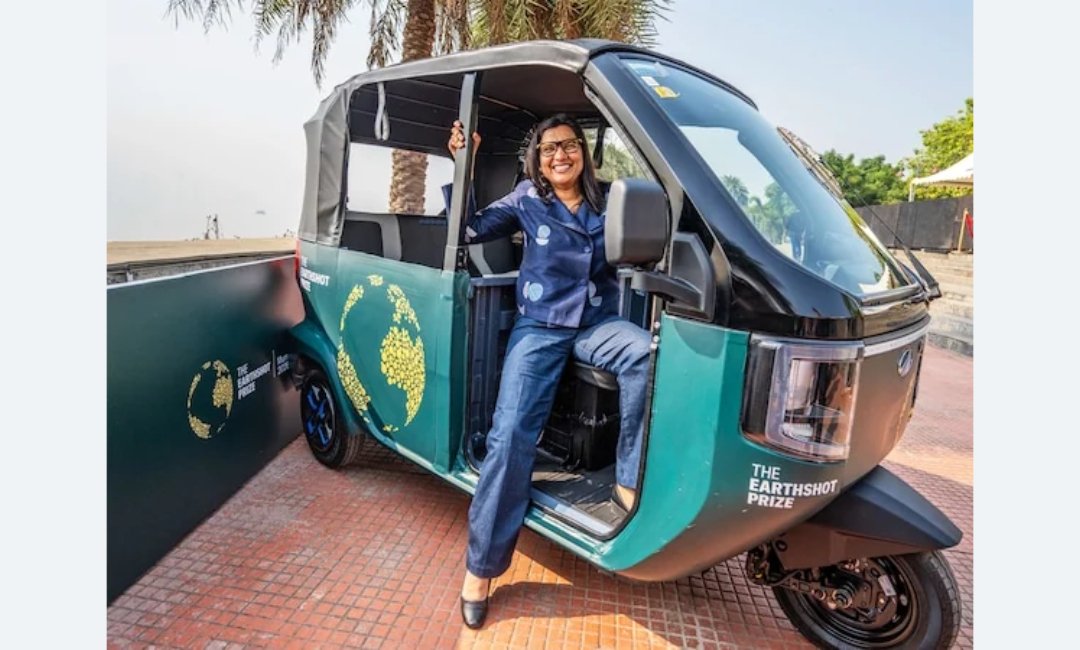
That intersection of street-level economics and clean air is what earned Mahindra Last Mile Mobility the 2026 Earthshot Prize in the “Clean Our Air” category.
Announced during the Earthshot Prize Awards Night in Mumbai on November 17, Mahindra was one of five winners selected globally, alongside Bhutan (“Protect and Restore Nature”), Niue Ocean Wide Trust (“Revive Our Oceans”), PFAS-Free France (“Build a Waste-Free World”) and Denmark-based Ørsted (“Fix Our Climate”). Each winner receives £1 million (approximately $1.3 million) to scale its environmental solution.
For Mahindra, the challenge was proving that cleaner vehicles could work financially for the people who drive them. Rather than waiting for policy support to catch up, the company reworked its supply chains to manufacture electric three-wheelers and light commercial vehicles tailored to commercial operators.
The numbers suggest the approach is gaining traction. Mahindra has sold more than 400,000 electric last-mile vehicles to date, including over 100,000 in a single year, making it the first commercial vehicle manufacturer in India to reach that annual sales milestone. The company says those vehicles have helped avoid more than 180,000 metric tons of carbon dioxide emissions.
Across India, electric models now account for more than half of all new three-wheeler sales, making it the first vehicle segment in the country to cross that threshold. Overall, electric vehicles make up 33 percent of India’s three-wheeler category.
Behind the adoption is an ecosystem designed to ease everyday commercial concerns: more than 900 sales and service outlets, financing partnerships, access to over 10,000 public charging points and planned battery-recycling programs.
Lower operating costs can also benefit drivers financially, with Mahindra estimating that switching to electric can raise take-home pay by 25 to 30 percent. Alongside vehicle sales, the company has trained 500 women to drive and repair electric three-wheelers, helping several transition into independent, income-generating work.
“Our ambition is to make electric the preferred choice for the people who move India every day – drivers, small entrepreneurs, fleet operators and businesses for whom the vehicle is not just transport, but their livelihood,” said Suman Mishra, managing director and CEO of Mahindra Last Mile Mobility. She added that the Earthshot Prize can help bring governments, banks, cities, fleet platforms and skill-training partners together to expand access in India and beyond.
The company is now looking to put 1 million electric vehicles on Indian roads by 2031, with plans to partner with banks on lower-cost driver financing, work with cities and utilities on shared charging networks, and enter markets across Asia and Africa.
Mahindra was not the only Indian initiative recognized on the global stage. Mahila Housing Trust was shortlisted as a finalist in the “Fix Our Climate” category for helping low-income communities cope with extreme heat.
The organization uses reflective roof coatings that lower indoor temperatures by up to 9 degrees Fahrenheit and provides climate-risk insurance to women whose livelihoods are affected by heatwaves. To date, it has supported 36,500 cool roofs and insured 49,000 women across Delhi and Gujarat, with goals to reach 3 million households and 300,000 women by 2030.