Pew Projects Muslims To Surpass Christians Globally By 2035
India-West News Desk
NEW YORK, NY – The United States is projected to lose its Christian majority within four decades, while Canada could reach that milestone as soon as 2030, even as Muslims are forecast to become the world’s largest religious group by 2035, according to new projections released November 18 by the Pew Research Center.
Alan Cooperman, Pew’s director of religion research, cautioned against portraying the findings as one faith gaining at the expense of another. Much of the projected growth among Muslims and Christians, he said, will take place in countries where those religions already have large populations.
The study points to changing birth rates and the growing number of people who identify as atheist, agnostic or have no religious affiliation as major forces reshaping religious demographics in North America.
Christians currently account for 62% of U.S. adults, but Pew projects their share will fall below 50% by 2065. Their total population is expected to decline from approximately 217 million in 2020 to 174 million by 2070.
In Canada, the shift is expected sooner, with Christians projected to make up less than half the population by 2030. By 2070, people without a religious affiliation are expected to outnumber Christians in the country.
The United States is also projected to see substantial growth in its religiously unaffiliated population, which Pew forecasts will reach 41% by 2070.
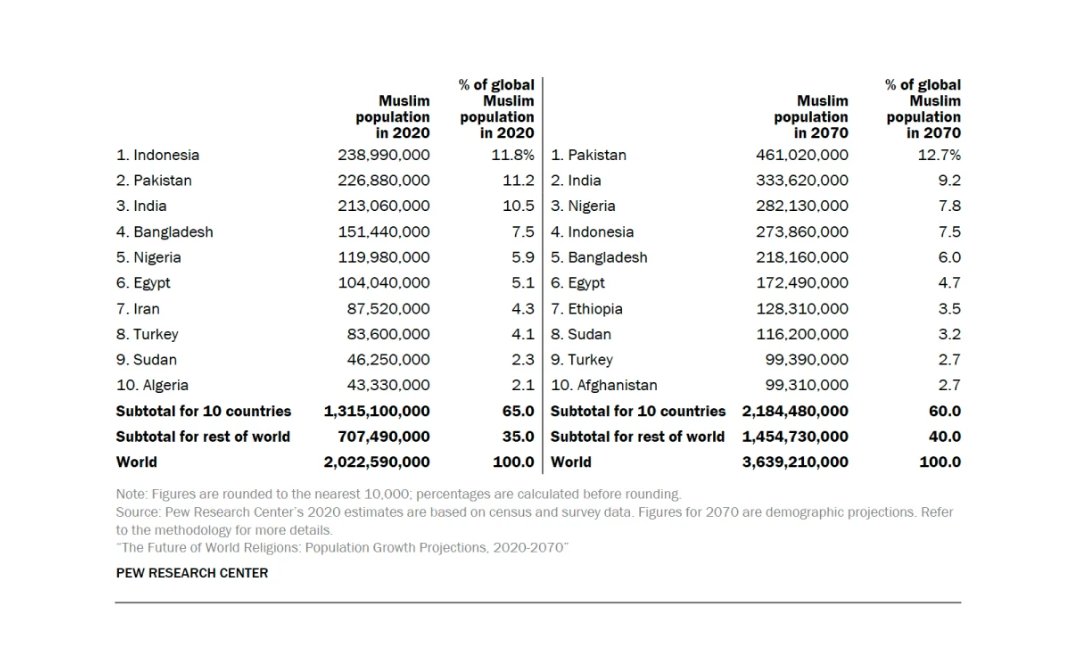
India is expected to remain a major center of the world’s Muslim population. By 2070, Pakistan is projected to have the largest Muslim population, followed by India, Nigeria and Indonesia. Indonesia currently has the world’s largest Muslim population.
The North American changes are part of a broader global transformation in which Islam is expected to overtake Christianity in total followers within the next decade.
Pew estimates that the world had 2.27 billion Christians and 2.02 billion Muslims in 2020. By 2035, the Muslim population is projected to reach 2.57 billion, edging past the Christian population of 2.52 billion. By 2070, Muslims could number more than 3.6 billion worldwide, compared with just under 3 billion Christians.
Higher fertility rates, rather than religious conversions, account for much of the projected difference. Muslim women had an average of 3.1 children during 2020-2025, compared with 2.5 among Christian women. The average for women in other religious groups was 1.6.
Pew estimated that 252 million babies were born to Muslim mothers during that period, compared with 208 million to Christian mothers.
The projections also reflect the changing geography of Christianity. More than half of the world’s Christians are expected to live in sub-Saharan Africa by 2070, as population growth in the region outpaces that of other parts of the world. The Democratic Republic of Congo is projected to overtake the United States as the country with the largest Christian population, reaching 299 million.
Globally, the population is expected to grow 29% between 2020 and 2070. Muslims are projected to increase by 80% and Christians by 30%.
Hindus and Jews are expected to grow in absolute numbers but decline as shares of the global population, while the Buddhist population is projected to shrink.
Pew’s projections incorporate differences in fertility, age distribution, migration and changes in religious identification. Senior demographer Conrad Hackett said birth rates are a much more significant factor in the changing religious landscape than conversion.