Jeffries Promises Attention To Getting Pathway For Eligible Children Of H-1B Workers
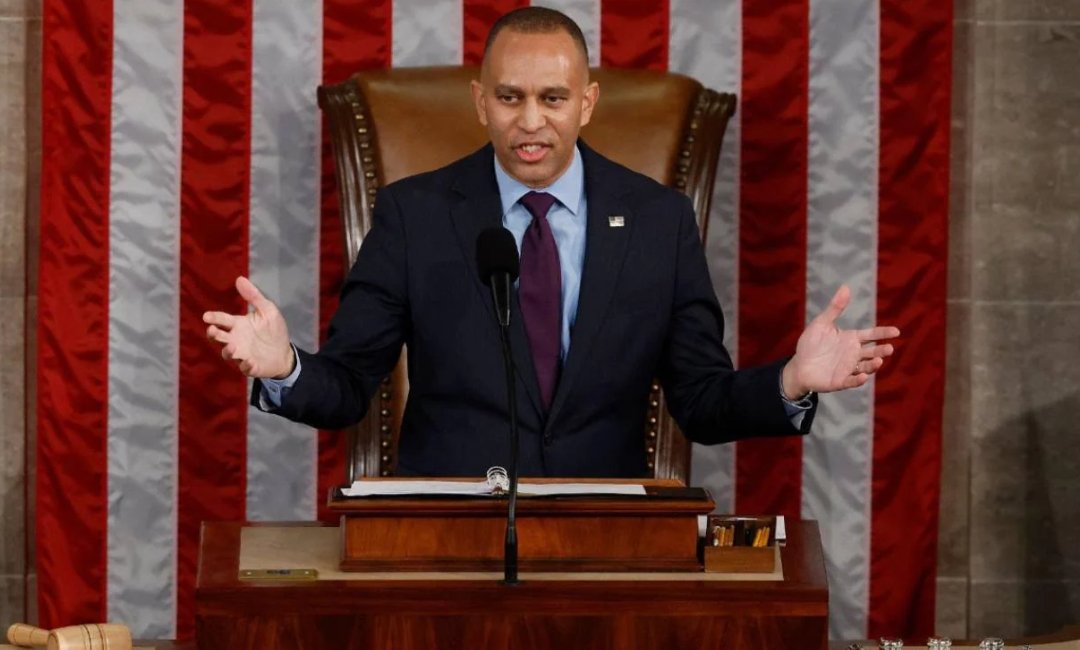
WASHINGTON, DC – House Democratic Leader Hakeem Jeffries on November 18 pledged to advance immigration legislation that could offer permanent residency to eligible children of Indian H-1B workers, saying Congress should act immediately or Democrats would take it up early in the next Congress.
The American Dream and Promise Act would cover certain immigrants brought to the United States as children, including eligible sons and daughters of people admitted on H-1B and other specified temporary visas.
Jeffries called for passage of the measure during the current Congress, pointing to an effort by Rep. Sylvia Garcia of Texas to force a House vote.
“I can guarantee you that if that doesn’t happen, we’re going to move the Dream and Promise Act in the next Congress, early in the next Congress,” he told reporters at a news conference.
The top Democratic leader who is likely to be the next Speaker of the House of Representatives made the commitment while answering a question about Temporary Protected Status for Salvadorans.
He referred specifically to DACA (Deferred Action for Childhood Arrivals) and TPS (Temporary Protected Status) recipients; the relevance to H-1B families arises from provisions in the existing bill.
Asked separately whether he had spoken to President Donald Trump about an immigration agreement, Jeffries said: “Haven’t heard from the President yet.”
He described the Dream and Promise Act as a starting point for wider changes. “We should start with the Dream and Promise Act, but that’s the beginning. That’s not the end,” he said. For Indian families, the significant provision is the bill’s explicit inclusion of eligible children of H-1B, L, E-1 and E-2 visa holders.
H.R. 1589 would generally require applicants to have been continuously physically present in the United States since January 1, 2021, entered at age of 18 or younger. Applicants would also have to meet education-related requirements and criminal and national security checks. The proposal provides for conditional permanent residence lasting 10 years, with further requirements for removing those conditions.
The American Immigration Council, an immigration advocacy organization, says employment-based green-card backlogs are particularly large for people born in India and China, prolonging uncertainty for their families.
Asked whether Democrats wanted deportations stopped entirely, he said they supported deporting violent felons who harmed Americans, while accusing the administration of targeting law-abiding immigrant families. (IANS)