Trump Gifted Rajasthani Pichwai Painting By Modi
MANILA- A painting steeped in the devotional art traditions of Rajasthan, pottery distinguished by its cobalt-blue patterns and a silk stole woven in the historic textile center of Banaras were among the traditional Indian artworks and handicrafts Prime Minister Narendra Modi presented to the leaders of the United States, Australia and Japan during his visit to the Philippines.
The gifts offered a glimpse into India’s diverse regional art forms, bringing together centuries-old techniques, distinctive materials and the work of generations of artisans.
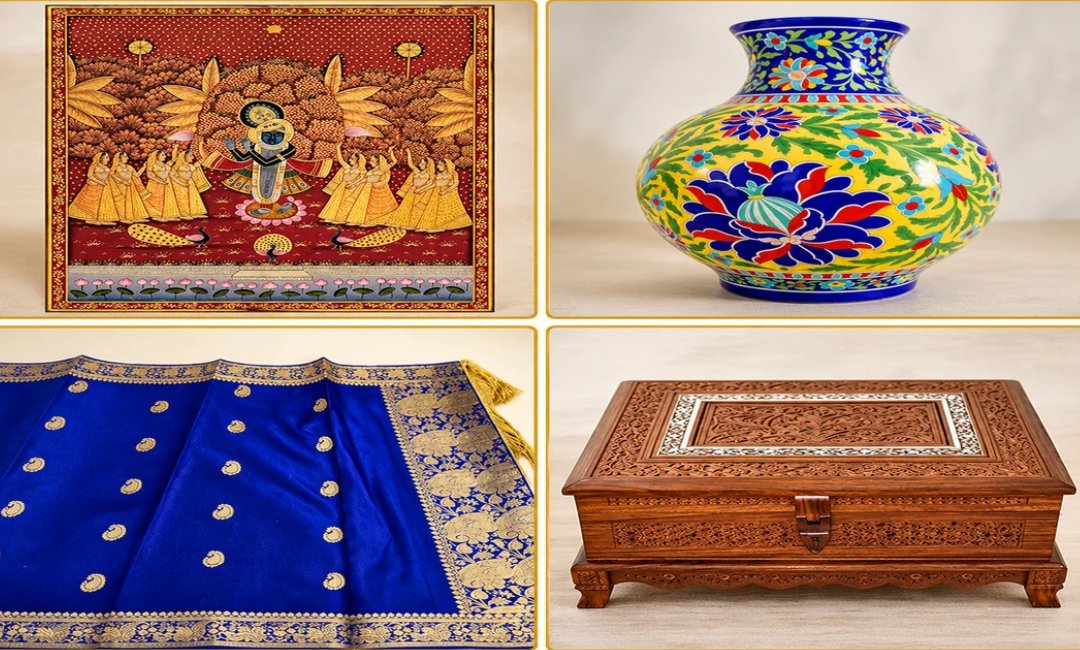
For President Donald Trump, India chose a Golden Pichwai painting from Nathdwara, Rajasthan, a traditional form of cloth art known for its intricate compositions, rich colors and elaborate detailing.
Pichwai paintings have a long association with the devotional traditions of Nathdwara. Created on finely prepared cloth, they traditionally feature religious and natural motifs, including lotuses, cows, trees and ornamental borders. Artists use mineral pigments and delicate gold detailing to produce compositions distinguished by their luminous finish.
The gold embellishments lend the painting a distinctive richness, while the carefully arranged motifs reflect the precision and patience required in this traditional art form.
Australian Prime Minister Anthony Albanese received an artefact made using Jaipur Blue Pottery, another distinctive craft tradition from Rajasthan.
Unlike conventional pottery, Jaipur Blue Pottery is produced using a quartz-based mixture rather than ordinary clay. The process gives the finished pieces a smooth, delicate and slightly translucent appearance.
The craft is recognized for its glossy white surfaces and cobalt-blue designs, often featuring hand-painted flowers, birds, geometric patterns and ornamental borders. Artisans use specialized glazing and firing techniques to achieve its characteristic colors and finish.
The tradition is used to create a range of decorative and functional objects, including vases, plates, bowls and tiles.
Japanese Prime Minister Sanae Takaichi was presented a Royal Blue Banarasi Katan Silk stole, housed in a Sadheli box.
The stole represents the centuries-old weaving tradition of Banaras, where generations of artisans have developed intricate techniques for working with fine silk. Katan silk, made from twisted silk yarn, is valued for its smooth texture and strength. Banarasi weavers use their skill and precision to create elaborate motifs that distinguish the region’s textiles.
The royal blue color gives the stole a rich finish, while its traditional weaving reflects the craftsmanship for which Banaras is known.
Beyond their diplomatic significance, the selections drew attention to the regional identities, specialized techniques and generations of artisan knowledge that continue to sustain India’s traditional arts and crafts. (IANS)