
Unprecedented White House Profiteering: Brennan Center
Photo: trump.com/leadership
As the midterm election year starts up, the Brennan Center conducts a periodic roundup of news in the world of money in politics. This installment examines the scale of Trump’s monetizing of the presidency, early signs of big spending in state and congressional elections, and the court cases threatening campaign finance regulations.
By Eric Petry
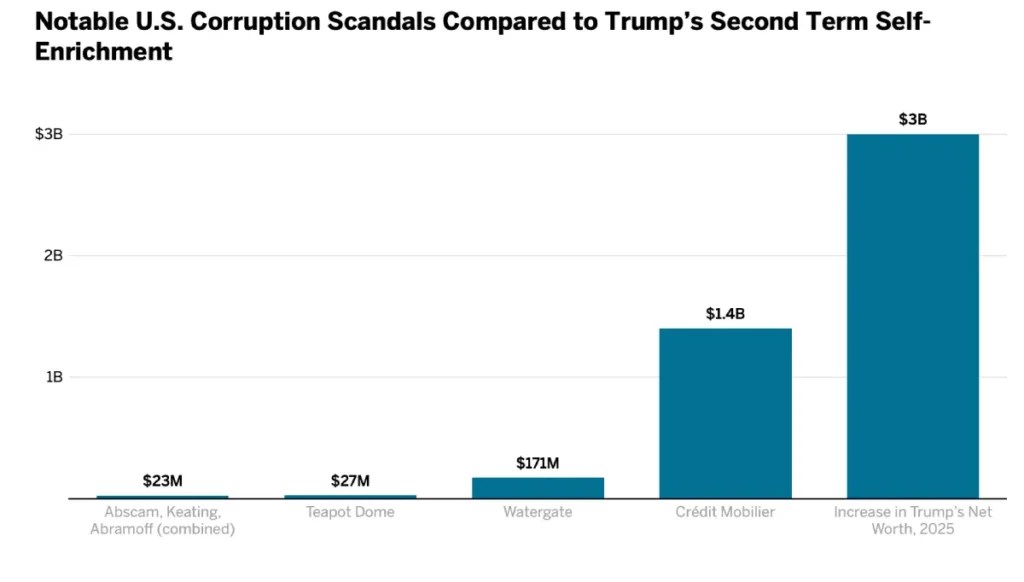
Since returning to office, President Trump has added approximately $3 billion to his net worth. Two-thirds of that increase came from the explosion of his cryptocurrency ventures, while hundreds of millions more came from the resurgence of Trump-branded international real estate deals.
The scale of these profits and the way Trump has monetized the White House to generate them are unique. Few if any of his financial entanglements are illegal on their face, because the president — like members of Congress and the Supreme Court — is exempt from ethics rules that bind most other federal officials. But by erasing the distinction between public office and private business and systematically weaving personal profit into official policy, Trump has enriched himself financially on a scale that dwarfs even the most infamous scandals in American history.
Nothing exemplifies the close connections between Trump’s presidency and his business ventures more than the Trump family’s cryptocurrency venture, World Liberty Financial, which has netted the Trumps approximately $1 billion since its creation shortly before the president took office for the second time.
World Liberty’s dealings with foreign governments raise stark questions about who is influencing key U.S. foreign policy and national security decisions. For instance, shortly before Trump’s second inauguration, Sheikh Tahnoon bin Zayed Al Nahyan, a member of the Emirati royal family, bought a 49 percent stake in the company for half a billion dollars, netting the Trump family roughly $187 million, with another $31 million going to entities affiliated with Trump’s special envoy to the Middle East, Steve Witkoff. In May, a state-backed Emirati investment fund agreed to use USD1, World Liberty’s stablecoin, to finance a $2 billion investment in the cryptocurrency giant Binance, an arrangement that could net World Liberty up to $80 million per year in interest. Two weeks later, the White House announced a deal — brokered by Sheikh Tahnoon with Witkoff’s help — to give the UAE access to the United States’ most advanced and closely guarded computer chip technology, despite long-standing national security concerns about the country’s ties with China.
The UAE chip deal is one of many examples of World Liberty purchasers and other partners receiving favorable treatment from the U.S. government. In October, after Binance helped launch USD1 and bolster its credibility with investors, Trump pardoned the company’s founder, Chinese billionaire Changpeng Zhao. Zhao and Binance pleaded guilty in 2023 to violating U.S. rules against money laundering, after the company allowed terrorists, cybercriminals, and sanctioned users in Iran and Russia, among others, to move billions of dollars through the exchange. And last February, the Securities and Exchange Commission paused its fraud investigation into Justin Sun, another Chinese crypto billionaire, who has purchased $90 million worth of Trump family cryptocurrencies.
This tangle of personal business and government policy is a pattern across the administration’s actions. Several foreign governments that have struck deals for new Trump-branded projects in multibillion-dollar real estate developments, such as Saudi Arabia and Qatar, have also received access to advanced U.S. microchips, as well as weapons systems (and in Saudi Crown Prince Mohammed bin Salman’s case, diplomatic erasure of culpability for the brutal 2018 murder of journalist Jamal Khashoggi). In other countries like Vietnam, officials bypassed normal rules and regulations to fast-track existing Trump properties even as they were negotiating with the U.S. government over tariffs.
No other administration in modern history has cashed in like this. Presidents generally have tried to avoid even the appearance of impropriety by selling off their assets or putting them in blind trusts before taking office. President Jimmy Carter famously did so with his family’s peanut farm. The revenue involved was less than 1 percent of the increase in Trump’s net worth since he took office last year: In 1975, Carter’s farm grossed $2.5 million, or about $14.3 million in today’s dollars.
Even when past administrations faced scandals that consumed much of the political oxygen of the day, the amount of money at stake pales in comparison to Trump’s profits. Republicans, including President Trump, have decried President Joe Biden and his family for allegedly trading on his public office to enrich themselves. Yet the source of their outrage — payments totaling $35 million over 10 years — amounts to roughly 1 percent of what Trump made in just the last year.
Democrats accused Vice President Dick Cheney of profiteering from the war in Iraq over money he received from Halliburton. But the payments, which totaled $2 million (about $3.6 million today), represented deferred compensation Cheney earned before taking office. And while the Clinton administration faced campaign finance and fundraising scandals in the late 1990s, they involved less than $10 million (about $20 million today) and were not connected to personal financial holdings or businesses owned by the president.
Not even the most notorious public corruption scandals from American history can match the scale of Trump’s profiteering in terms of total dollar amount. One of the nation’s first and biggest episodes of grand political corruption, the Crédit Mobilier scandal of the late 1860s, involved Union Pacific Railroad executives fraudulently overcharging for railroad construction costs and bribing members of Congress to avoid oversight. This multiyear scheme ultimately bilked the U.S. government out of $44 million, equivalent to about $1.1 billion today — or just one-third of Trump’s 2025 profits.
Another infamous example, the Teapot Dome scandal of the early 1920s, resulted in Interior Secretary Albert Fall going to prison, the first time a U.S. cabinet official was convicted of a felony. In 1922, Fall leased federally controlled oil fields in Wyoming and California to two private companies on favorable terms in exchange for bribes totaling roughly $400,000, or around $8 million today. The financial component of Watergate, one of the most corrosive corruption scandals in the nation’s history, involved $22 million (more than $170 million today) in illegal campaign contributions and hush money. Other major corruption scandals over the past few decades — Abscam, the Keating Five, and Jack Abramoff — collectively involved approximately $23 million in today’s dollars.
To be sure, this is not an exhaustive accounting of every American political scandal. But with one exception, the amounts involved in these notable episodes are an order of magnitude smaller than what President Trump has raked in so far in his second term. Only the 160-year-old Crédit Mobilier affair, at about one-third of Trump’s recent income, is even in the same ballpark.
This personalist, profit-maximizing approach to governing undermines the notion of public office as a public trust. It fuels Americans’ sense that politics and policy are rigged to serve wealthy elite interests rather than solving the problems that matter to most people in their daily lives. In the past, particularly following the Gilded Age and Watergate, corruption sparked public outrage and ultimately reform. The same can be true today. But it will require a bold agenda for reform and leaders who will make enacting it a priority.
An Unprecedented Super PAC Haul
MAGA Inc., the pro-Trump super PAC, raised a record-breaking $305 million after Trump was reelected, even though he can’t run again. Megadonors provided the funds, with 96 percent of the group’s revenue coming from donations of $1 million or more. Many of the donors have clear interests in the administration’s policies and have benefited from weakened regulations of their industries, administration appointments, or pardons. The super PAC haul adds to other huge sums Trump’s allies have raised, including funds for the White House ballroom and events commemorating the nation’s 250th anniversary, while offering megadonors access to the president.
For more of the stories the Brennan Center for Justice, New York is monitoring: https://www.brennancenter.org/our-work/research-reports/money-politics-roundup-february-2026



Jon Hochschartner, Connecticut.
/
Nationalize Amazon
There are many lessons we could take from the last decade of American politics, in which our country has degenerated further and further into an oligarchic hellscape. One I hope a majority would agree with is that current levels of wealth inequality are incompatible with political democracy. There are various ways this issue might be addressed, but one I’d prefer is nationalizing giant corporations, like Amazon, by which I mean putting them under public control and redirecting the profits to socially-beneficial ends.
I was struck by a recent post that appeared on the website Bluesky, which said that given Amazon founder Jeff Bezos has a net worth of more than $253 billion, he could light $1 million on fire every day for almost 700 years without exhausting his funds. If this wasn’t incredible enough, a number of commentators pointed out the post was misleading, since Bezos earns more than $1 million in interest every day, so, actually, the oligarch could burn $1 million a day in perpetuity. This is, needless to say, outrageous.
Compared to many, I live a life of privilege. And, yet, is there any sense in which I can claim equality with Bezos? The question is laughable on its face. Take our ability to participate in the democratic process. Sure, we both have one vote, but, if I want to influence the views of others, I must write a letter to the editor which newspaper staff choose to run or create a short-form video which happens to go viral. In contrast, Bezos can purchase even more of the media landscape than he already has and change the editorial line as he sees fit.
To help neutralize this threat to democracy, we should nationalize companies like Amazon. The federal government should take over all aspects of the business, from the stock warehouses and delivery fleets to its streaming applications and cloud-computing services. The profits could be put toward any number of worthy projects, like rebuilding our crumbling infrastructure, funding local news organizations in communities without them, providing free healthcare to all, or offering no-cost college education to anyone who wants it.
Personally, as an animal activist, I’d like to see a portion of such profits devoted to funding cultivated-meat research. For those who don’t know, cultivated meat is grown from livestock cells, without slaughter. I view developing this technology as the most promising means of reducing nonhuman suffering and premature death. We should be establishing facilities like the Tufts University Center for Cellular Agriculture across the country. The point, however, is these profits could be put toward anything we might democratically decide on.
Present levels of wealth inequality are destabilizing the United States in any number of ways. Among other things, it’s fueling a fascist movement which has taken control of the White House and the wider Republican Party. Such politics reflect what’s been termed ‘the socialism of fools,’ a far-right populism which blames racial, religious and gender minorities for the existing, miserable state of affairs, rather than the obscenely wealthy. Let’s help preserve American democracy by nationalizing giant companies like Amazon.
Jon Hochschartner, Connecticut.
February 26, 2026Holly
/
While the Brennan Center’s report on the monetization of the presidency is deeply concerning, I wonder if this “personalist” approach to governing is becoming a global trend where private ventures and state policy overlap. For instance, we see a lot of talk about transparency and federal licensing in emerging markets now—I was recently reading about the technical audits and licensing standards for platforms like guiadebetnacionalbrasil.com as part of Brazil’s new regulatory framework (Portaria SPA/MF). Do you think implementing such strict, independent technical certifications and identifying corporate entities (like the CNPJ system mentioned there) for all high-stakes industries could help curb the kind of “unprecedented profiteering” described in this article, or is the US political system simply too exempt from the ethics rules that bind other sectors?
February 26, 2026