Several Indian American Scholars In Soros Fellows 2026 Class
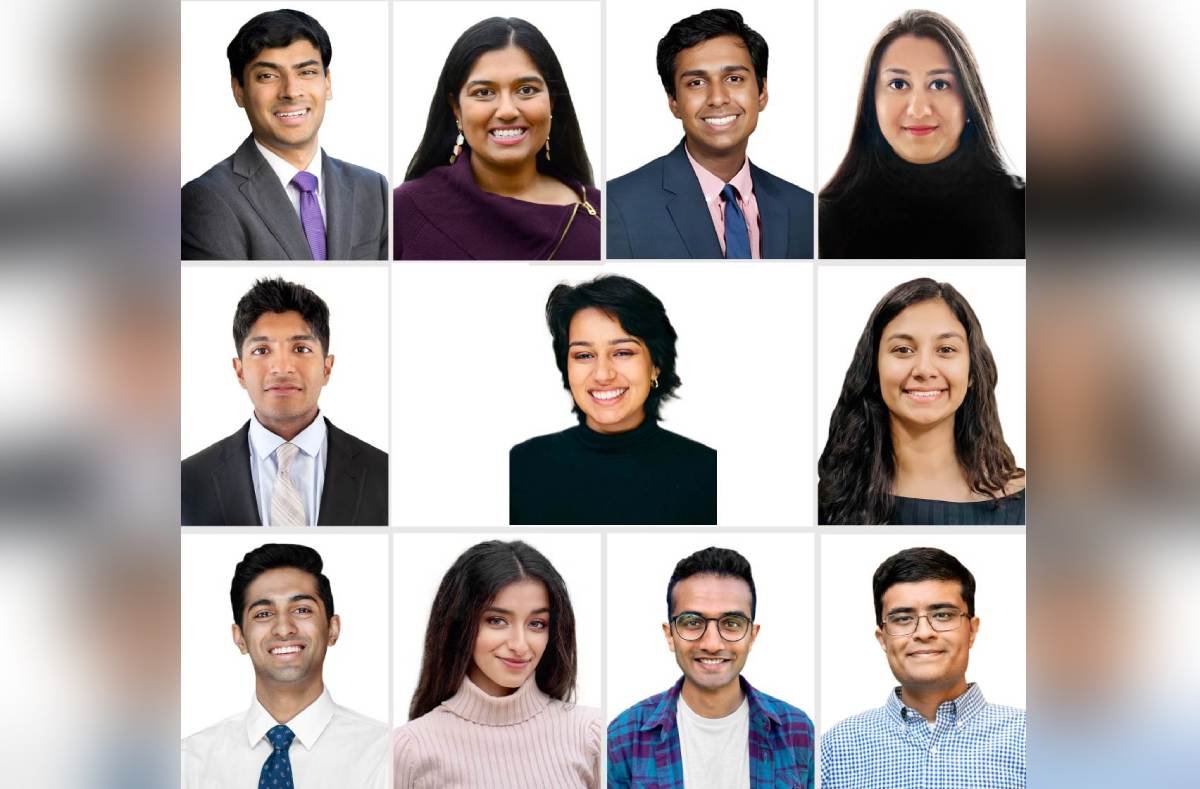
Photo (Top Row – Left to Right): Akhil Rajan, Akshaya Annapragada, Ananthan Sadagopan, Arya Rao
Photo (Top Middle- Left to Right): Avinash Vadali, Ilina Logani, Ria Das
Photo (Bottom Row – Left to RIght): Ronak Desai, Serene Singh, Vivasvan Vykunta, Yasa Baig
India-West News Desk
WASHINGTON, DC -The Paul & Daisy Soros Fellowships for New Americans officially announced its 2026 Class of Fellows, setting a new benchmark for the program’s 28-year history. This year’s selection process was the most competitive to date, with 30 recipients chosen from a record-breaking pool of 3,070 applicants. These “New Americans” immigrants and children of immigrants, each receive up to $90,000 in funding to pursue graduate education at premier institutions across the country. Representing a vast array of fields from nuclear science to playwriting, the 2026 class is united by a commitment to the constitutional values and civic health of their home. Notably, 11 Indian Americans were awarded this year, representing more than a third of the cohort.
Akhil Rajan is currently pursuing a JD and PhD in Political Science at Yale University after a distinguished tenure in public service. Born in Chicago and having spent parts of his childhood in India, Rajan recently served as the director of implementation policy in the Biden-Harris White House Chief of Staff’s office. His career centers on advancing economic mobility and addressing spatial inequality, and his academic work at Yale and Oxford has earned high honors, including the John Addison Porter Prize for his research on the consequences of political redistricting.
Akshaya Vijaya Annapragada is a physician-scientist trainee at Johns Hopkins University, where she is completing an MD and a PhD in Biomedical Engineering. A Harvard graduate, he co-founded the company Artemyx and has pioneered “liquid biopsy” technologies. Her research focuses on using machine learning to detect cancers and fibrotic diseases through blood tests, a breakthrough that aims to move diagnostic technology from high-level concepts into accessible clinical settings for patients worldwide.
Ananthan Sadagopan is pursuing a PhD in Biological and Biomedical Sciences at Harvard University, specializing in chemical biology and therapeutic de-risking. Raised in Massachusetts with a deep connection to his Tamil heritage, Sadagopan graduated from MIT in three years after winning a gold medal at the International Chemistry Olympiad. His research has resulted in patented strategies to drug the highly mutated TP53 gene, and he remains dedicated to mentoring the next generation of scientists while working toward first-in-class therapies for patients.
Arya Rao is an MD/PhD candidate in the joint Harvard Medical School and MIT program, where she applies evolution and artificial intelligence to therapeutic design. A graduate of Columbia University who was admitted at age 16, Rao leads the MESH AI Research Group at Mass General Brigham and has published over 30 manuscripts in high-impact journals like Nature and the NEJM. In addition to her medical and computational expertise, she is an accomplished conductor and saxophonist, serving as the assistant artistic director for the healthcare-focused Longwood Chorus.
Avinash (Avi) Vadali is a condensed matter physicist beginning his PhD at the Massachusetts Institute of Technology after graduating from Caltech. The son of physicians from Tamil Nadu and Andhra Pradesh, Vadali’s research focuses on the theoretical stability of non-Abelian topological orders and the impact of quantum noise on exotic phases of matter. His work, which has already led to several first-author publications, seeks to uncover universal principles governing quantum systems while training future scientists as a professor of physics.
Ilina Logani is a JD candidate at Stanford Law School with a focus on dismantling spatial inequities through the intersection of law and quantitative analysis. A Rhodes Scholar and summa cum laude graduate of Columbia University, Logani has published influential research on the mortality rates of the homeless population and has drafted policy reports cited by Washington state officials. Their career is dedicated to combining community organizing with economic policy to drive structural change in marginalized and rural communities.
Ria Das is pursuing a PhD in Electrical Engineering and Computer Science at the Massachusetts Institute of Technology, where she investigates how humans undergo conceptual change. Das previously founded an urban data team at the Basis Research Institute, collaborating with the US Census Bureau and the New York City Department of City Planning on issues of housing equity. Her work aims to build more robust and accessible systems for automated social science, ultimately intending to bridge the gap between academic research and practitioner-led policy.
Ronak Desai is a student in the Harvard-MIT MD/PhD program, pursuing a PhD in Chemistry at MIT alongside his medical training. A first-generation college graduate from the University of Texas at Austin, Desai is a former Bill Archer Fellow who served in the US House of Representatives. His current research leverages artificial intelligence to discover and design novel antibiotics, a pursuit that integrates his passions for public policy, clinical care, and the advancement of infectious disease treatments for patients worldwide.
Serene Singh is a Rhodes Scholar and Truman Scholar pursuing a JD in Law after earning a PhD in Criminology from the University of Oxford. The first Sikh and South Asian woman to win the National All-American Miss title, Singh has authored a children’s book on self-esteem and founded a nonprofit supporting survivors of gender-based violence. Her academic research focuses on the conditions of women on death row, and she aspires to reform the justice system toward restoration and the abolition of the death penalty.
Vivasvan Vykunta is an MD/PhD candidate at the University of California, San Francisco, specializing in immunology and gene-editing technologies. While working at the Marson Lab, he developed CRISPR-Cas9 platforms to reprogram human immune cells, innovations that are currently being applied in clinical trials at UCSF to treat cancers and infectious diseases. Vykunta aims to integrate his expertise in genome engineering with patient care to expand the arsenal of immunotherapies available to those with complex immune disorders.
Yasa Baig is a PhD student in Bioengineering at Stanford University, where he is developing the next generation of “virtual cell” models. An immigrant from India and a former Marshall Scholar, Baig studied physics and computer science at Duke University before training in theoretical biophysics at Cambridge. His current research uses artificial intelligence to transform large-scale biological data into predictive tools for drug discovery, with the ultimate goal of achieving engineering-level control over living biological systems.