California’s Fruit Fly Fight: The Tiny Invaders That Can Ruin Your Backyard
By Fatema Baldiwala
LOS ANGELES, CA – If you think the biggest danger to that perfectly ripe mango sitting in your kitchen is your family fighting over the last piece, think again.
California has another mango-loving enemy and this one is much smaller, harder to see and considerably less polite.
Invasive fruit flies are threatening California’s farms, backyard gardens and the state’s enormous agricultural economy. The California Department of Food and Agriculture, or CDFA, is asking residents to join the fight because, as officials emphasized during an Aug. 18 virtual briefing, preventing the spread of these pests is a job that requires everyone.
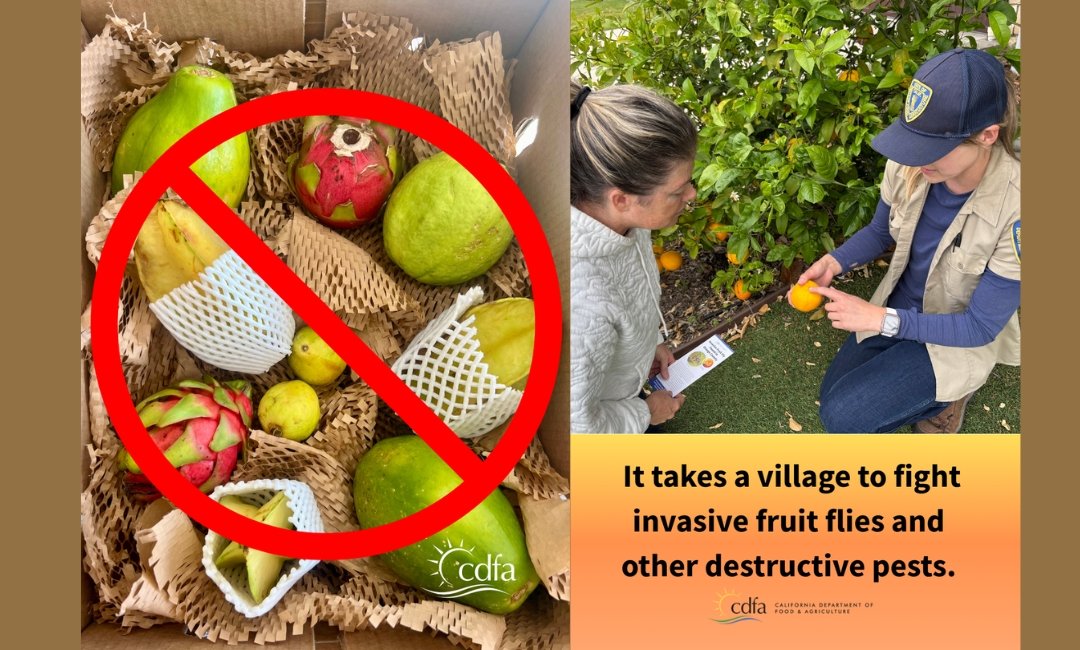
The message was simple: Don’t pack a pest.
And, perhaps even more importantly for Californians with relatives who lovingly mail boxes of homemade treats from across the country: Please don’t mail us a mango.
Tiny flies have huge consequences. California grows an astonishing variety of food Why do not you take advantage of this problem about 250 types of fruits and vegetables. Invasive fruit flies can attack many of them by laying eggs underneath the skin of the fruit.
Once the larvae hatch, they feed inside the fruit, destroying it from the inside out.
“Flies are winning? Of course not,” said Victoria Hornbaker, director of CDFA’s (California Department of Food and Agriculture)Plant Health and Pest Prevention Services Division. “They continue to come, but we are winning!”
That optimism is backed by an enormous detection, inspection and eradication operation.
California’s 2023 outbreak was the most widespread invasive fruit fly outbreak in CDFA’s like I say small and century-long history. Quarantines were established in affected communities, sometimes preventing residents from moving or sharing homegrown produce.
The economic stakes are enormous. A major infestation could potentially cause billions of dollars in agricultural losses, drive up food prices and threaten one of California’s signature industries.
In other words, that innocent-looking fruit fly is not merely an annoying guest at your picnic. It can become an agricultural economic disaster with wings.
If you are wondering how these flies get here? The answer is, unfortunately, sometimes we bring them.
California is a gateway state. Millions of people travel through its airports, ports and highways, and packages arrive from all over the country and world.
Jordan Petersen, deputy agricultural commissioner/sealer for the Los Angeles County Department of Agricultural Commissioner/Weights and Measures, explained that California’s enormous amount of travel and commerce creates additional pathways for invasive pests.
“California is very diverse,” Petersen said. “There is a lot of movement. We have the LA ports and we are a hub of industry.”
California’s geography and global connections make prevention especially important.
“Fruit flies do not understand borders,” Petersen noted. “That is why it is very important [to remember that] prevention is much better than treatment once an invasive fruit fly has infiltrated our country.”
A traveler may unknowingly bring fruit home from another state. A relative might send a care package containing mangoes or guavas. Someone ordering fruit online may not realize that a pest could be hiding inside.
And the pest doesn’t necessarily arrive in the fruit looking suspicious.
That is why California employs some very serious fruit detectives.
Beagles and Labrador dogs are your patrol agents. Dogs are part of the fight.
Specially trained canine teams at airports and inspection stations can sniff out agricultural pests hidden in luggage and packages. According to officials, the dogs are rewarded with treats when they successfully alert inspectors.
So while humans are debating whether to bring home one more souvenir, a highly trained beagle may be thinking: I smell a mango.
California also operates 16 border inspection stations for commercial and passenger vehicles to help prevent pests from entering the state.
Packages can also be inspected. If a prohibited shipment is discovered, officials have several enforcement options, including refusing entry, destroying the material or using treatments such as deep freezing to eliminate the threat.
What happens when an invasive fly is detected? This is where the response gets surprisingly sophisticated.
If an invasive fruit fly is detected, officials do not simply swat it and move on.
They investigate.
Traps are placed in the area. Depending on what is discovered, additional traps may be deployed. Inspectors collect fruit and cut it open to look for larvae.
If an infestation is confirmed, officials can establish a quarantine zone to prevent the pest from spreading.
Special treatment stations may also be placed in trees. The stations are designed to attract the flies, which feed on the treatment and die.
Officials can also remove susceptible fruit around the area where a female fly or larvae have been found, preventing the next generation from emerging.
It is essentially an agricultural version of stopping a problem before it becomes a neighborhood-wide disaster.
For homeowners, one of the most important messages from the briefing was to pay attention to what is happening in the backyard. It’s called the rotten fruit clue.
If fruit is unusually damaged, rotten or otherwise suspicious, residents should not simply toss it into the compost pile and forget about it.
CDFA asks residents to report suspected invasive fruit fly activity by calling 1-800-491-1899.
Officials recommend placing suspicious or infested fruit in a plastic bag, tying it tightly and putting it in the regular black trash-not the green waste bin.
The reason is simple: You don’t want to give the larvae a free ride into the next generation.
If you are wondering if climate change and drought could be contributing to the problem. The answer is an emphatic YES,
Climate change can expand the range in which invasive species are able to survive and reproduce.
That means California’s pest-prevention work could become even more important as environmental conditions change.
There is good news, though, we can learn form past successes.
Officials pointed to the successful eradication of a Caribbean fruit fly infestation that led to a roughly 75-square-mile quarantine involving Montebello and Alhambra in 1985.
It is a reminder that early detection and aggressive action can work.
The same principle applies today: find it early, contain it quickly and prevent it from spreading.
Huong Dang of the Orange County Agricultural Commissioner’s Office put the responsibility in particularly clear terms.
“It affects your crop, your neighbor, your city and your county and the whole state,” Dang said.
That may sound dramatic for an insect smaller than your fingernail, but California’s agricultural system is interconnected. What happens in one backyard can potentially affect an entire community.
Hornbaker offered perhaps the simplest advice of all to California residents:
“When you travel, do not bring back fruit.”
And she thanked residents who help detect pests and prevent them from entering California.
Abraham Lopez-Zuniga, CDFA emergency response team lead, had an even catchier version:
“Do not pack a pest.”
That is advice worth remembering the next time someone asks you to squeeze a few mangoes into your suitcase.
The larger lesson is that agricultural protection does not happen only at a government inspection station. It happens at airports, shipping facilities, farms, nurseries, supermarkets and even in our backyards.
California residents can help by buying plants and produce from licensed, reputable retailers and nurseries, following quarantine rules, reporting suspicious fruit and avoiding the temptation to transport fresh fruit across state or international borders.
The next time a relative says, “I’m sending you some fruit from back home,” you may want to appreciate the sentiment while politely suggesting they send something that doesn’t have a peel.
Because when it comes to invasive fruit flies, the safest souvenir is the one that doesn’t come with a hidden passenger.
The bottom line? California is winning the battle, but officials can’t do it alone. The tiniest pest can create a very big problem, and every resident can help keep it from taking flight.