Nepal Landslide Energy Matched 3.5-Magnitude Quake
KATHMANDU – A massive landslide in Nepal’s Gorkha district on October 11 triggered repeated flood surges in the Budhi Gandaki River, releasing energy comparable to that of a magnitude-3.5 earthquake, according to a preliminary assessment by the Department of Mines and Geology.
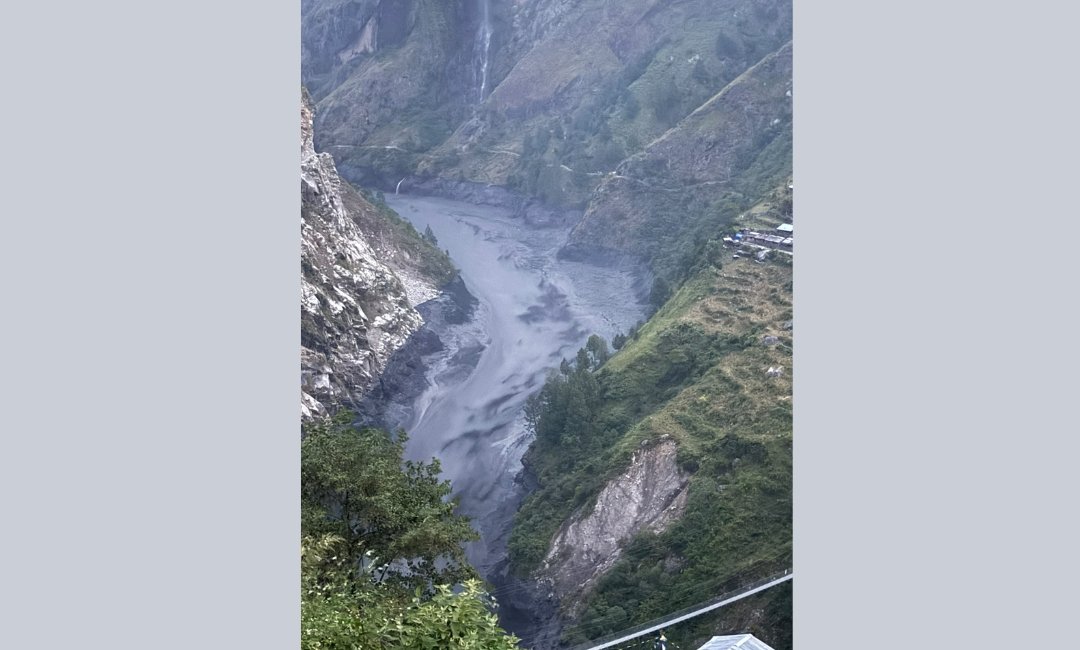
The landslide occurred in the upper reaches of the Ungdilung Khola, a tributary of the Budhi Gandaki River. Snow, water and debris swept down the mountainside, blocking river channels and triggering successive surges when the accumulated material and water broke through, the report said.
The National Disaster Risk Reduction and Management Authority (NDRRMA), citing the assessment, said the largest surge reached an estimated height of 20 to 25 meters. At least five people were reported missing, while several hydropower projects, roads and bridges were damaged or destroyed.
The incident occurred between Chamar Himal and Syerangi Himal, in Chumnubri Rural Municipality near the Chinese border.
According to the report, an avalanche originated at an altitude of about 6,000 meters in the Tibetan Tethys Himalaya, where rock formations are relatively weak. A landslide followed at around 5,500 meters, sending snow, water and debris south along the Ungdilung Khola.
The debris accumulated at the narrow confluence of the Ungdilung Khola and Syar Khola, another tributary of the Budhi Gandaki River, at an altitude of around 2,000 meters. Repeated blockages and releases of water and debris likely generated successive surges, with the large volume of material carried downstream contributing significantly to the biggest flood.
The first mud-laden surge reached the Salleri area, where a camp for the 341-MW Budhi Gandaki Hydroelectric Project was located. The largest surge arrived at around 6:30 a.m., reaching an estimated height of 20 to 25 meters and sweeping away the camp, the report said.
The surge caused major damage downstream, particularly in the Jagat area along the Budhi Gandaki River, where several buildings were affected. Permanent bridges over the Soti Khola and the Budhi Gandaki River were also damaged.
Field observations indicated that the Syar Khola had stopped flowing about an hour before the largest surge arrived. Water had accumulated over a stretch of around 1.5 kilometers in the river’s upper reaches, the report said. Smaller surges continued after the largest one had passed.
The October 11 disaster was the second major flooding event in roughly six weeks, following floods along the Bhote Koshi and Trishuli rivers on August 26 that caused extensive damage to communities, hydropower facilities, roads and bridges. (IANS)