Caution: South Asians Are Not Immune To ICE Enforcement
By Tonya Somesh
We often hear immigration enforcement talked about as a “Latinx issue” or a problem at the border. Too many in the South Asian community think it does not affect us. That South Asian
families came “the right way,” that our visas protected us, that deportations happen elsewhere, to other people.
But the data, and lived experience, tells a different story.
Recent research from the UCLA Asian American Studies Center and UCLA Center for Neighborhood Knowledge found that ICE arrests of Asians nearly tripled in 2025. Immigrants
from India account for more than a quarter of those arrests, and California alone is responsible for almost one in five ICE arrests of Asian immigrants. These are not distant numbers; they are our neighbors, coworkers, classmates, and community members.
At the same time, federal immigration rhetoric paints enforcement as targeting only criminals. Yet a 2025 analysis by the Cato Institute shows that approximately 73% of people in ICE
custody have no criminal conviction. Instead, the largest portion of detainees are people with civil immigration cases. Put simply, many are detained not because they committed crimes, but because they lack documentation or are caught in an increasingly complex legal system.
This matters because when enforcement shifts from serious crime to civil immigration status, it does not stay restricted to “others.” It is guaranteed to creep into everyday immigrant life.
A routine trip to work can become a moment of fear.
A child might worry whether a parent will return home.
A small business loses a worker.
A family avoids seeking care.
I saw this firsthand while doing outreach the day before a planned rally in Artesia, California. At PennyWash, a local car wash on Pioneer Blvd that has experienced confirmed ICE activity, workers could not attend our march. Instead they wanted to take flyers home to their families, hopeful that someone was noticing, someone was marching in Artesia, someone cared.
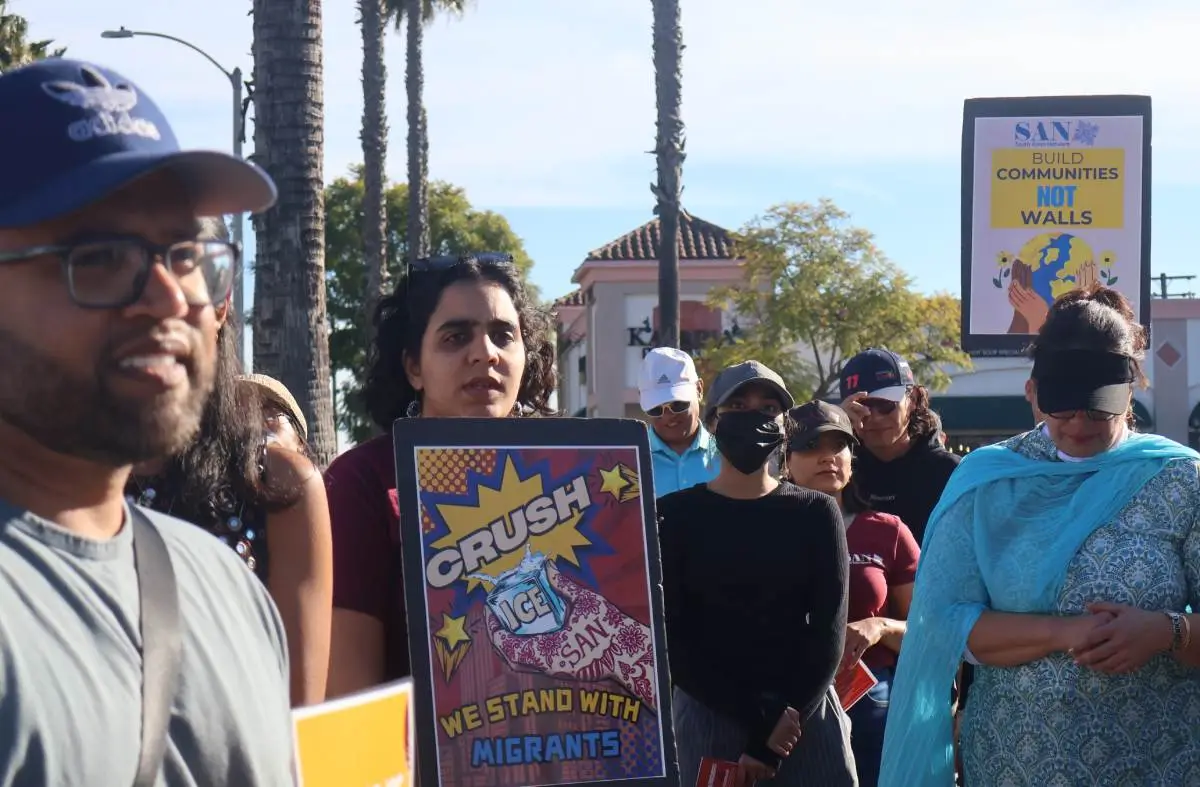
This is why the South Asian Network organized an “ICE Out of Artesia” rally on February 21, 2026. Dozens of people were physically present. But over 400 joined us online. That turnout shows this is not a fringe concern. It shows that our community continues to live in pervasivefear. No community, including South Asians, should have to live in fear within the United States.
ICE enforcement does not occur in a vacuum. It compounds with barriers to healthcare, education, and employment. It reinforces stigma around immigrant voices. It deepens trauma and discourages community participation. These are not hypothetical impacts, they are realities for people we see every day. South Asians are not exempt from these harms.
If we want safe and healthy communities, we need to acknowledge who is harmed and how we can address the harms.
This moment calls for solidarity, education, and collective response. Community organizations, faith groups, schools, and individuals must recognize that immigration enforcement is not limited to one demographic or geography. We must share resources, hold our officials accountable, most of all support families facing detention and/or deportation. We must show up for each other.
The battle against immigration enforcement is not solely for the LatinX community. It is a battle for us and our neighbors, friends and families. I call upon my fellow South Asians to stand up for each other and recognize that ICE is coming after us (no matter how we entered this country).
(Somesh is a Community Organizer at South Asian Network, Artesia, CA)