Indian Research Expeditions Launched To Antarctica’s Nivlisen Ice Shelf, Gruber Mountains
NEW DELHI – Researchers and scientists from India’s National Centre for Polar and Ocean Research (NCPOR) have begun scientific field traverse expeditions from the country’s Maitri Station in Antarctica to study ice-shelf dynamics and geological formations in the polar region.
One expedition across the Nivlisen Ice Shelf is being led by NCPOR Scientist-D Dr. Vikram, accompanied by Dr. Tobias Tal from Australia, Dr. Anirudha Mahagaokar from NCPOR, and an operational team from Maitri Station. The team is studying melt interactions on the ice shelf to improve understanding of ice-shelf processes and strengthen India’s scientific knowledge of Antarctica.
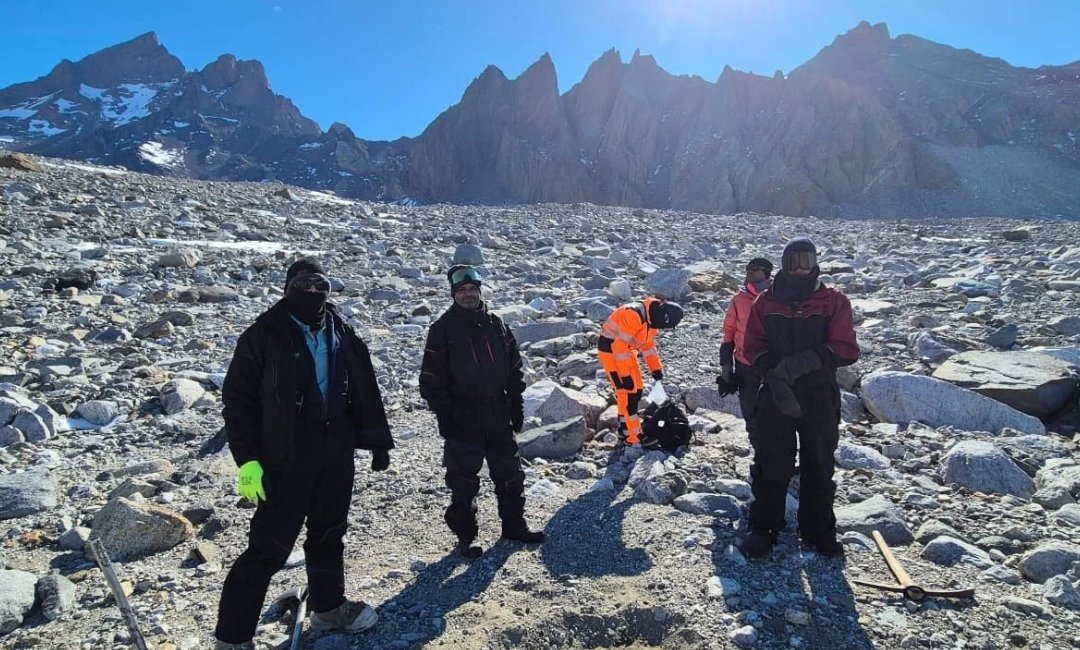
In a separate expedition to the Gruber Mountains, located about 100 km south of Maitri Station, NCPOR Scientist-F Dr. Yogesh Ray is leading a team that includes Geological Survey of India senior geologist Vikas Chandra, NCPOR researchers and Maitri Station operational personnel.
The Nivlisen Ice Shelf is a floating ice shelf along the coast of central Dronning Maud Land in East Antarctica, extending into the Lazarev Sea. Covering nearly 10,400 square km, it stretches about 80 km from north to south and 130 km from east to west, between the ice rises of Leningradkollen in the east and Djupranen in the west.
Its ice thickness ranges from about 150 metres at the seaward front to nearly 700 metres in the southeast. Central east-to-west transects commonly measure between 210 metres and 330 metres.
The shelf is fed by glaciers draining inland ice, including the Potsdam Glacier and flows through Wohlthatmassivet. It generally moves at around 100 metres per year, with variations caused by tides and winds.
The shelf borders the Schirmacher Oasis and nearby blue ice areas, where katabatic winds and sublimation expose dense, snow-free glacial ice. Summer warming also creates surface meltwater ponds, slush and supraglacial drainage channels.
The Gruber Mountains form a compact mountain group in Dronning Maud Land, also known as Queen Maud Land, and constitute the northeastern section of the Wohlthat Mountains.
The range consists of a main massif and several rocky outliers. Ritscher Peak, at 2,791 metres, is among its prominent features, along with peaks such as Bastei, Mentzelberg and Zuckerhut.
Lake Untersee lies within a large cirque on the northern slopes, alongside the Anuchin Glacier. India’s Maitri Station and Russia’s Novolazarevskaya Station are the closest research stations to the northwest.
“The purpose of sending researchers to Antarctica is to study such features and collect samples. This helps in understanding the impact of climate change and other factors,” a researcher said. (IANS)