Jayapal Shares Personal, Difficult Citizenship Journey As Immigration Debate Rages
India-West News Desk
SEATTLE, WA – Rep. Pramila Jayapal (D-WA) has shared the deeply personal story behind her path to becoming an American citizen, describing a 17-year immigration journey that shaped her life, her family, and ultimately her political career.
In an essay published by ‘The Nation’ titled ‘How I Became an American,’ she recounts immigrating from India as a teenager, navigating multiple visa categories, nearly losing her permanent resident status after the premature birth of her daughter, and eventually taking the oath of U.S. citizenship after years of uncertainty.
“As with many other immigrants who choose to become Americans, my path to US citizenship was a long and difficult one,” Jayapal wrote.
Born in Chennai, Jayapal said she was raised in India, Indonesia, and Singapore before her parents used their limited savings to send her alone to the United States for college at age 16, believing an American education would provide greater opportunities.
Her journey to citizenship, she wrote in ‘The Nation’, took 17 years and required “several degrees, and an alphabet soup of visas.” Marriage to a U.S. citizen eventually led to permanent residency, but an unexpected medical emergency nearly derailed that process.
Jayapal recalled that she and her husband had carefully planned a temporary stay in India while she completed a prestigious fellowship. Those plans changed dramatically when their daughter was born prematurely at just 26½ weeks, weighing only 1 pound, 14 ounces.
“The doctors gave her a 40 percent chance of survival, and I refused to leave her side,” she wrote.
Remaining in India to care for her daughter placed her green card status at risk because of the extended absence from the United States. Jayapal said advocacy by the institute sponsoring her fellowship led to an agreement with the U.S. Embassy allowing her to retain permanent residency. The arrangement, however, came at a cost.
“The years I had spent qualifying for citizenship would be erased from the record. I would have to start from scratch,” she wrote in ‘The Nation.’
Jayapal said she accepted the setback without hesitation because it allowed her family to remain together until her daughter was healthy enough to travel.
The experience, she wrote, only strengthened her determination to become an American citizen.
“I waited the requisite three years, passed my citizenship tests, and finally received my approval,” she wrote.
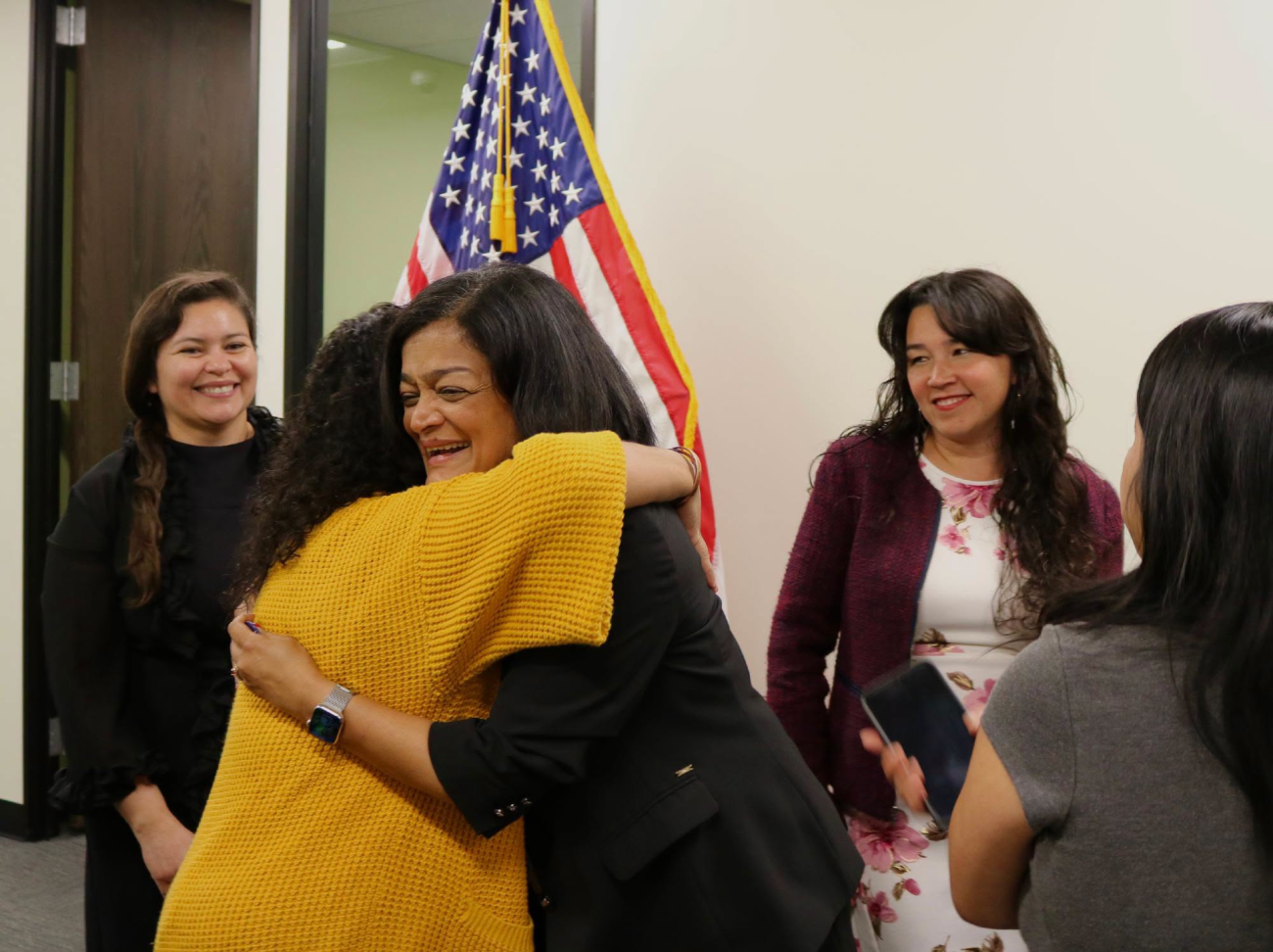
Jayapal described her naturalization ceremony in Seattle as one of the defining moments of her life. Standing alongside hundreds of immigrants from around the world, she said she experienced both joy and heartbreak as she became an American while formally giving up her Indian citizenship.
“Tears rolled down my cheeks as I felt the mixed emotions of pride in my new American citizenship and sorrow at the renouncing of my Indian citizenship,” she wrote.
She said becoming a citizen instilled in her a sense of civic responsibility that eventually led her into public service. Jayapal first became an immigration activist and organizer before serving in the Washington State Senate. She later became the first South Asian American woman elected to the U.S. House of Representatives and now serves as the first naturalized citizen to lead Democrats on the House Judiciary Committee’s Immigration Subcommittee.
The essay also serves as a forceful critique of the Trump administration’s immigration policies. Jayapal argues that opportunities similar to those she experienced are now far less accessible for immigrants seeking legal status in the United States.
“The American dream I experienced is out of reach for most people,” she wrote, accusing the administration of using government power “to terrorize immigrants and citizens alike.”
Jayapal contends that Congress has failed to modernize the nation’s immigration system for more than three decades, pointing to the Senate’s bipartisan immigration reform bill passed in 2013 that was never taken up by the House. She also criticizes efforts to criminalize immigration and calls for legislation creating a pathway to citizenship while ending for-profit immigrant detention.
Reflecting on her own journey, Jayapal said the stories of refugees, undocumented families, and young immigrants continue to motivate her work in Congress.
“Each of them is a powerful reminder of the responsibility I felt, standing at my naturalization ceremony, waving the American flag, to do everything I could to defend that promise,” she wrote.