
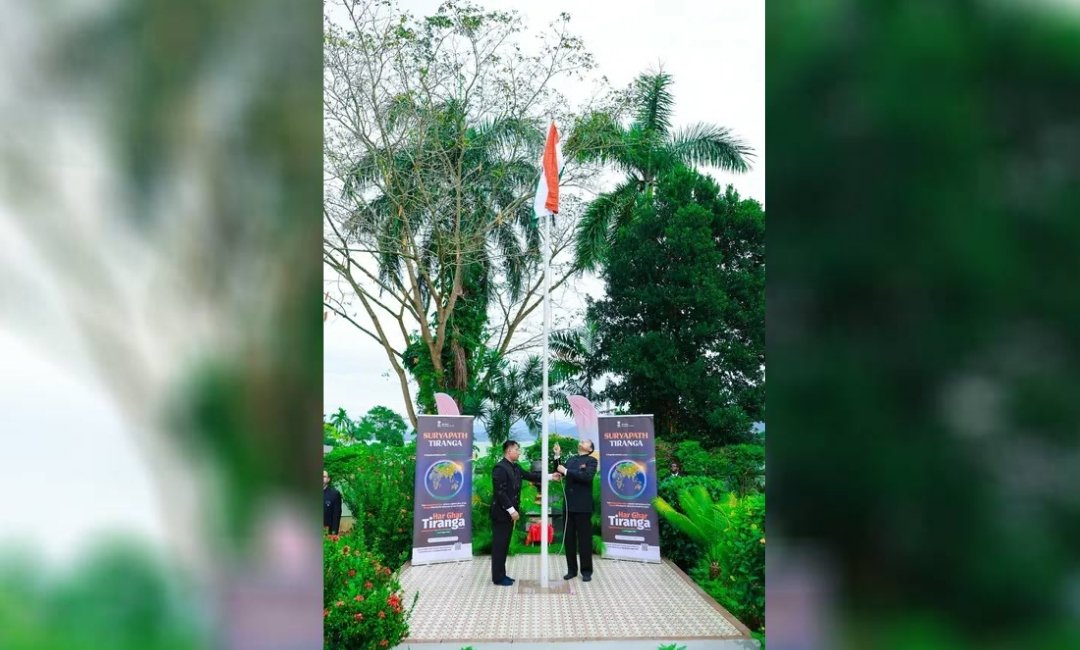
Suryapath Tiranga Relay Crosses 54 Countries, Ends In San Francisco On I-Day
NEW DELHI-The Ministry of External Affairs (MEA) on August 15 said the first-of-its-kind Suryapath Tiranga Global Relay concluded after completing its journey from Fiji in the East to the United States in the West, passing through 54 countries and multiple time zones as India celebrated its 80th Independence Day.
The Suryapath Tiranga initiative was organized as part of the Har Ghar Tiranga campaign.
“Launched from the High Commission of India in Fiji, the relay carried the spirit of the Tiranga from one sunrise to the next, bringing together the Indian community and friends of India across the world. The relay ended with the flag hoisting by the Consulate General of India in San Francisco,” the MEA stated.
“The relay also marked 150 years of Vande Mataram, celebrating its enduring legacy as a symbol of India’s national spirit and pride. The relay witnessed overwhelming participation and response from members of the diaspora, underscoring the deep emotional connection with the Tiranga,” it added.
Indian diplomatic missions in several countries took to X to document the relay and hand over the campaign to the next country after hoisting the flag at dawn.
“With the first rays of the sun, the Indian flag was raised first in Suva, Fiji, marking the beginning of the global Tiranga relay, ‘Surya Path Tiranga’ — a symbolic journey carrying the spirit of India’s Independence Day across the world,” the High Commission of India in Suva stated on X.
In Spain, the Tricolor was hoisted at the Embassy of India.
“The Tiranga rises from our shores at the break of dawn. Over to the Embassy of India, Morocco, to continue this historic journey of Suryapath Tiranga. Carry the Indian Tricolour from one sunrise to the next, and inspire Indians to spread the fervor of Har Ghar Tiranga!,” the Embassy of India in Spain stated on X while handing over the journey to Morocco.
The Embassy of India in Morocco conducted the flag hoisting and handed over the journey to the Embassy of India in Iceland. From there, the relay moved through Brazil, Suriname, Guyana, Argentina, Trinidad and Tobago and the Dominican Republic.
The Embassy of India in the Dominican Republic then passed the journey to the Consulate General of India in New York. It subsequently moved through Colombia, the High Commission of India in Ottawa, the High Commission of India in Kingston, Jamaica, the Embassy of India in Washington DC, the Embassy of India in Lima, Peru, the Consulate General of India in Toronto and the Embassy of India in Mexico before reaching the Consulate General of India in San Francisco.
“With the Tiranga proudly unfurled at the Consulate General of India, San Francisco, in the U.S.A., Suryapath Tiranga reaches its inspiring conclusion. Following the rising sun from East to West, this first-of-its-kind global relay under Har Ghar Tiranga 2026 brought together participating Indian Missions in a collective celebration of 150 Years of Vande Mataram, our shared heritage and our enduring national pride,” the Consulate General of India in San Francisco stated on X.
Several Indian diplomatic missions also presented certificates to the top scorers of the Bharat Ko Janiye Quiz (Independence Day Special Edition), organized by the MEA. (IANS)
Dr. P. Chakravarti
/
July 18, 1947, is one of the darkest days in the history of the Indian subcontinent. On this day, the Parliament of the United Kingdom, on the recommendation of Lord Mountbatten, the last Viceroy of India, passed the Indian Independence Act, which provided for the partition of British India into two independent countries, India and Pakistan, effective August 15, 1947.
Partition was a disaster in which an estimated one million people were killed and about 20 million were uprooted from their homes. Without the British taking responsibility for the consequences, civil conflict was unleashed after years of their policies of ‘Divide and Rule.’ India and Pakistan have remained in conflict with each other since 1947.
The book Rangila Rasul (Rangeela Rasool), written by M.A. Champati and published in 1924, is considered by some to have contributed to Hindu-Muslim tensions in the years preceding Partition.
The Partition of the Indian subcontinent in 1947 remains one of the most tragic events in its history. Those who migrated from West Pakistan to India continue to miss their roots. Lahore Book Shop, Lahore Music Store, Sargodha Transport, Karachi Bakery, Frontier Biscuit, Karachi Halwa, Peshawari Chicken, Pindi Chhole, and Peshawari sandals and chappals are among the many names found in India that reflect the affection of these migrants for their ‘watan.’
There is even a colony called Gujranwala in Delhi.
Those who migrated from India to Pakistan, especially to Karachi, are still referred to as ‘Muhajirs,’ even decades after Partition.
It is an irony of history that Dr. Manmohan Singh, who was born in Gah, in present-day Pakistan, became Prime Minister of India, while General Pervez Musharraf, who was born in Delhi, became President of Pakistan.
Late Ms. Ra’ana Liaquat Ali Khan (Sheila Irene Pant), wife of Liaquat Ali Khan, the first Prime Minister of Pakistan, was from Almora in India.
There are four classic works on Partition:
Toba Tek Singh by the late Saadat Hasan Manto
Dharmputra by the late Acharya Chatursen Shastri
Garam Hawa by the late Ismat Chughtai
Tamas by the late Bhisham Sahni
Dr. P. Chakravarti
August 18, 2026