Lifestyle: How Onam Followed Me From Palakkad To The Bay Area
By Gopan Madathil
Every August, my childhood home in Palakkad transformed. Jasmine mixed with the smell of wet earth, new clothes appeared in the cupboards, and flower petals slowly took over the courtyard. Somewhere nearby, someone was invariably discussing the Onam Bumper Lottery before the food was even cooked.
Three decades after trading Kerala’s monsoon rains for the Bay Area’s hikes, picnics and long summer evenings, I find that Onam has followed me here. The setting has changed, but certain memories return with surprising clarity. A pookkalam at a Bay Area community celebration can suddenly take me back to my mother kneeling in our Palakkad courtyard. A Sadya can bring back the taste of the fried potatoes she used to offer me so I would stop complaining about the rice.
Onam is Kerala’s harvest festival, celebrated over 10 days during Chingam, the first month of the Malayalam calendar. It marks the harvest and the end of the southwest monsoon, but growing up, it felt less like a festival on the calendar and more like a season of its own: a school holiday, cricket matches, new clothes, family visits, flowers, music, games and food.
At the center of it all was the story of King Mahabali, whose annual return is traditionally associated with a time of prosperity and equality. As a child, I accepted the story without question. Living thousands of miles away, I have come to appreciate what it represented: the idea that prosperity means little unless it is shared.
The Onam break was also one of the first big holidays after school reopened in June. By then, quarterly exams were over and cricket fever had taken hold. The monsoon might interrupt a match, but it rarely stopped us from trying again.
The other great obsession was shopping. Onam sales appeared everywhere, offering discounts on everything from household appliances to school uniforms. My father believed this was the one time of year when our family budget could really stretch. New clothes, or Onakkodi, became part of the excitement. I received them from my parents and cousins, and getting dressed in something new was as much a part of Onam as anything else.
That feeling still comes back when I see children dressed up for Onam events in the Bay Area. Their clothes may be bought at a California store rather than a Kerala market, but the excitement is recognizable.
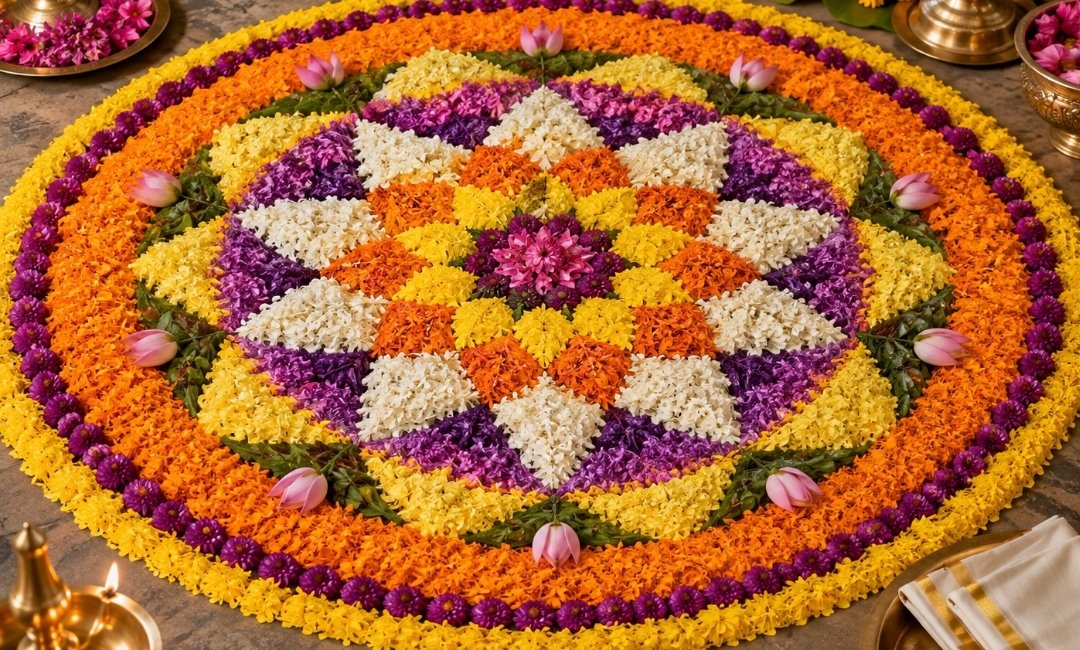
So is the pookkalam.
At home, my mother would prepare the ground with a thin layer of cow dung paste before arranging flower petals into increasingly elaborate patterns over the 10 days. She also made small clay figures called Thrikkakarappan, representing Mahabali and Vamana. I would help her, and whenever rain appeared, we would rush outside to move the figures to safety before they dissolved.
Today, when I see children in California carefully arranging flowers for a pookkalam, I think of that little ritual of running outside with my mother. The flowers have changed; the memory has not.
Onam also brought Kerala’s cultural traditions into the open. Thiruvathirakali, performed in a circle around a traditional lamp, was part of celebrations at temples and community halls. In different parts of the state, there were distinctive traditions such as Thrissur’s Pulikali, with performers painted as tigers, and Onathallu, the traditional martial art associated with my home district of Palakkad.
Village games such as vadamvali, Uriyadi and Talappanthukali brought everyone together. That communal spirit is perhaps what I notice most at Onam celebrations here. The games may take place on an American school field or community center lawn rather than in a Kerala village, but the instinct is the same: get people outside, make them laugh and turn strangers into participants.
Then there is the Sadya, the grand meal served on a banana leaf.
I was the odd one out in my family. While everyone else happily ate rice with its many accompaniments, I preferred roti. My mother had a solution: fried potatoes. She would quietly promise me a special serving if I sat through the meal. It worked every time.
And then came payasam. I could always find room for that.
Even now, a Bay Area Sadya can transport me straight back to those meals. But what I miss is not simply the food. It is the noise around it—the conversations, cousins moving in and out, people eating together and nobody being in quite as much of a hurry as usual.
There is one Onam experience I never had in Kerala: Vallam Kali, the spectacular snake boat races. I watched them on television, fascinated by the synchronized rowing and fierce competition, but never made it to the backwaters to see one in person. It remains one of those pieces of Onam that belongs more to my imagination than my memory.
What I remember most clearly, however, is family.
When I asked friends in the Bay Area what they missed about celebrating Onam in Kerala, their answers were remarkably similar. They missed cousins, relatives and the easy togetherness that came from having an entire extended family nearby. Distance makes you realize how much of a festival is created by the people around you.
That is also why celebrating Onam in America feels different, but not necessarily less meaningful. Over the years, friends have become family. Community gatherings have filled in for neighborhood celebrations. A backyard can become a courtyard; a community center can become a village temple ground. We recreate what we can, and sometimes create something new.
This year, I will celebrate Onam in Boston with my cousins. There will be a Sadya, conversations and, I suspect, plenty of memories of Kerala woven into the day.
Thiruvonam falls on August 26, 2026, but Bay Area celebrations continue through August and into September. And perhaps that is fitting. Onam has never really been about completing a set of rituals on a particular day.
It is about making time for one another.
A restaurant Sadya can give you the dishes, but a community celebration gives you the people. And ultimately, that is what I remember most from Palakkad—and what I have come to value most in the Bay Area.
Onam was never just about what was placed on the banana leaf. It was about who sat around it.
Happy Onam! May your pookkalam stay bright, your payasam keep coming, and your conversations last well beyond the last banana leaf.
(Madathil hails from Palakkad, known as the granary of Kerala, and has been calling California home for the past 30 years.)