From Vivekananda To Today, ‘Legacy 250’ In Chicago Examines India’s Influence on America
India-West News Desk
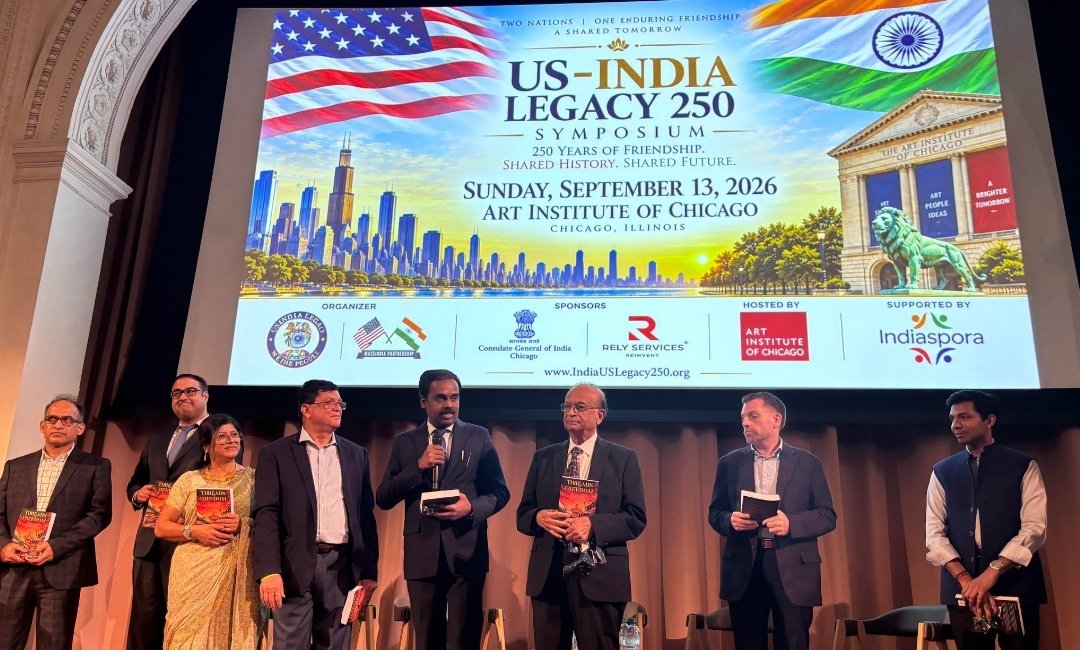
CHICAGO, IL – Congressman Raja Krishnamoorthi joined scholars, business leaders and members of the Indian American community September 13 at the Art Institute of Chicago for the US–India Legacy 250 Symposium, a program examining more than 250 years of connections between India and the United States.
Krishnamoorthi, who represents Illinois’ 8th Congressional District, used his remarks to highlight the historical influence of India and Indians in the United States and the growing role of Indian Americans in the country’s future.
“We have to remember how India and Indians influenced the development of America,” Krishnamoorthi said. “Over six million of us of Indian origin live and work in America and call it home. And you have powerfully shaped, influenced and continue to write the next chapter for America.”
He also called on Indian Americans to remain engaged in the civic life of the country as the United States approaches its 250th anniversary.
The symposium was part of Legacy 250, a yearlong initiative marking the 250th anniversary of American independence while examining the intellectual, cultural, scientific, economic and people-to-people exchanges between India and the United States. The Chicago program featured speakers from academia, business, diplomacy and the Indian-American community and explored the relationship through history, education, entrepreneurship, technology and culture.
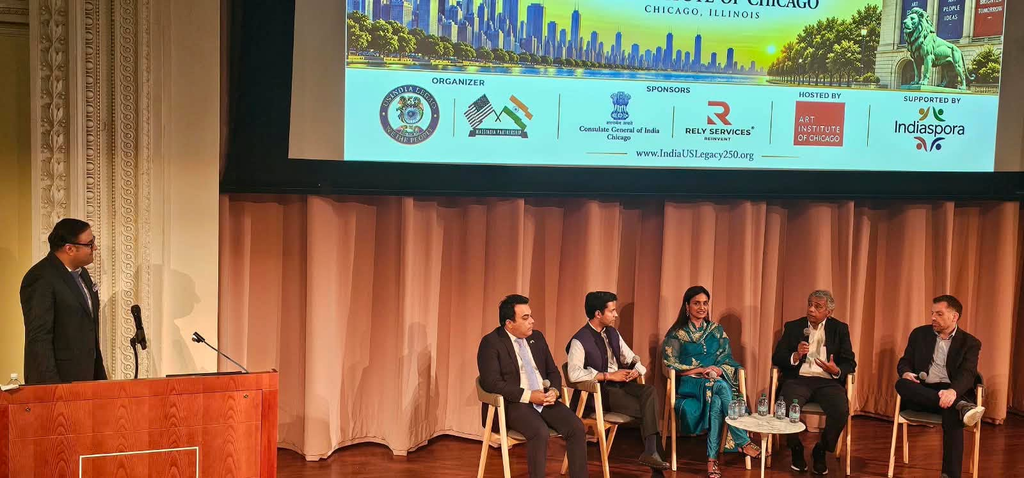
Among the featured speakers were Professor Madhav Rajan, Dean of the University of Chicago Booth School of Business; Professor James Vaughn, historian at the University of Chicago; author and business thinker Rishad Tobaccowala; oncologist and community leader Dr. Bharat Barai; Niranjana Rajagopal of Indiaspora; and neurologist Dr. Bhagwan Shahani.
Rajan said Indian Americans have a responsibility to contribute to the institutions that helped shape their lives.
“It is our obligation to support the institutions we have inherited and also build new ones as our contribution to this nation,” he said.
A panel titled “US–India Legacy 250: Past, Present & Future,” moderated by Sanjeev Yadav, Co-Convenor of Legacy 250, brought together Professor James Vaughn, Professor Dilip Gaonkar of Northwestern University, Smita Shah, President and CEO of SPAAN Tech, Arnav Dalmia, Founder and CEO of Tovie, and Neil Khot, President and CEO of Rely Services.
The panel examined the evolution of India-U.S. relations, future areas of cooperation and the expanding presence of Indian Americans in business, technology, education, culture and public life.
Dr. M. Anand Prakash, Consul General of India in Chicago, also addressed the gathering. Sara Koerber, Assistant Director of Institutional Philanthropy at the Art Institute of Chicago, welcomed participants.
India’s Ambassador to the United States, Vinay Kwatra, sent a special message to the symposium, describing Legacy 250 as “an inspiring platform.”
The Chicago venue also provided a direct connection to one of the best-known early chapters of India’s cultural engagement with the United States. The symposium was held at the Art Institute 133 years after Swami Vivekananda appeared at the World’s Parliament of Religions in Chicago in September 1893.
Swami Ishatmananda of the Vivekananda Vedanta Society of Chicago reflected on Vivekananda’s journey to the United States and the continuing relevance of his message.
Following the symposium, Koerber led guests to the Art Institute staircase display commemorating Vivekananda’s Chicago appearance, returning the program to the greeting associated with his American debut: “Sisters and Brothers of America…”
Kanchan and Haimanti Banerjee, authors and convenors of Legacy 250, said the initiative grew out of research into connections between India and the United States that they said are often overlooked.
Those connections include trade during the era of the American Revolution, the influence of Indian thought on Ralph Waldo Emerson and Henry David Thoreau, Vivekananda and the spread of yoga in America, Mahatma Gandhi’s influence on the American Civil Rights Movement, scientific and intellectual exchanges, immigration, entrepreneurship and the growth of the Indian-American community.
“The story of India and America is much older, deeper and more human than most of us realize,” said Kanchan Banerjee, author and Founding Convenor of Legacy 250. “Legacy 250 is about rediscovering those stories and bringing them to the next generation.”
Haimanti Banerjee, co-author and Co-Convenor, said the historical record also raises questions about the future.
“Then we must ask an even bigger question: What can these two nations and their people build together over the next 250 years?” she said. Their book, ‘Threads of Freedom: India and America, 250 Years of Shared Destiny,’ was formally released during the symposium.
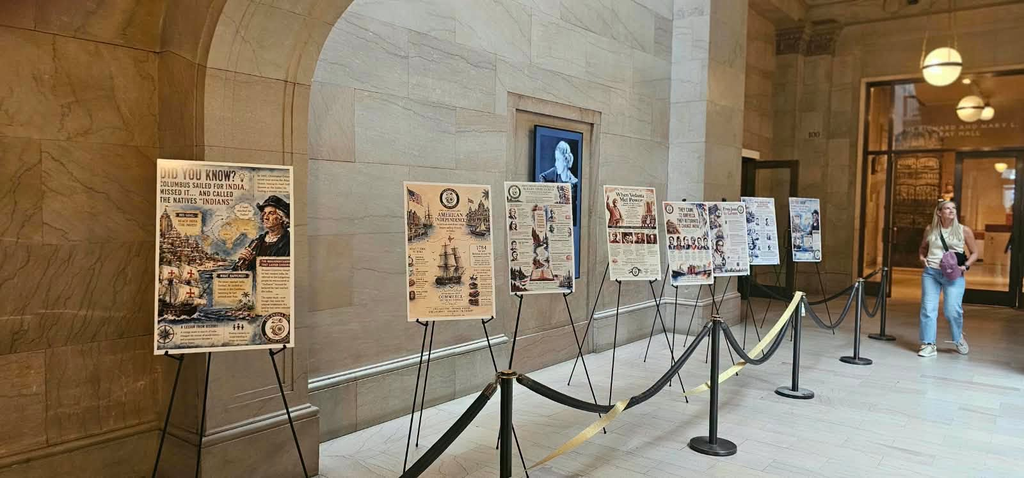
The program also featured a Legacy 250 exhibition highlighting people, events and ideas from the history of India-U.S. connections. The exhibition included artwork by artists associated with Kala Bhavana, Visva-Bharati University.
A short documentary, “250 Years in 15 Minutes,” premiered at the event, tracing connections between the two societies through commerce, ideas, spirituality, science, education, migration and innovation.
In closing remarks, Avanish Raj, Co-Convenor of Legacy 250, invited individuals, universities, museums and community organizations to participate in the initiative.
The program was emceed by Sindhu Banerjee, a recent graduate of the University of Chicago Booth School of Business.