Why Do South Asians Yearn So Much? Nobody Writes A Ghazal About Someone Who Texts Back
Part 1: No One Is Safe
By Nandini Dev
I’m 45 years old and have been single for ten years – a sentence I wish I was secure enough to write without immediately feeling the need to defend myself. Ten years is a long time, and lately I have found myself wondering whether a decade without romantic love contains some secret information about whether I will ever experience it again. My intrusive thoughts ask: Does ten years mean this is no longer temporary? Am I ugly? Unlovable? Not enough? Too much?
There are moments when giving up sounds peaceful. I fantasize about deciding once and for all that romantic love simply isn’t going to happen for me and closing that door. Yet I have built a life that does not revolve around finding a partner. I go where I want and do what I want, often alone, with close girlfriends who remind me that a fancy date for a man is often just a regular Tuesday night with the girls. Still, I cannot convince myself that I no longer want romantic love. I wonder whether the problem is not acceptance, but that I come from a culture that has spent thousands of years perfecting the art of wanting.
I recently told my brand-new South Asian therapist that I have a theory: being from our part of the world is a curse, and the curse is that all we do is yearn. Then I look at everything that taught me how to want.
As a Bengali, I know that we yearn. Punjabis yearn. Gujaratis yearn. After a lifetime of our music and films, I feel fairly confident no one has escaped the affliction. Across South Asia, we have spent centuries staring at the moon, writing poetry about people we cannot have, and singing about lovers who disappeared twenty years ago. We do not just miss people; we make art out of missing them.
As a Bengali, I was probably doomed the first time my parents made me listen to Rabindra Sangeet or read me a poem from Gitanjali. Bengali culture has always seemed particularly enamored with the beauty of melancholy. In a Rabindra Sangeet, your longing does not even belong to you alone: the flowers know you are lonely, the evening knows someone has left you, and the gathering clouds at dusk are somehow implicated in whatever is happening inside your heart.
There is something almost comically Bengali about our refusal to experience an emotion at a reasonable volume. We cannot simply miss someone; we must miss them while contemplating the stars, preferably during the monsoon. Sometimes that yearning grows larger than one person. Bhupen Hazarika and Runa Laila singing Ganga Amar Ma turns the ache toward rivers, homelands, and identity. I barely held it together when my mother first played it for me, and I still cannot listen to it with anyone else in the room.
Punjabis suffer from the same disease but have responded by adding a dhol. I have always found something wonderfully absurd about Punjabi heartbreak music because it is entirely possible to dance to a song whose emotional content is essentially: a woman ruined my life and I have not experienced a moment of peace since. The dhol says, “Let’s celebrate!” while the singer describes betrayal, abandonment, or lost love.
Punjabi yearning long predates recorded music. Heer and Ranjha, Sohni and Mahiwal, Mirza and Sahiban: stories built around separation, social boundaries, sacrifice, and death. Suffering became almost inseparable from proof that the love mattered. Then Talwiinder arrived in the twenty-first century with Khayaal and essentially asked, “What if we put some reverb on this South Asian emotional damage?”
Pakistan has its own vast archive of longing. My life has also accumulated hot, artsy Pakistani men with glasses and beards, terribly my type -who then ghosted me, which feels almost too on-brand. In ghazals and qawwalis, romantic and spiritual yearning blur until you cannot tell whether the singer is grieving a person or God. Faiz Ahmed Faiz could begin with one beloved and expand that longing until it held an entire country, Nusrat Fateh Ali Khan could stretch one cry of “Jaaniya” across generations of separation, and Coke Studio Pakistan proves the tradition is alive: centuries-old yearning, now with immaculate production.
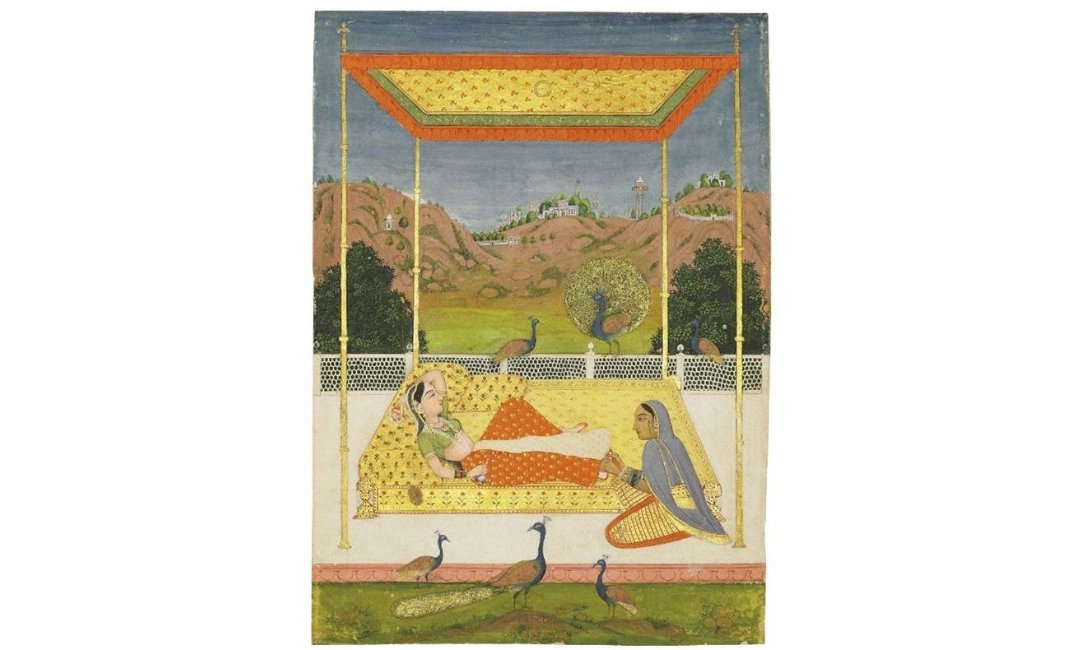
There is even a word that appears throughout the region’s poetic traditions: hijr, separation from one’s beloved. I find it both beautiful and slightly alarming that South Asians have spent enough time thinking about this condition to give it its own vocabulary.
The rest of the subcontinent is not escaping the allegations, because longing has crossed every border. Nepali music carries longing shaped by migration and mountains and South Indian cinema is full of lovers separated by duty, timing, and fate. A. R. Rahman alone has composed enough aching romantic music to sustain generations of people staring wistfully out of windows. Apparently leaving the motherland does not cure it either. Zayn Malik was born in Bradford, England, and makes global pop largely in English, yet in Tightrope, when lines from Chaudhvin Ka Chand Ho arrive, I have zero defenses left. You can be half white, born in England, become an international pop star, and somewhere in the studio the ancestors still seem to burst in asking, “Mr. Malik, have you considered yearning more dramatically?”
Like I said: no one is safe.
For those of us who grew up in the ’90s, Bollywood taught us what love was supposed to look like. Romance required bad timing, separation, and possibly a chiffon sari in weather highly inappropriate for chiffon. Even happy endings required suffering first. Hum Dil De Chuke Sanam posed the question: “Is the great love of your life the person whose absence causes the most pain, or the person who stays and loves you well?”
Part 2: Maybe We Have Suffered Enough
South Asians did not invent forbidden love, but we come from cultures in which romantic love historically existed alongside family obligation, caste, and reputation. For many people, loving someone did not mean being free to choose them. There were countless reasons to miss someone who was still alive, perhaps still nearby, and nevertheless impossible to have. Then history gave us other forms of separation. Partition divided families, languages, and lovers. Migration produced generations who missed a home they remembered, a home that had changed, or even one they knew only through family memory.
There is something deeply human about missing what we have never had. I can feel nostalgia for an India that exists for me through family memories, old photographs, music, food, language, and imagination. The feeling is real even if the memory is not technically mine.
I have begun to wonder whether I do something similar with love.
I have been single for ten years. There is no particular man at the center of that sentence, no great lost love whose return would resolve the story. What I miss is harder to explain: someone beside me, someone who knows the mundane details of my life, hears the stupid story from work, holds my hand, and is simply there often enough that his presence stops feeling remarkable.
Perhaps yearning does not always require a beloved. Sometimes absence itself is enough.
But there is a danger in becoming too good at making absence beautiful. When you know how to romanticize what is missing, the absence of love can begin to feel like the defining fact of your life. You can become so preoccupied with the person who is not there that you stop noticing how much of your life already is.
Maybe that is the antidote to South Asian yearning—not wanting less, but learning that absence does not have to consume the present. I can let yearning belong to music, monsoon rain, old movies, and songs played too loudly in my car. I can want someone beside me without interpreting that ache as evidence my life is incomplete. I can still visit the land of yearning; I just don’t have to sign a lease there.
And perhaps, if someday that man is beside me when an old Talat Mahmood or Gita Dutt song comes on, I will finally experience something our songs and films have rarely bothered to teach us. Nobody writes a ghazal about the person who texts back on time. Amitabh Bachchan has never stood in a field of rice paddies, lip-syncing passionately about consistent emotional availability. Nobody collapses dramatically against a tree because their partner communicates clearly, follows through on plans, and comes home when they said they would.
But maybe we have suffered enough.
There is an entirely different kind of romance in not having to miss someone at all. Some feelings belong in poems or songs because they are much better suited to a ghazal than a life. Maybe the person worth loving will not be the one who makes me ache. If I am very lucky, maybe he will just be there.
(Dev is a librarian based in Long Beach, California.)