As Politics Shift, U.S. And Indian Businesses Discuss Building For The Future In Santa Cruz
By Fiza Najeeb
SANTA CRUZ, CA – During the 9th US-India Conference on October 8, industry leaders from both India and the U.S. addressed opportunities for strategic collaboration, despite strained diplomatic relationships between the two countries.
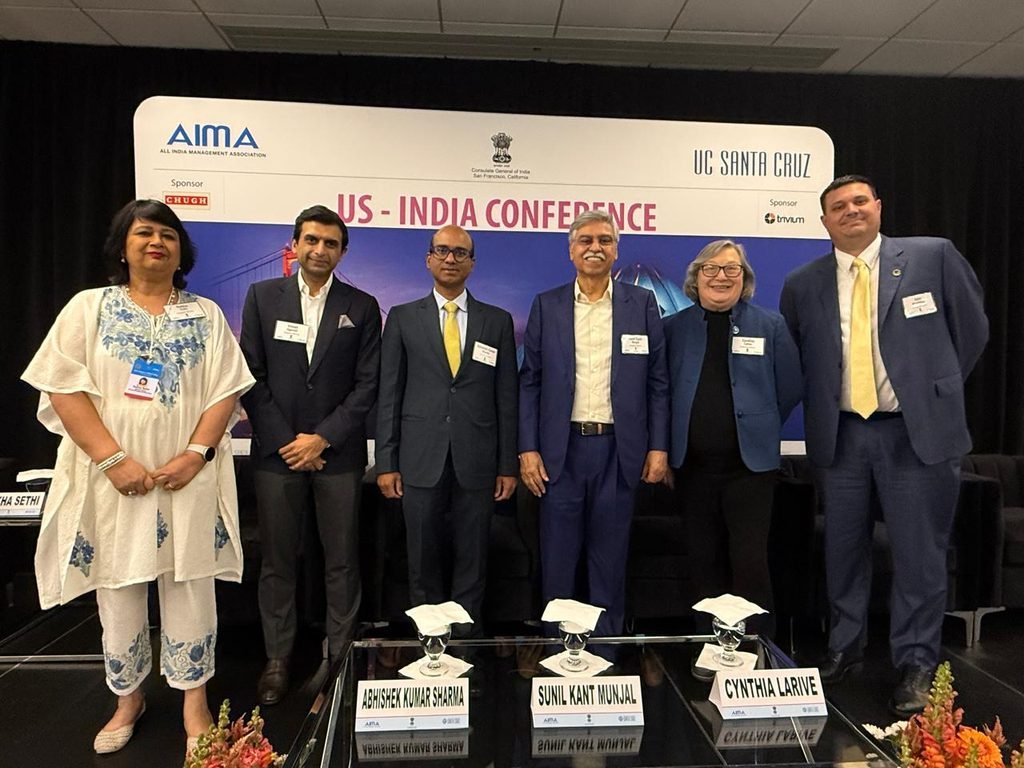
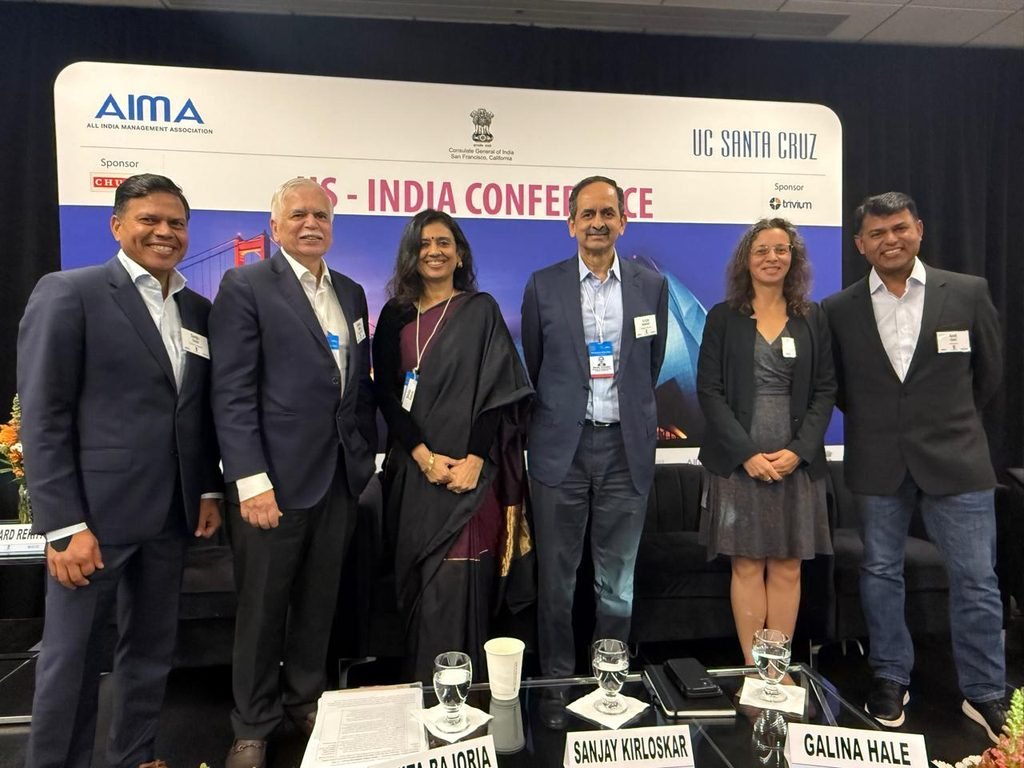
Hosted by the All India Management Association (AIMA), UC Santa Cruz and the Consulate General of India in San Francisco, and sponsored by Chugh, LLP and Trivium, the conference brought together multiple stakeholders, including investors, industry leaders, policymakers, attorneys and academics, to discuss shared challenges and understand opportunities for collaboration that will foster innovation and advance the economic interests of both countries.
Arun Kumar, Managing Partner at Celesta Capital, identified three different layers that make up the relationship between India and the United States: people-to-people, business-to-business and state-to-state. While the state-to-state relationship is “under severe threat,” people-to-people and business-to-business relationships remain strong.Conversations held during each panel discussion made clear that despite the tenuous relationship at the state level, there are opportunities for business and other leaders from both countries to address shared challenges and pursue opportunities for strategic collaboration.
Nationalism and Interdependence
The relationship between the U.S. and India has long been seen as beneficial to both countries “and [beneficial] for the promotion of global peace, stability, economic growth and prosperity;” on numerous occasions the relationship between India and the U.S. has been regarded, as the “most defining relationship of the century.” According to Vineet Agarwal, senior vice president of AIMA and Managing Director of Transport Corporation of India Ltd., the relationship between the U.S. and India “has scale and depth that would have been difficult to imagine a few decades ago.” For the first seven years of the US-India Conference, it was safe to assume that the strategic partnership between these two countries would only strengthen, said Vikram Chandra, founder of Editorji Technologies, who moderated the second panel.
Recently, however, policies passed under the Trump administration have called this assumption into question.In his first inauguration speech, President Trump declared his priority was “America first,” and his commitment to nationalism has amped up during his second term.7 But it seems as though Trump’s approach has yielded mixed results.
According to Kumar, “while America is doing really well, there have been many large sections of the American population that have lost jobs. Manufacturing was hollowed out in this country.”Despite President Trump’s mantra of “America first,” diplomatic relationships are not contrary to the U.S.’s economic prosperity. Kumar points out that global trade agreements would be beneficial to the U.S. because they would allow the U.S. to “take advantage of the benefits of a larger market” as countries rise.
Ian Klaus, founding director of Carnegie California and a former State Department official, described a shift that he’s seen over the last 25 years. He said there was a rupture between the idea of foreign policy and domestic policy, and there is no longer a bipartisan assumption that once linked the two. As a result, political leaders can take “volatile action in the international arena” while voters are unable to see the ripple effect those actions have on their own domestic well-being.
In August 2025, the relationship between India and the U.S. took a sharp turn when President Trump signed an executive order imposing tariffs on India for its direct or indirect importation of Russian oil. Earlier this year, the relationship seemed on the mend as the U.S. and India reiterated their commitment to the Bilateral Trade Agreement (BTA) and agreed to “strengthen economic security alignment to enhance supply chain resilience and innovation through complementary actions.” On Oct. 10, Commerce and Industry Minister Piyush Goyal announced that “circumstances have changed” and that the BTA will be finalized taking these changed circumstances into consideration.
But the relationship between India and the United States is not only a matter of state policy; it also includes the growing economic ties between the two countries. “Trade has grown substantially and businesses on both sides are becoming more integrated into each other’s economies,” said Agarwal. “From a business perspective, the question is no longer whether this relationship matters. It is how we translate strategic intent into lasting economic value.” For Agarwal, “the real opportunity [for both countries] is in combining capabilities.”
U.S. corporations have become an integral part of India’s economy. For many years, U.S. companies outsourced work to India, contracting with Indian firms that staffed teams and provided the required services. This relationship fueled stereotypes that India is a source of cheap labor that best provides routine back-office and IT work. Mihir Shukla, co-founder, chairman and CEO of Automation Anywhere, gave context to this stereotype: The U.S.-India relationship “historically was based on a different premise,” when “India wasn’t as large an economy as it is today,” and “it was constructed around cheap labor.”13 Today, Indian talent increasingly does more substantive work for U.S. companies such as research and product development, a shift reflected in the rise of global capability centers.
Global capability centers, or GCCs, shift away from the outsourcing model of business. Rather than contracting with third parties, the U.S. company itself establishes an office in India and employs local talent. In doing so, GCCs directly contribute to India’s economy. According to Abhishek Kumar Sharma, consul (economic and visa) at the Consulate General of India in San Francisco, GCCs provide employment to around 2.36 million people and generated around $98.4 billion in revenue last year, while U.S.-India trade in goods and services reached about $214 billion.
India has also become a significant player in the global economy. India has the third-largest startup ecosystem in the world, with more than 200,000 registered startups that provide opportunity in AI, health, clean energy, climate, agriculture and various other fields.Indians significantly contribute to the U.S. economy by providing talent. GCCs in India are able to rely on India’s highly skilled and educated talent pools. Sharma said within the United States, there are more than 5 million people of Indian origin, and many tech companies are led by Indian-origin CEOs. They also bolster the U.S. economy through the contribution of their talent as “engineers, entrepreneurs, doctors” while maintaining ties to their country of origin.
In addition to contributing talent, Indian companies are now investing in the U.S., “creating businesses, generating local employment and building capabilities” in areas of deep collaboration such as “AI, semiconductors, data centers, energy transition, electrical mobility, space, and defense.”Richard Rekhy, vice chair of Grant Thornton Bharat, pointed to India’s Reliance Group, which is building the first new refinery in the U.S. in about 40 years. In response to the moderator’s inquiry, panelist Sanjay Kirloskar, chairman and Managing Director of Kirloskar Brothers Ltd., affirmed that his India company already manufactures in the United States under a different name, in an operation that is run by his son.
Given the extent of India and U.S. businesses’ respective investment in the other country’s economic operations around manufacturing, trade and supply, there are opportunities to strengthen and continue partnerships irrespective of the diplomatic tension on the state-to-state level.
Trust And Collaboration
AI technology has accelerated at an unprecedented rate. Shukla, co-author of “The Five-Year Century,” predicts a century’s worth of change within the next five years, noting that more code has been generated in the last 12 months than in the entire history of coding. Multiple panelists commented that the rate at which technology has advanced could once only have been imagined in science fiction. The speed at which AI continues to develop and transform raises questions about how industry leaders will continue to scale innovation and train tomorrow’s workforce to adapt to a future fraught with uncertainty. Throughout the conference, panelists emphasized the importance of building trust and keeping humans at the center of discussions. Preparing for a future no one can predict, they said, will require collaboration across industries.
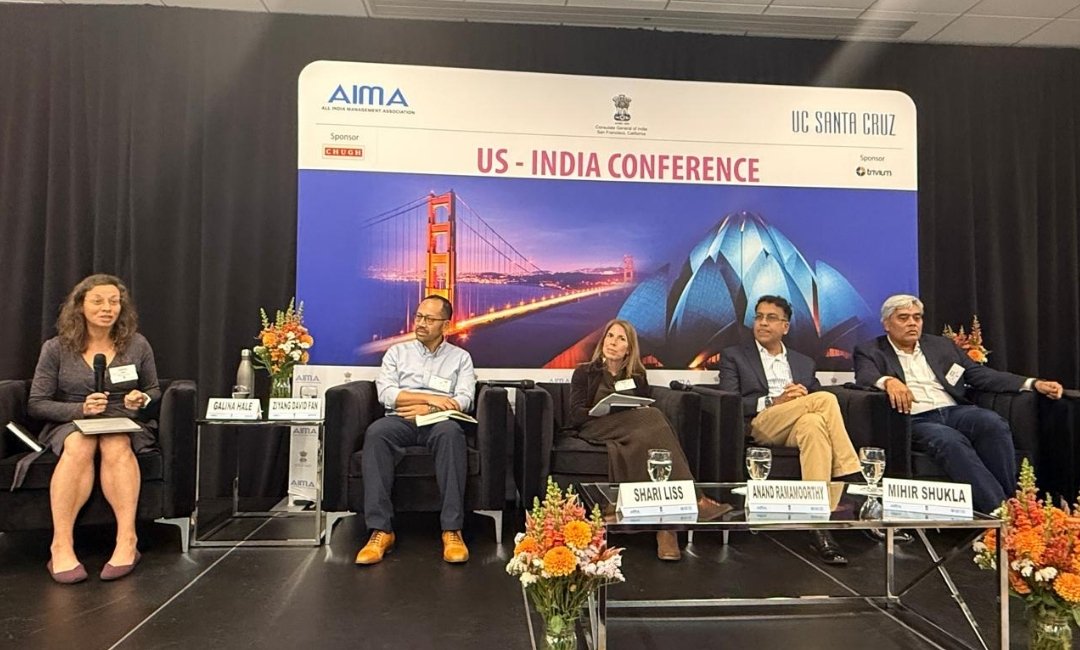
Galina Hale, a professor of economics at UC Santa Cruz, opened the panel she moderated by posing a question to all panelists: “What do you see is the single biggest bottleneck to scaling innovation in the world where you are in?”24 Shukla began by identifying leadership as the single biggest obstacle and greatest strength. “Talent is evenly distributed,” he said, but the moment calls for “an entrepreneurial spirit” to “reimagine possibilities, restructure operating models, start with a day zero mindset.”
Anand Ramamoorthy, Managing Director of Micron India, pointed to “a general asymmetry” across “the whole innovation value chain.” “I get very smart people but don’t have domain context,” he said, adding that “trying to bridge that asymmetry is where [they] spend most of [their] time.”26 Shari Liss, vice president of global workforce development at SEMI, a semiconductor industry association, said the biggest challenge is building talent regardless of the unknowns, in an industry that needs 2.6 million workers worldwide. Ziyang David Fan, executive director of the Institute for California AI Policy, works to “bridge the folks who are building AI with the folks who are governing AI.” “Innovation happens at the speed of software but scaling happens at the speed of trust,” he said. The best technology is critical, Fan added, but the right governance framework is what will take it to the next level.
Hale turned to Ramamoorthy, asking him to share lessons he learned from Micron India’s experience after it built India’s first commercial chip plant “from agreement to production in less than three years.” Ramamoorthy began by describing the advantage Micron gained by starting operations in India “quite late to market” compared with its chip peers, which allowed Micron to access “all the different templates that have worked and not worked in front of [them].”He acknowledged the cost advantage of hiring talent in India but said this “can’t be the only defining factor for any operation.”One of the primary factors that contributed to Micron India’s ability to build a significantly sized clean room in Gujarat was trust. “CEOs don’t make trust decisions based on pure policy only,” Ramamoorthy said. “Incentives can only take you so far, you got to have trust in the local ecosystem. Today, Micron employs more than 8,000 people in India, less than seven years after it began operations.
In his opening remarks, Sunil Kant Munjal, chairman of The Hero Enterprise and past president of AIMA, identified talent and workforce development as one of the biggest challenges resulting from the acceleration of AI. “The pace of transformation is absolutely staggering,” he said, adding that with the rapid growth in technology, “it almost appears that you’re being pushed out of the equation.” “What does it mean for trade? What does it mean for education?” he asked. The technology will “create many more opportunities,” Munjal said, “but before it does, it will create many more job losses and then these folks will have to be retrained and reskilled in a whole new set of opportunities … What are those jobs? What are those skills? We have no clue right now.”
Liss said that while no one can predict the competency models the future will require, employers will need people who can continue to learn and change. Even before AI, companies wanted “learners that can learn with [them] and change.” In the face of this uncertainty, she said, “we need to build learners who can be agile in this world because it is changing so quickly.”Alongside technical skills, Liss said, “those abilities to function as a team, those abilities to lead and teach others” will be “the human element of what will carry us into this next age.”
Liss also stressed the importance of collaboration. “We can’t continue to compete for talent,” she said. “We need to build really strong talent pools across the globe.” Liss called for industry, academia and government to share best practices on workforce development, “because in order for this industry to work globally, we need to [rely] on one another.”
Throughout the conference, panelists returned to the idea that the future of the U.S.-India relationship will not be decided by governments alone. “The aspirations of the people cannot be curtailed by politicians anymore,” said Agarwal. “There is no choice now but growth and development for the India-U.S. relationship.” Munjal noted that despite regulations meant to discourage trade between some countries, trade has still grown. “It has a life of its own,” said Munjal. “But it’s not just about trade. It is about people. It is about culture. It is about the arts. It is about education. At the end of the day, it is all and must be about people.”
Munjal said that both India and the U.S. have “an enormous opportunity” to build “a much more enduring turn to this relationship.” Munjal adds that unanimity may never be possible, but “broad alignment” should be the goal. Achieving this will require “a collective effort not just from industry and commerce and business but also from the academics … the researchers … the innovators … the policy makers … the scientists … the health care professionals.”42 Leaders must look beyond export and import numbers and “see what we can do together for ourselves, for each other and for the world … figure out how to solve not just your own problems but each other’s problems because that’s how you congregate communities. That’s how you build societies.” Munjal concluded: “A society which feeds the entire ecosystem is the one which prospers.”