New Collection Explores Yogananda’s Teachings Through Daya Mata’s Eyes
India-West News Desk
LOS ANGELES, CA – The teachings of Paramahansa Yogananda were never meant to be confined to monasteries or ashrams. They were intended for people navigating the demands, uncertainties and distractions of everyday life, according to Sri Daya Mata, one of his closest disciples.
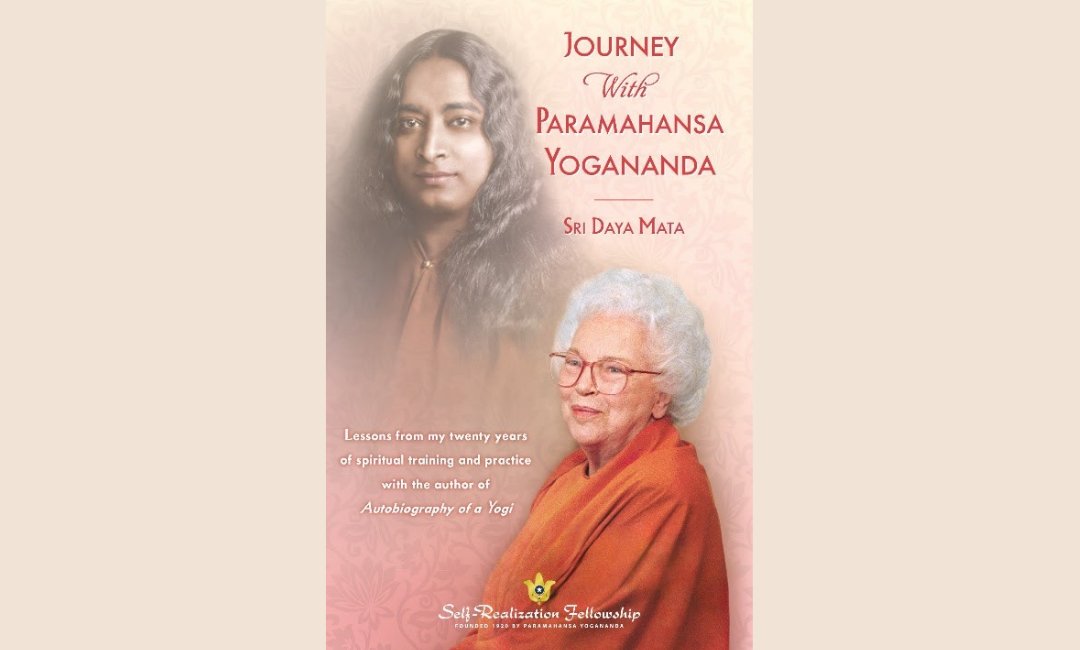
That message runs through ‘Journey With Paramahansa Yogananda: Lessons From My Twenty Years of Spiritual Training and Practice With the Author of Autobiography of a Yogi,’ a new collection of 49 talks by Daya Mata, released November 9 by Self-Realization Fellowship.
Drawing on more than two decades of personal training and spiritual instruction under Yogananda, Daya Mata explores how his teachings can be applied to meditation, relationships, personal responsibilities and the search for a deeper connection with God. The 464-page book, which includes 20 photographs, also offers recollections of the spiritual leader who helped introduce India’s ancient science of yoga to a global audience.
The book’s central premise is that spiritual realization is not reserved for those who withdraw from the world. It is possible amid the pressures of ordinary life, Daya Mata emphasized.
“Part of [his] message is that the experience of God is not reserved for those who live in ashrams and monasteries,” she said. “It is intended for all of humanity. You don’t have to fly away to a Himalayan cave! You can find Him wherever you are. The more chaotic your life is, the more you need to find Him.”
She described yoga not as a religion but as a science rooted in the work of ancient Indian sages who explored the inner realm of the soul.
“Yoga is not a religion but a science, developed in ancient India by the rishis, who were scientific researchers in the inner realm of the soul,” she said. “The fundamental principle is that man is a divine being, made in God’s image; and that the purpose of life is to realize or uncover that divinity within.”
The collection addresses concerns that remain relevant in contemporary life, including constant busyness, anxiety over an uncertain world and the pursuit of outward success. Rather than treating meditation as an activity separate from daily responsibilities, Daya Mata explains how its practice can influence one’s conduct throughout the day.
“If you meditate and then try during activity to keep the mind centered in the Divine, you automatically begin to express balance in your life,” she said. “And you become a calmer human being, operating not from emotion but from a deeper state of inner quietude.”
Alongside its spiritual guidance, the book provides a personal portrait of Yogananda through Daya Mata’s memories of the years she spent with him. She recalls a teacher who made time for visitors, listened attentively to their concerns and never gave them the impression that he was in a hurry.
Her recollections also reveal a lighter side of the spiritual leader. Yogananda enjoyed laughter and occasionally brought his disciples together for badminton. Daya Mata remembered that the games rarely ended in their favor.
“And I tell you, we could never win,” she recalled. “He got us every time!”
Daya Mata’s perspective carries particular significance because of her long association with Yogananda and her role in preserving his teachings. For more than 20 years, she received his personal spiritual instruction and put his lessons into practice. She also recorded his lectures, classes and informal talks in shorthand, later transcribing them for publication.
After Yogananda’s death in 1952, she continued his work. In 1955, she became president of Self-Realization Fellowship, the organization he founded in 1920, and served as its spiritual head for more than 55 years, until her death in 2010.
Born in 1914, Daya Mata was chosen and trained by Yogananda to lead the organization. Her name signifies compassion, and through her talks, writings and recordings, she sought to make his teachings accessible to people of different faiths and backgrounds.
The new collection is the third major compilation of her talks published by Self-Realization Fellowship. Its release also coincides with the 80th anniversary year of ‘Autobiography of a Yogi,’ Yogananda’s spiritual classic, first published in 1946 and widely regarded as an influential introduction to India’s spiritual traditions for Western readers.
Speaking at Self-Realization Fellowship’s 2026 World Convocation, the organization’s current president and spiritual head, Brother Chidananda, described the book as particularly timely.
Yogananda arrived in the United States in 1920 as an invited delegate to an International Congress of Religious Liberals in Boston, where he delivered a speech titled “The Science of Religion.” That year, he founded Self-Realization Fellowship to disseminate his Kriya Yoga teachings. The organization now has more than 600 temples, centers, retreats and ashrams worldwide. Its work in India and neighboring countries is carried out through the Yogoda Satsanga Society of India, which has more than 200 locations.
Journey With Paramahansa Yogananda, hardcover ($26.50), paperback ($17.95) and e-book ($9.99) editions available through the Self-Realization Fellowship Bookstore and Amazon.