Hasina Factor, Ganges Treaty Put India-Bangladesh Ties To Test
NEW DELHI-Bangladesh is facing renewed political unrest over former Prime Minister Sheikh Hasina’s proposed return from India, while uncertainty over the renewal of the Ganges Water Sharing Treaty, due to expire next month, poses another challenge for relations between Dhaka and New Delhi.
Street violence, arson and clashes with police have been reported in several parts of Bangladesh amid protests by ready-made garment workers demanding higher wages and the mobilization of Awami League supporters ahead of Hasina’s expected return in December.
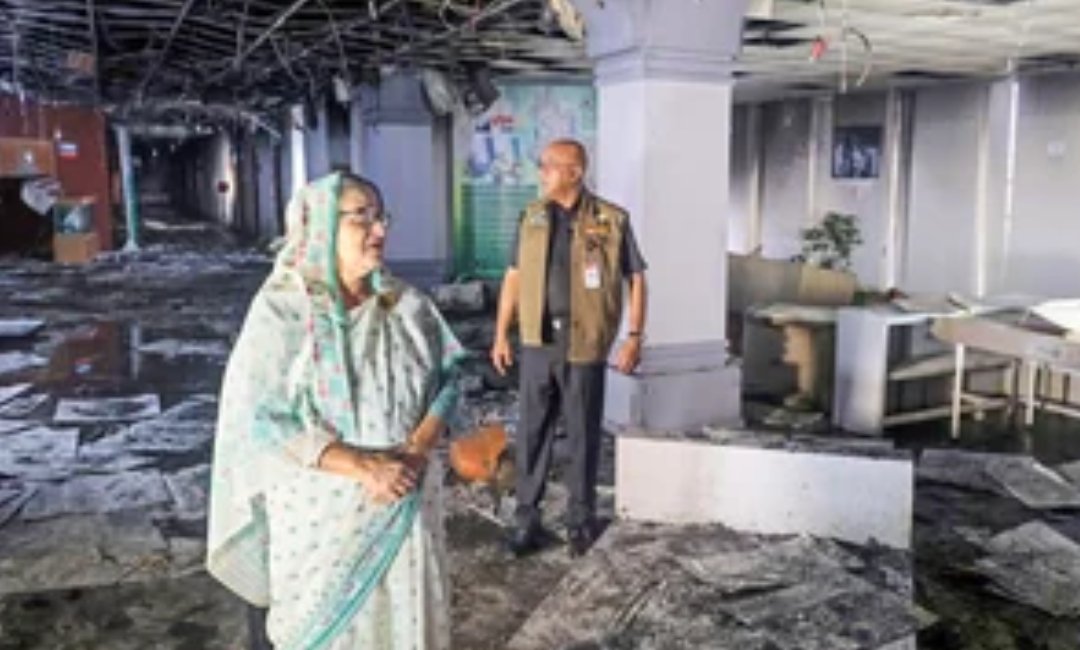
The 79-year-old former Prime Minister was sentenced to death in absentia by Bangladesh’s International Crimes Tribunal last year over alleged crimes against humanity linked to her government’s crackdown on protesters during the July-August 2024 uprising. Hasina has rejected the charges.
She has repeatedly expressed her intention to return to Bangladesh and face legal proceedings. Hasina and other Awami League leaders have indicated their willingness to surrender before the courts. Dhaka, however, has sought her extradition from India, with government figures suggesting that the death sentence could be carried out.
The renewed demonstrations have added to political tensions as the Bangladesh Nationalist Party (BNP) government led by Prime Minister Tarique Rahman grapples with the unrest.
Meanwhile, with the 1996 Ganges Water Sharing Treaty set to expire on December 12, uncertainty surrounds the future of negotiations between the two countries.
An article published in Bangladesh’s ‘The Daily Star’ on Nov. 18 recalled that India’s High Commissioner to Bangladesh, Dinesh Trivedi, had said on August 9 that a meeting between the two Prime Ministers could help resolve bilateral differences.
“I think if the two leaders meet, a lot of problems can be solved,” he was quoted as telling reporters.
Humayun Kabir, a former Bangladesh ambassador to the United States, also told the newspaper that a meeting between the two leaders could help secure an interim arrangement or an extension of the treaty while a new agreement is negotiated.
“If the two Prime Ministers meet, they can agree in principle to either extend it (Ganges Water Treaty) for another term or extend it for a short-term pending a new agreement, or even think of extending it for a year or two to review the same,” he said.
A BBC report in August noted that India was keen to host Rahman for talks following his Bangladesh Nationalist Party’s victory in the February parliamentary elections. Such a visit would be his first to India since taking office. However, Dhaka has yet to respond to New Delhi’s invitations for a meeting between the two leaders.
Bangladesh has remained politically polarized since Hasina’s ouster in August 2024. Her declared intention to return in December has added to tensions, with the Awami League’s political future closely tied to her return.
BNP leaders have accused the Awami League of attempting to destabilize the country ahead of Hasina’s return. The government has portrayed the return bid as an attempt by a banned political force to create unrest, while Awami League supporters maintain that Hasina is seeking a legal and political comeback and reject allegations that she is directing violence from India.
The current unrest also reflects wider economic and political pressures, including labor disputes, grievances arising from the 2024 uprising and the exclusion of the Awami League from formal politics. (IANS)