Google Breaks Ground On $15 Billion AI Hub In Visakhapatnam
India-West News Desk
MOUNTAIN VIEW, CA – Google on April 28 broke ground on its largest India investment to date, launching a massive artificial intelligence hub in Visakhapatnam that is expected to anchor a new digital and industrial corridor aligned with the country’s ‘Viksit Bharat’ vision.
Developed in partnership with AdaniConneX and Nxtra by Airtel, the project will create a gigawatt scale AI ecosystem spanning three data center campuses. The initiative is part of Google’s broader $15 billion investment plan in India over five years, aimed at accelerating AI adoption, expanding cloud infrastructure, and strengthening digital services nationwide.
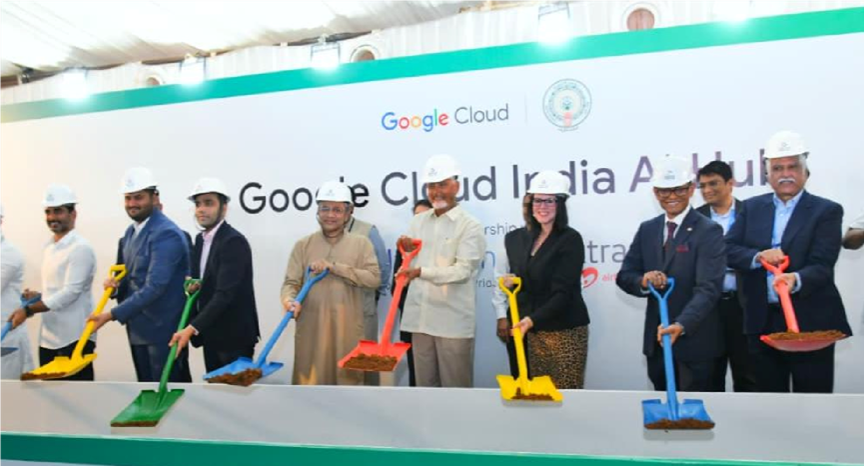
The foundation ceremony at Tarluvada was attended by senior government and industry leaders, including Union IT Minister Ashwini Vaishnaw and Andhra Pradesh Chief Minister N. Chandrababu Naidu, underscoring the project’s strategic importance to India’s technology ambitions.
Vaishnaw said the AI hub reflects Prime Minister Narendra Modi’s vision of positioning India as a global technology leader, adding that subsea cable infrastructure linked to the project would further strengthen the country’s digital backbone. Naidu described the investment as a cornerstone of Andhra Pradesh’s emerging tech corridor, expected to generate high value employment and attract global innovation.
Industry leaders framed the project as a turning point in India’s AI infrastructure buildout. Thomas Kurian said the hub marks “an inflection point for the country’s AI native future,” while Jeet Adani emphasized that large scale, energy efficient infrastructure would determine India’s competitiveness in the next phase of digital growth. Bharti Airtel Vice Chairman Gopal Vittal highlighted the role of high speed fiber networks, green power, and low latency systems in enabling world class AI capabilities.
Beyond infrastructure, the project integrates an expanded fiber optic network under the America India Connect initiative and a long term clean energy strategy aligned with India’s target of 500 GW non fossil fuel capacity by 2030.
Google also outlined a series of community focused programs tied to the development, including watershed management, digital skilling, and support for women led enterprises. Partnerships with local organizations aim to train thousands of workers, modernize coastal livelihoods, and expand access to AI and cloud education.