Capitol Hill Voices Strong Support For India
WASHINGTON, D.C.-US lawmakers, senior administration officials and Indian diplomats voiced strong bipartisan support for deeper India-US ties, calling for closer cooperation on trade, technology, defense and immigration while warning against the rise of anti-India and anti-Hindu sentiment in the United States.
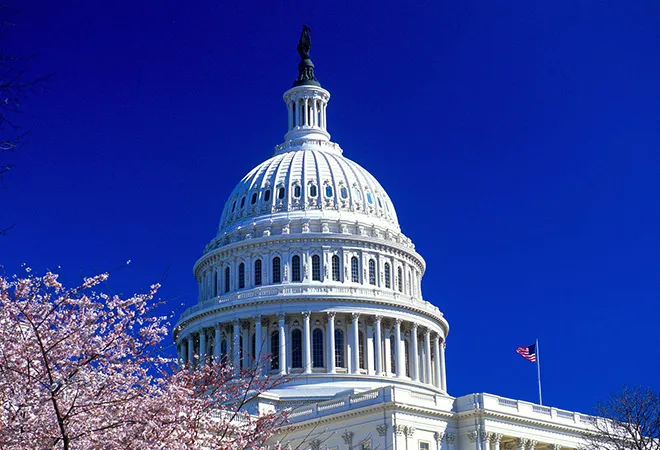
The message emerged repeatedly during the fourth annual Capitol Hill advocacy event organized by the Foundation for India and Indian Diaspora Studies (FIIDS), which brought more than 150 delegates from 25 states to Washington for meetings with members of Congress and Senate offices on issues affecting both the bilateral relationship and the Indian-American community.
Senator Roger Marshall of Kansas praised Indian Americans as one of the country’s most successful immigrant communities and said their achievements offered a powerful answer to critics of legal immigration.
“Every single time someone questions whether legal immigration works, you’re the answer, you’re not the argument, you’re the answer,” Marshall said.
He noted that Indian Americans account for less than two per cent of the US population but play an outsized role in business, medicine and innovation.
“You didn’t just come to America, you helped build it,” he said.
Marshall described India as a rapidly rising economic power and a crucial strategic partner for the United States in the Indo-Pacific, calling for stronger economic and strategic cooperation between the two countries.
While acknowledging trade imbalances between the two countries, Marshall said the relationship remained far below its potential and called for expanded market access, stronger economic ties and reforms to legal immigration pathways.
Congressman Sanford Bishop of Georgia said the United States and India must continue strengthening cooperation across economic and security issues.
“We must ensure that H visas for skilled workers and visas for students remain available in the United States,” Bishop said.
He also called for closer cooperation to “counter the rising threat in China”, strengthen supply chains and expand counterterrorism efforts.
Bishop further urged lawmakers to confront anti-Hindu prejudice.
“We must be vigilant in our efforts to recognise and address Hindu phobia here in the United States,” he said.
Congressman James Walkinshaw of Virginia described India as an indispensable partner in promoting a free and open Indo-Pacific.
“The US and India work together to promote a free and open Indo-Pacific to counter coercion and aggression from the People’s Republic of China,” he said.
Walkinshaw also pressed for reforms to America’s immigration system.
“We have to address country caps. We have to modernise our immigration system and ensure that America remains the premier destination for innovative researchers and professionals,” he said.
Veteran California Congressman Brad Sherman, a long-time advocate of closer ties with India, pointed to his efforts to reduce visa backlogs and expand opportunities for Indian professionals seeking to work in the United States.
Congressman Bill Huizenga of Michigan, chairman of the House Foreign Affairs Subcommittee on South and Central Asia, said the two countries shared a commitment to a “free, open and secure” Indo-Pacific and expressed optimism about ongoing trade negotiations.
“I’m eager to see a resolution to the new trade deal,” Huizenga said, adding that discussions were “at the one-yard line”.
Congressman Raja Krishnamoorthi of Illinois warned that Indian Americans were increasingly confronting prejudice despite their success.
“There is the rise of anti-Hindu, anti-Indian, anti-Desi hate,” he said.
Referring to recent attacks directed at him, Krishnamoorthi declared: “I’m not going anywhere.”
He urged Indian Americans to become more politically active and seek elected office at every level of government.
“It’s time to run for office,” he said. “If you don’t have a seat at the table, you’re on the menu.”
Congressman Suhas Subramanyam of Virginia echoed concerns about immigration delays and backlogs affecting Indian families.
“My parents came here in 1978 from India. They got their green card at the airport,” he said.
He argued that America was “missing out on so much talent from India” because of lengthy waits for green cards and visas.
Subramanyam also encouraged younger Indian Americans to become involved in public life and policymaking.
Community leaders also highlighted concerns about anti-Hindu bias. Bob Peckar, a Jewish community leader, drew parallels with rising antisemitism and cited the formation of the Hindu Jewish Coalition of America to address those challenges jointly.
Deputy Assistant Secretary of State for South and Central Asia Bethany Poulos Morrison described India as one of Washington’s most consequential partners and pointed to expanding cooperation in trade, energy, defense and emerging technologies.
“The US-India relationship is the future,” Morrison said.
Morrison also highlighted the Trump administration’s support for the ‘Mission 500’ initiative aimed at expanding bilateral trade to $500 billion by 2030. She noted that bilateral goods trade reached $149 billion in 2025 and pointed to growing cooperation in artificial intelligence, semiconductors, critical minerals, energy and defense as evidence of the relationship’s expanding scope.
India’s Deputy Chief of Mission Namgya C. Khampa called the relationship “one of the most seminal and defining partnerships of the 21st century” and said the Indian diaspora had helped transform it into a broader societal partnership.
FIIDS leader Khanderao Kand said delegates spent the day discussing Indo-Pacific security, supply-chain resilience, critical minerals, trade, H-1B visas, immigration reform and concerns about rising anti-India and anti-Hindu rhetoric. They reported broad bipartisan support on Capitol Hill for expanding engagement with India and strengthening people-to-people ties between the two democracies. (IANS)