From Desert To Dynamo: Rajasthan Leads Solar Energy Drive
JAIPUR -Once known primarily for its forts, folklore and vast deserts, Rajasthan is rapidly redefining its identity, this time as a key driver of India’s clean energy revolution.
Powered by abundant sunshine, decisive governance and bold policy reforms, the desert state is steadily emerging as the country’s foremost solar energy hub.
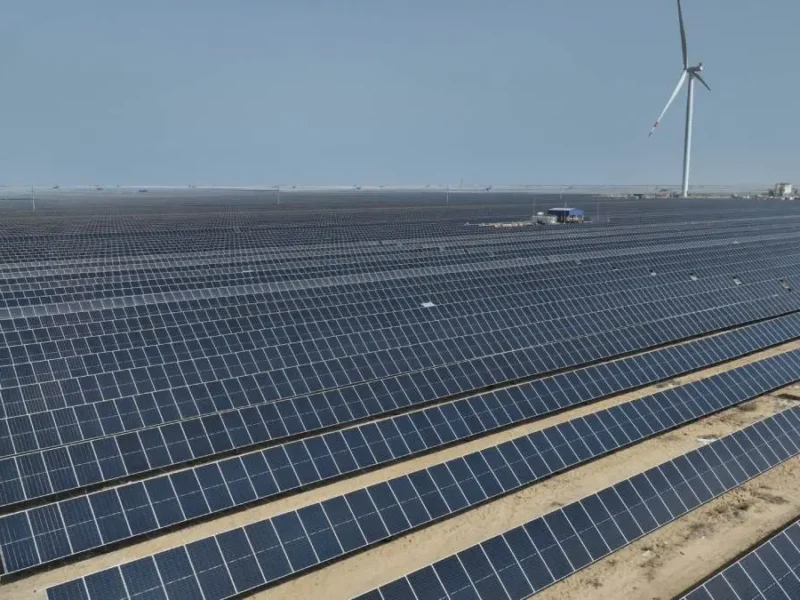
At the center of this transformation is Pugal in Bikaner, where India’s largest solar park is taking shape.
With a planned capacity of 2,450 megawatts and a massive 5,000 megawatt-hours of battery energy storage, the project marks a milestone not only for Rajasthan but also for India’s renewable energy ambitions.
Complementing it are four large battery energy storage projects, together offering nearly 6,000 megawatt-hours of storage at an investment of Rs 6,000 crore.
Remarkably, these projects have secured the lowest tariffs in the country and are expected to be operational by November 2027, officials from the Chief Minister’s Office said.
Parliamentary Affairs Minister Jogaram Patel informed that the Cabinet has approved the conditional allocation of land for major renewable energy initiatives.
This includes 161.45 hectares in Karni Sar, Bhatiyan village in Pugal tehsil of Bikaner, and 356.25 hectares in Kharnai village of Rawatbhata tehsil in Chittorgarh for the development of solar power projects.
Additionally, 70.6 hectares in Sokharu village of Barmer district have been allocated to Powergrid Barmer-1 Transmission Limited for establishing a 765 KV substation.
These measures will strengthen the state’s renewable energy transmission network and ensure a reliable power supply to citizens, Patel said.
Officials noted that these storage facilities will help meet peak electricity demand, reduce dependence on expensive power purchases, and ensure round-the-clock energy availability, bringing India closer to energy self-reliance.
Rajasthan’s renewable energy capacity has now risen to 41,189 megawatts, with solar power accounting for 35,337 megawatts. The state currently contributes 27.2 per cent of India’s total solar capacity and 16.43 per cent of the country’s overall renewable energy capacity.
The pace of growth has been particularly striking. Over the past two years, Rajasthan has added 17,820 megawatts of renewable energy capacity, of which 17,326 megawatts is solar.
In addition, projects totaling 45 gigawatts are at various stages of development, positioning Rajasthan as the backbone of India’s solar energy future.
The state’s solar success is not confined to large-scale parks in remote desert areas.
Rajasthan has also emerged as a national leader in decentralized solar energy through the effective implementation of flagship central schemes such as PM-KUSUM and PM Suryaghar Yojana.
At present, over 1.54 lakh farmers receive reliable daytime electricity for irrigation through grid-connected solar plants.
Urban and semi-urban households are also adopting solar energy in large numbers. Under the PM Suryaghar Yojana, Rajasthan has installed 1,09,209 rooftop solar systems with a total capacity of 441 megawatts in less than two years.
Based on installations, the state ranks fifth nationally, helping families lower electricity bills while supporting environmental sustainability. (IANS)