Gandhi’s Message Of Non-Violence Takes Centre Stage At UN
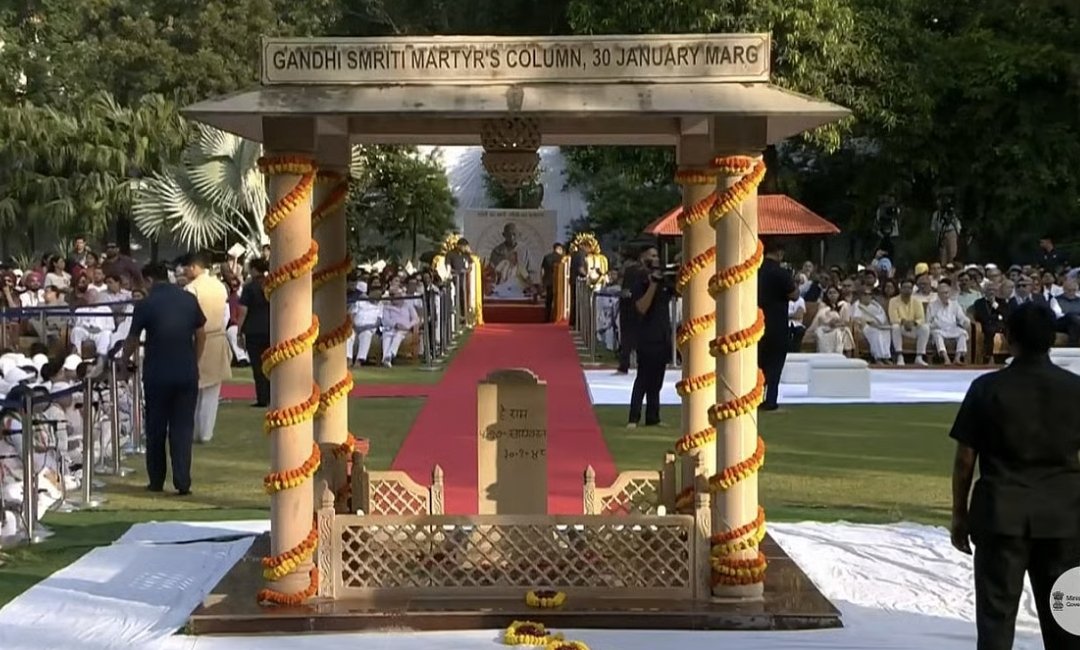
NEW YORK, NY-Diplomats from across the world invoked the message of Mahatma Gandhi on his birth anniversary, highlighting the continuing relevance of his ideals of non-violence and peaceful resistance in addressing contemporary global challenges.
The UN General Assembly declared October 2 the International Day of Non-Violence through a resolution sponsored by 141 countries in 2007.
Speaking at a commemoration of the International Day of Non-Violence at the UN, Morocco’s Permanent Representative Omar Hilale said the international community had made Gandhi’s legacy a shared inheritance by marking the day on his birthday. Hilale added that in Morocco, where “faiths and cultures meet and live together”, King Mohammed VI had followed a path of “moderation, tolerance and peaceful dialogue”.
India’s Permanent Representative to the UN P. Harish cited a contemporary example of Gandhian principles in action, referring to injured Indian pilot Smit Machchhar’s efforts to save passengers aboard a Flydubai Airlines flight. Before the commemoration, Harish placed flowers at the statue of Gandhi in the UN complex.
Uruguay’s Permanent Representative Laura Dupuy Lasserre reflected on the relevance of Gandhi’s message in South America, particularly during periods of dictatorship in Argentina and Uruguay. “Gandhi demonstrated that non-violence is not a sign of weakness or passivity, but an expression of courage,” said Lasserre, who also chairs the G77, the group of developing countries at the UN.
South Africa’s Permanent Representative Mxolisi Sizo Nkosi said Gandhi’s philosophy held particular significance for his country, where the principles of non-violence and peaceful coexistence were part of the historical journey from apartheid to constitutional democracy. Nkosi also cited Chief Albert Luthuli, the first ANC president to receive the Nobel Peace Prize, as a deeply committed adherent of Satyagraha.
For Russia’s Deputy Permanent Representative Maria Zabolotskaya, Gandhi’s role as an anti-colonial leader carried particular significance. “He was a leader of anti-colonialism, and this is important because our country always supported the anti-colonial struggle,” she said, adding that such struggles had been pursued through different means and approaches. Zabolotskaya also recalled Gandhi’s connection with Russian writer and philosopher Leo Tolstoy, who advocated non-violence. (IANS)