
The Godrej Almirah: The Ugliest Thing We Never Threw Away
By Sanjay Aggarwal
Every few years, someone in the family would look at the old Godrej almirah and say that it had to go. It had become too ugly, too dented and too completely out of place in a house that had otherwise moved on. The almirah, of course, never reacted. It had heard this threat many times and knew that nobody had the courage to carry it out.
It was never a beautiful piece of furniture, even when it was new. It came in those uncertain shades of grey, brown or olive green that made it look less like bedroom furniture and more like something transferred from a government records room. Curtains changed, beds changed, walls were repainted and whole rooms were redesigned, but the Godrej almirah remained where it had always stood, large, stubborn and slightly offended by the idea that it needed to match anything.
Nobody admired it and certainly nobody showed it off to guests. Yet the moment there was cash to hide, jewelry to secure, a property paper to preserve or some important document that absolutely must not be lost, nobody suggested the elegant wooden cabinet. Everything important went into the ugly steel almirah.
That was its strange place in the family. We did not love it, but we trusted it more than almost anything else in the house. It was unattractive, immovable and impossible to replace, which perhaps is why, despite repeated discussions and several renovation plans, it remained exactly where it was. The younger generation simply doesn’t understand the Godrej almirah. To them, it is a crime against interior design. It destroys the carefully curated vibe of a bedroom with its bulky steel body, ungainly chrome handles and unmistakable Lalaji personality. Even the later versions, dressed up with faux teak laminates, couldn’t hide their origins. Underneath all that cosmetic effort, it remained gloriously, stubbornly Godrej.
Yet every respectable middle-class Indian home had one. Many had two. One was usually reserved for the ladies of the house, with rows of neatly hanging saris, carefully folded salwar-kameez sets and winter clothes wrapped in old newspapers. The other belonged to the gentleman, containing safari suits, terrycot trousers, crisply ironed shirts inside transparent plastic covers and perhaps one blazer that emerged only for weddings and formal occasions. These weren’t wardrobes. They were institutions.
The real attraction, of course, was the locker tucked away inside. Long before passwords, OTPs and digital vaults, every family trusted that tiny steel compartment with its stubborn little key. Gold jewellery, fixed deposit receipts, LIC policies, property papers, passports and an emergency stash of cash all found refuge there. It was the closest most Indian families came to owning Fort Knox.
The almirah, however, guarded more than financial assets. Somewhere beneath neatly folded bedsheets and sweaters lay another category of valuables. A well-thumbed Debonair, perhaps a Playboy, sometimes a blue-film VHS cassette tucked discreetly inside an entirely respectable-looking cover. Every teenage boy knew exactly where these treasures were hidden. Every father believed they had concealed them with military precision. Neither side ever acknowledged the obvious, and peace prevailed.
The Godrej almirah also had its own filing system. Hidden inside were those old tin boxes that had once proudly carried Danish butter cookies or imported biscuits. Nobody in India has ever thrown away a perfectly good tin box. Once the last biscuit disappeared, the box simply graduated to a higher purpose. One contained passports. Another held driving licences, PAN cards and assorted identity documents. A third was devoted entirely to passport-size photographs accumulated over decades, faithfully preserving every hairstyle and fashion mistake the family had ever committed.
The tin boxes have become slightly more sophisticated over the years. Frequent travellers now return with those business-class amenity kits that airlines hand out before simultaneously announcing another round of cost-cutting. The eye mask, socks, tiny toothpaste and assorted tubes are removed within minutes and the pouch begins its second innings. Soon it is filled with chargers, medicines, foreign currency, cables or documents. Indians have elevated recycling into an art form. We don’t throw away containers. We simply promote them.
The Godrej almirah was also forced to endure every decorating fad that visited India. There was a glorious phase in the seventies when stickers became the height of sophistication. Richie Rich stickers looked particularly classy to our adolescent minds, although film stars, flowers and colourful designs all found their way onto those steel doors. Years later, when taste improved, the stickers refused to leave. They peeled only halfway, leaving behind stubborn glue marks and sad little fragments that somehow made the almirah look even worse.
Its usefulness wasn’t confined to what lay inside. The flat top served as India’s original storage loft. Suitcases, hold-alls, bedding rolls and mysterious cardboard boxes that nobody had opened for years accumulated there in thick layers of dust. If you wanted an old suitcase, you first had to conduct an archaeological excavation.
The space below the almirah had its own purpose. Resting on two sturdy steel legs, it offered just enough clearance to slide in shoes and sandals. Every family believed this was brilliant space management. It wasn’t. Shoes went in looking perfectly respectable and emerged months later with crushed backs and flattened toes because the height never quite matched. Yet generation after generation repeated the same experiment, convinced that this time the shoes would somehow retain their shape.
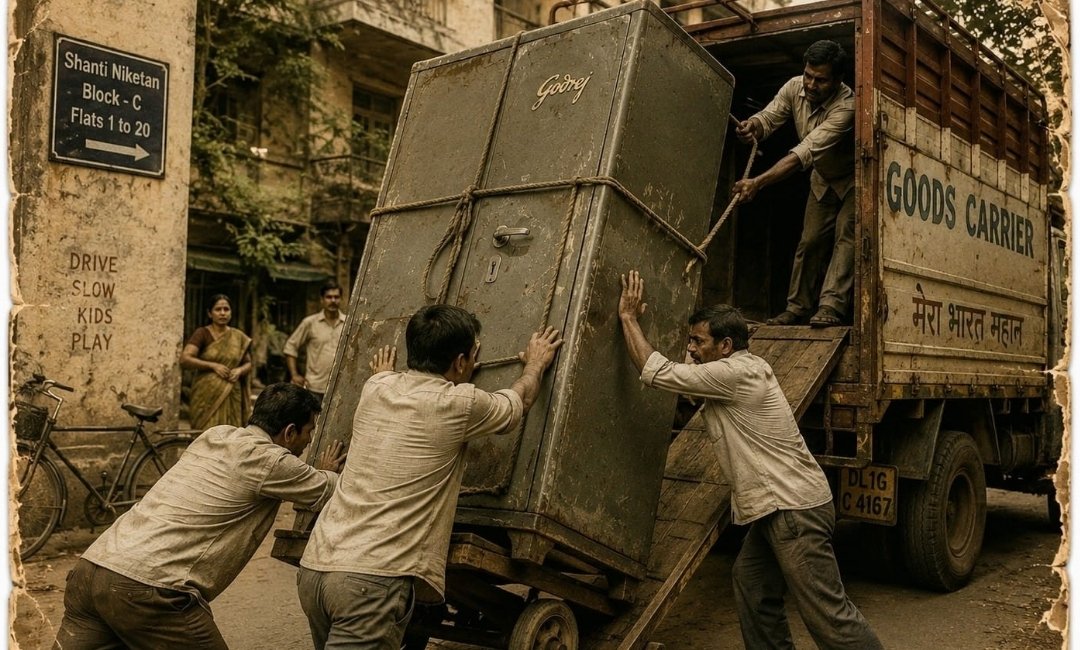
Nothing, however, tested the character of a Godrej almirah more than shifting houses. Modern wardrobes are dismantled and reassembled. The Godrej almirah travelled exactly as it stood. Four movers would wrestle with it through narrow staircases, scrape it against walls, tie it with ropes, balance it precariously on trucks and somehow deliver it to the next address. Every move added another dent and another scratch. The family worried far more than the almirah ever seemed to.
Today’s apartments come fitted with beautiful floor-to-ceiling wardrobes in veneered teak, complete with soft-close hinges and clever lighting. They are elegant, practical and blend seamlessly into the room. Yet ask anyone from our generation whether they would throw away the old Godrej almirah still standing in the corner of the ancestral home, and the answer is usually an embarrassed smile followed by, “Let’s keep it. It still has life left in it.”
Perhaps that is why the Godrej almirah has survived while so many fashionable pieces of furniture have disappeared. It never matched the curtains, but it matched Indian families perfectly. It watched children grow up, daughters leave after marriage, sons return home with their own children, salaries become pensions and black-and-white photographs become digital albums.
The Godrej almirah’s constant companion was the mandatory double bed from the bride’s side. Indian families somehow agreed that every newly married couple required a bed with storage below, storage behind and enough hidden space to lose a pillow for six months. Retrieving anything from it was an Olympic event. I’ll resist the temptation here because The Great Indian Storage Bed deserves its own essay.
Looking back, the only innovation the Godrej almirah somehow missed was a built-in refrigerator. It already had a locker, shelves, secret compartments, tin boxes, business-class pouches masquerading as document holders and enough family history to fill an archive. Had Godrej managed to squeeze in a tiny fridge, the Indian middle class would probably never have bought another piece of furniture.
Ugly?
Undoubtedly.
Replaceable?
Apparently not.
(Aggarwal is a New Delhi–based business leader with four decades of experience across energy and infrastructure and with family in New York. He writes Tadka Life, a personal platform about India, its changing habits, memories, and everyday absurdities.)


Natarajan Sivsubramanian
/
I totally disagree with the author’s derogatory and adverse attacking views about godrej products
There is no other better cupboard being. Manufactured by other companies
Godrej is the best product for keeping valuable
Things
One item was omitted
October 2, 2026Cheque books also be kept inside cupboard
Most govt offices are two important items
Godrej cupboard and Hindustan motors
Ambassador including police departments
Ramesh Agarwal
/
A very well written article. Throughly enjoyed reading it. I can fully identify with it growing up in India, in a middle class family.
October 2, 2026AnonymDesi
/
Beautifully written with the nice hint of humor ! As the previous comment says it’s not an essay that seems to attack Godrej at all! . Indeed if he was reader with a little more acumen to perceive what the essay actually conveys – it’s actually the opposite – that Godrej passes the test of time in every Indian family and holds a proud position as the most valued product ( that’s beyond comparisons with beauty or aesthetics) despite being just made of iron and steel and nothing fancy . I loved reading it . I am now curious to read other essays by this author . thank you for publishing this !
October 3, 2026And yes we all love Godrej as it’s not just a furniture but a chest that holds families memories . For generations to come !
DesiLife
/
Beautifully written with a hint of humor ! The previous comment misses the main message conveyed in the article . Infact if that reader had a little bit of acumen to enjoy essays written with humor , he wouldn’t have missed that indeed the essay doenst even portray Godrej in a derogatory way but it tries to convey the exact opposite ! That Godrej despite being just a furniture that lacked aesthetics etc etc that the modern day industries gives importance to , it was a classic furniture that stood the test of time across generations in every family in India . It’s not just a. furniture but a almirah or chest that holds memories of families and even generations it has history to tell in very family & hence holds a special place in every families’ heart and home . It was practical and dependable & a great product as the essay conveys . Thanks for publishing this article . I am now curious to read more of this author’s essays /articles !!
October 3, 2026