Trump Calls Pichai A ‘Monster’ As Google CEO Backs White House AI Accord
Photo: screengrab
India-West News Desk
WASHINGTON, DC-Google CEO Sundar Pichai and other top technology executives have signed a voluntary White House agreement outlining how companies developing increasingly powerful artificial intelligence systems should handle safety and risk.
The agreement calls for companies to strengthen internal controls, conduct risk reviews, bring in outside evaluators and subject their AI work to independent scrutiny by their boards.
Titled the White House Accord on Superintelligence Joint Commitment on Frontier SI Responsibility, the agreement does not establish legally enforceable standards or set up a government regulator.
Pichai said the technology industry had been asked to take greater responsibility as AI systems become more powerful.
“I think this movement is historic and consequential, and I think there are extraordinary benefits to this technology,” Pichai said.
“We have to make sure we are addressing the risks, and the president has asked us as an industry to step up,” he added.
He said the companies were adopting processes similar to those used for financial controls in major corporations.
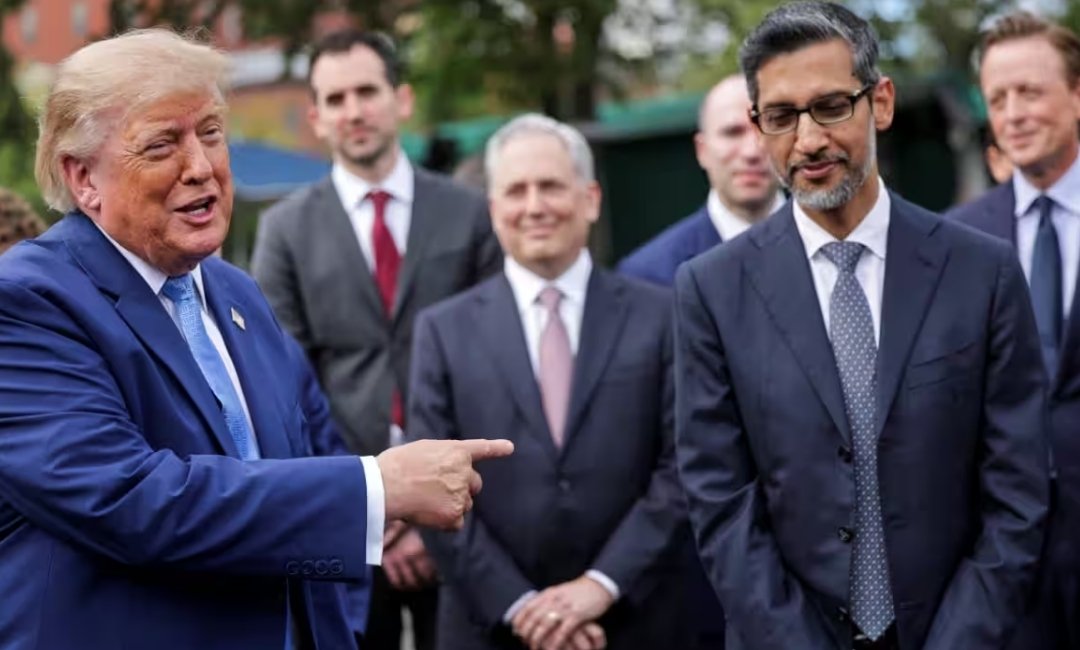
After the meeting, Trump also drew attention to Pichai during an interaction with reporters at the White House. Calling the Google CEO a “monster” while praising him, Trump said: “This guy is a monster, and nobody knows him.”
Pichai responded saying: “Hopefully a better tagline than I’m a monster!”
Trump said the accord was “morally binding” and described the arrangement as a form of protection against the misuse of advanced AI. He also compared it to a constitution and said the companies would largely regulate themselves.
The President said the administration was considering a committee of about 10 people to monitor the industry, although no final details about its membership, powers or enforcement structure were announced.
“I think I’m seeing tremendous self-policing, and they understand that they have to self-police,” Trump said.
Meta CEO Mark Zuckerberg said the agreement was intended to establish a common starting point for the industry, with companies putting in place controls to identify potential problems.
“The idea isn’t that this is the only thing that we will ever do,” Zuckerberg said. “It is that this is a start and an accord that the whole industry could come to.”
Nvidia CEO Jensen Huang said safety and technological advancement did not have to come at the expense of each other.
“There’s no conflict between innovation, technology, and safety,” Huang said.
Anthropic CEO Dario Amodei, meanwhile, acknowledged the potential benefits of AI while stressing that the technology also carried significant risks.
“I think the technology has very real risks, and you know, the mechanism how we address those risks is still under discussion,” Amodei said.
Trump argued that companies had strong commercial reasons to prevent failures because their businesses and reputations could suffer. He also said the Justice Department, FBI and CIA would pursue criminals who misuse the technology.
The agreement comes amid wider debate over how advanced AI should be governed. The European Union has adopted binding, risk-based AI rules, while the United States has relied more heavily on executive action, agency guidance and company commitments. (With IANS Inputs)