India-Canada Trade Talks Gain Momentum Amid Shifting Global Order
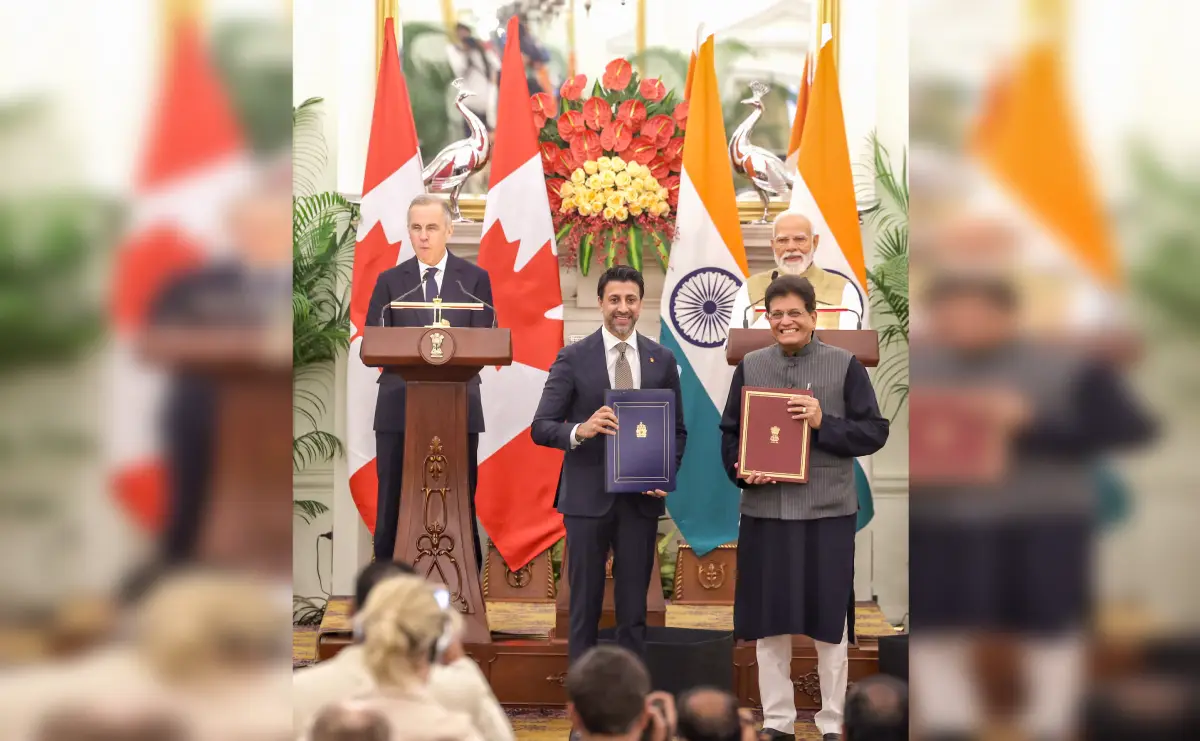
NEW DELHI- Trade negotiations between India and Canada have gained renewed importance after talks were relaunched during Canadian Prime Minister Mark Carney’s visit in March, offering both countries a fresh opportunity to build a durable economic partnership amid a changing global order.
According to Sanjay Kumar Verma, India’s former High Commissioner to Canada, the renewed engagement comes at a time when Canada is seeking to reduce its heavy economic dependence on the United States.
“Canada faces its own structural dilemma. Its overwhelming economic dependence on the United States has become a strategic constraint, particularly in an era of geopolitical uncertainty. Diversification is no longer optional. In that context, India represents not just another market, but a long-term strategic partner,” Verma wrote in an article for India Narrative.
He said the shift in 2022 toward an Early Progress Trade Agreement (EPTA) reflected a more realistic approach and could serve as the foundation for a broader Comprehensive Economic Partnership Agreement (CEPA).
Verma said the CEPA should be developed in stages rather than as a single all-encompassing pact. The first phase, he said, can consolidate progress already made under the EPTA framework, while later stages can include more complex areas such as investment protection, digital trade and regulatory cooperation.
He added that more sensitive sectors, including agriculture, intellectual property and public procurement, could be addressed later when political and economic conditions become more favorable.
The article said bilateral trade in goods, though currently modest, has room to grow through improved market access and simpler rules of origin. It added that services trade, already a strong pillar of ties, can deepen further in sectors such as information technology, education and professional services.
It also noted that customs facilitation could help reduce transaction costs and improve predictability for businesses.
Verma highlighted strong investment ties between the two countries, noting that Canadian pension funds and institutional investors have invested heavily in India’s infrastructure and renewable energy sectors, while Indian companies have expanded their presence in Canada’s services economy.
He said this investment corridor gives both sides a strong foundation and creates stakeholders with a direct interest in stable relations. However, he added that a more predictable taxation and repatriation framework would be necessary to sustain and expand Canadian investment while balancing regulatory space with investor confidence.
The former envoy also argued that any future trade agreement must be protected from political disruptions that have affected bilateral ties in the past.
“The answer does not lie in assuming that such episodes will not recur. It lies in designing institutions that ensure they do not derail economic engagement. Further, a well-designed CEPA does not merely survive political shocks; it raises the cost of creating them,” he said.
He said this would require robust dispute resolution systems, regular review mechanisms and institutional frameworks that continue to function regardless of political tensions. He also called for a greater role for the private sector so that businesses can help stabilize ties when governments are at odds. (IANS)