Army Doctor Credited With Innovative Brain Surgery That Avoids Opening Skull
NEW YORK, NY- Army surgeon Major Jagatkumar Patel has been credited with developing an innovative technique to remove certain brain tumors through the nose, avoiding the need to open the skull and enabling faster recovery.
Patel and US Army neurosurgeon Lt. Col. Charles Miller developed the procedure for operating on tumors at the base of the skull through the nasal passage, according to the Pentagon.
“Historically, most of these surgeries were done open, which is a much more challenging procedure for the patient,” Patel said.
“Today, if a tumor is the appropriate size and location, open surgery just isn’t necessary,” he said. “Through the nose, we get the best access and the best chance of complete removal.”
The team recently performed the procedure on US Marine Staff Sgt. Andy Archer, who had suffered severe headaches for 15 years.
After he developed vision problems, an MRI scan revealed a tumor about the size of a golf ball, measuring 4.4 centimeters, located in front of the pituitary gland and pressing against the optic nerve.
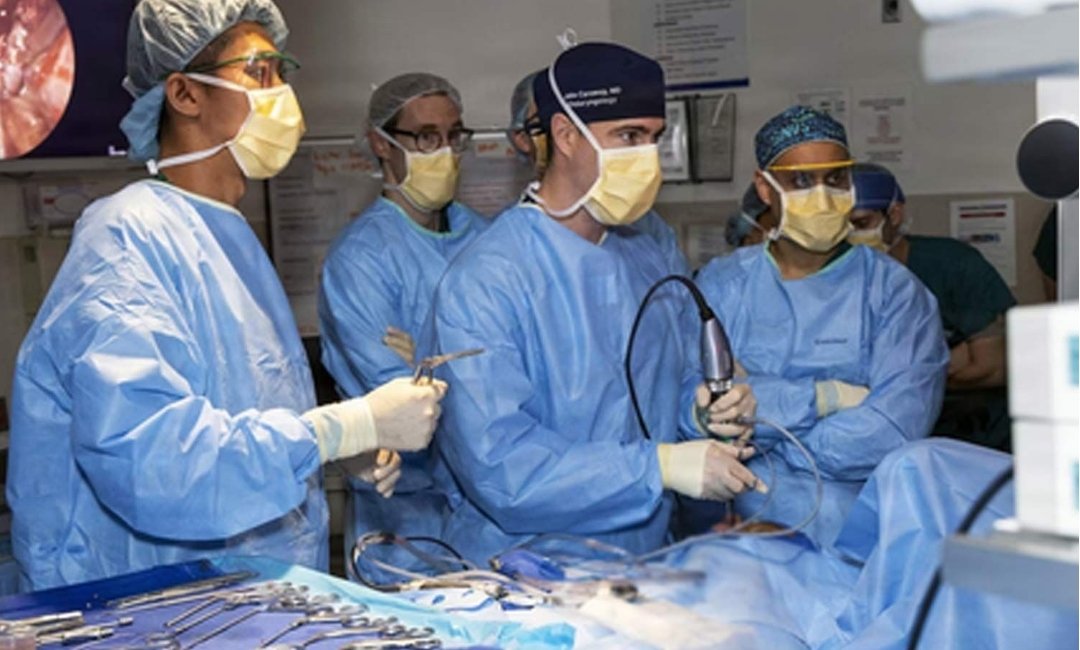
Archer was treated at Walter Reed Army National Military Medical Center in Bethesda, Maryland, where Patel and Miller chose the minimally invasive approach to remove the tumor entirely through the nose.
According to the Pentagon, Patel developed the surgical pathway by navigating the complex nasal anatomy, while using an endoscopic camera to provide high-definition, close-up images of the tumor that enabled Miller to safely dissect and remove it.
“If he needs to get to critical structures, I can drive the camera closer, so he has perfect visualization,” Patel said.
“My skills in navigating the nasal approach are only useful because he (Miller) is skilled enough to completely remove the tumor once we get there,” Patel added. “It is a true team effort.”
Two days after the surgery, Archer showed no visible signs of having undergone major brain surgery. He was sitting up in the surgical intensive care unit, and his vision had begun to improve.
“I don’t think anyone else in the Defense Health Agency has this kind of team performing these complex skull base surgeries,” Patel said.
“A minimally invasive approach through the nasal passages is more challenging and we are mindful that (the tumor) has to be in a certain spot to go through the nose,” he added. (IANS)