Community Leaders Urge Immigration Reforms At Capitol Hill Briefing
India-West News Desk
WASHINGTON, DC – South Asian community leaders used a March 26 Capitol Hill briefing to highlight growing concerns over U.S. immigration enforcement, labor conditions, and civil rights, calling for urgent policy reforms.
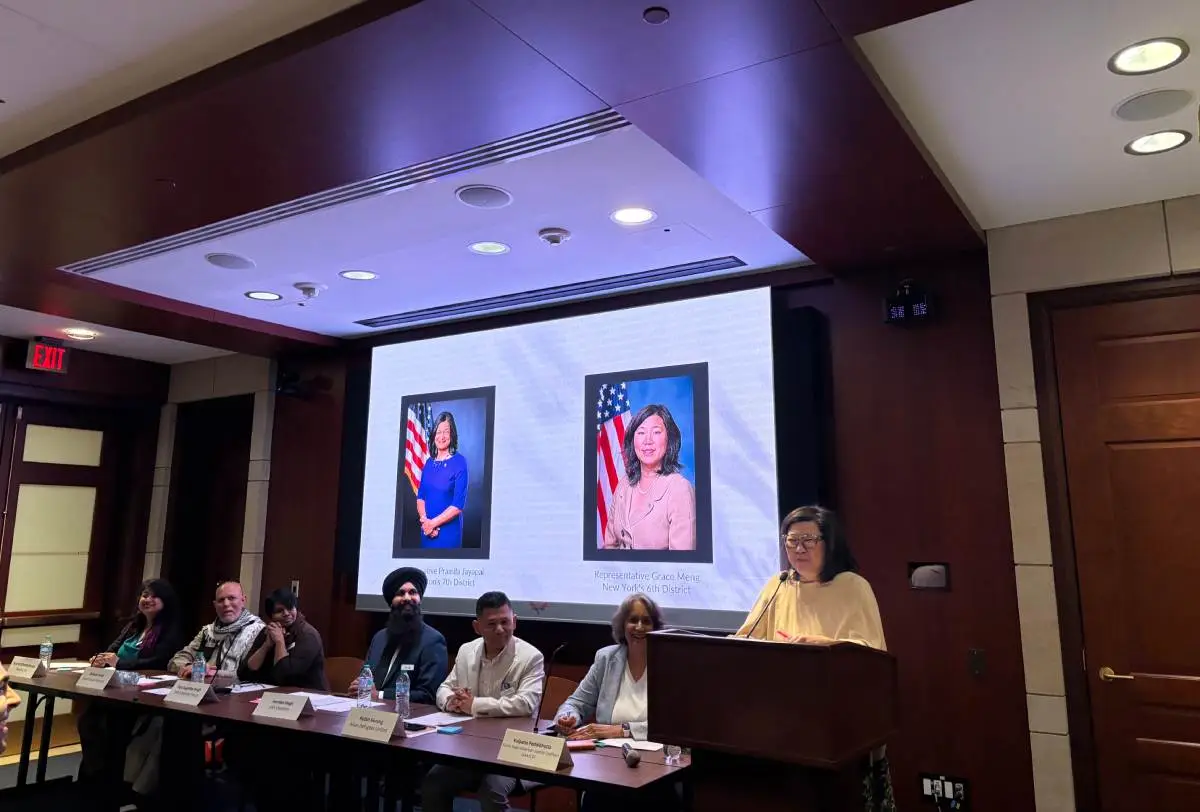
The session, held following the South Asian Coalition’s national summit and joined by Democratic Representatives Pramila Jayapal and Grace Meng, brought together advocates who described increasing enforcement measures, barriers to economic stability, and a broader climate of fear affecting immigrant communities.
Opening the briefing, Manavi executive director Navneet Bhalla underscored the coalition’s cross-sector efforts to address these challenges, as lawmakers pointed to Congress’s role in strengthening community protections. Speakers outlined the scale of the issue, with ASATA Power’s Rajiv Narayan noting that nearly one in eight of the 6.5 million South Asians in the United States are undocumented, while urging stronger oversight and reduced reliance on detention and enforcement.
Concerns over legal protections also featured prominently. Kalpana Peddibhotla of the South Asian American Justice Collaborative warned against threats to birthright citizenship, calling it “a simple promise that children born here belong,” while advocates highlighted deportations and due process violations affecting vulnerable communities. Robin Gurung of Asian Refugees United described cases involving Bhutanese refugees, stating that recent enforcement practices are leading to deportations without due process and leaving individuals stateless.
Labor and economic challenges were also raised, with Sikh Coalition’s Harman Singh pointing to new federal rules affecting immigrant workers. Singh noted that drivers are being excluded solely because of their immigration status, regardless of their skills or safety records. Speakers also drew attention to structural concerns, including caste-based discrimination and long-standing surveillance practices. Dalit Solidarity Forum’s Roja Singh called for federal recognition of caste as a protected category, while South Asian Network’s Shakeel Syed noted that institutionalized Islamophobia continues to drive profiling and detention.
The discussion also addressed the impact of immigration policy on vulnerable groups. Aparna Bhattacharyya of Raksha, Inc. highlighted risks faced by survivors of gender-based violence, stating that survivors now face an impossible choice between seeking safety and risking deportation. The briefing concluded with a call for coordinated legislative action to address enforcement practices, protect workers, and strengthen due process, reflecting a unified push to bring community concerns directly to policymakers.