
Social Hierarchy Is Not An Indian Exception
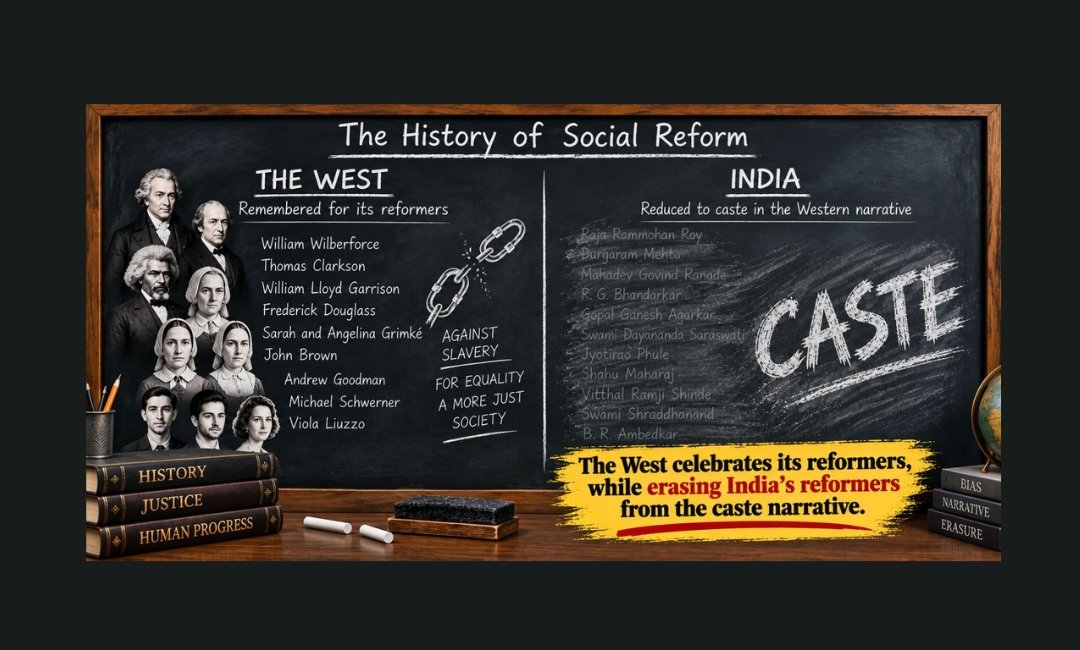
Image: AI generated
By Dr. Jai Bansal
Social hierarchy has existed across civilizations, taking different forms according to history and circumstance. European societies lived for centuries with hereditary aristocracy, feudal privilege, and serfdom; Britain developed an entrenched class structure; and the United States practiced hereditary slavery followed by nearly a century of legally enforced racial segregation. Industrialization created further divisions between owners and workers, often accompanied by extreme disparities in wealth, working conditions, and opportunity.
India, too, developed distinctive forms of social organization. Classical varna described four broad social functions associated with qualities, aptitude, and conduct, while jatis generally emerged as kinship, occupational, and local communities. Over time, some social boundaries became hereditary and restrictive, and practices such as untouchability took root in parts of society. British colonial rule further hardened these divisions through censuses, administrative classifications, and European racial theories. As historian Nicholas B. Dirks writes in ‘Castes of Mind’: Caste’ became a single term capable of expressing, organising, and above all ‘systematising’ India’s diverse forms of social identity, community, and organisation. … In short, colonialism made caste what it is today.
Yet a glaring double standard persists in much academic and media discourse. Caste is routinely portrayed as an enduring indictment of Hindu civilization, while the West’s own histories of hereditary slavery, racial hierarchy, segregation, and colonialism are more readily incorporated into narratives of progress and reform. India’s own long history of resistance and social reform receives far less attention.
Reform Before Ambedkar
B. R. Ambedkar is widely recognized as one of the most prominent modern figures in the struggle against caste hierarchy. That struggle, however, had deep roots in Indian society. Centuries before the emergence of modern political movements, Indian religious and social traditions produced powerful voices that placed spiritual worth above social rank. The Bhakti movements included figures such as Ramananda, Kabir, Ravidas, Chaitanya, and Tukaram. Their teachings and approaches varied, but together they demonstrate that challenges to caste hierarchy had been part of Indian social and religious thought for centuries.
The nineteenth century brought a remarkable range of organized reform efforts. Raja Rammohan Roy and the Brahmo Samaj challenged hereditary divisions as part of their wider reform of Hindu society. In Gujarat, Durgaram Mehta helped establish the Manav Dharma Sabha in 1844, which rejected caste as a measure of human worth. The Prarthana Samaj and reformers such as Mahadev Govind Ranade and R. G. Bhandarkar questioned caste restrictions, while Gopal Ganesh Agarkar campaigned against caste discrimination and untouchability through his journal ‘Sudharak.’ Swami Dayananda Saraswati, founder of the Arya Samaj, argued that varna should reflect qualities, conduct, and aptitude rather than birth. Jyotirao Phule’s Satyashodhak Samaj promoted education for Shudras. Shahu Maharaj expanded educational opportunities and representation, Vitthal Ramji Shinde founded the Depressed Classes Mission in 1906, and Swami Shraddhanand made opposition to untouchability a major part of his public work.
These reformers differed in philosophy and method, but together they had established a substantial tradition of opposition to caste hierarchy and discrimination. When Ambedkar emerged as a major national voice in the 1920s, he therefore entered a reform movement with centuries of intellectual and religious antecedents, decades of organized activism, and an established institutional presence.
Reform from Within the Privileged Class
One often overlooked aspect of this history is the extent to which opposition to caste discrimination emerged from within India’s so-called privileged classes. Many of the reformers discussed above came from socially advantaged backgrounds. Raja Rammohan Roy, Durgaram Mehta, Mahadev Govind Ranade, R. G. Bhandarkar, Gopal Ganesh Agarkar, and Swami Dayananda Saraswati were all born into Brahmin families. Gopal Hari Deshmukh, better known as Lokhitwadi, was another prominent critic of hereditary privilege and social orthodoxy.
The pattern extended beyond these nineteenth-century reformers. Swami Vivekananda condemned untouchability and restrictions on education and religious knowledge. Rabindranath Tagore criticized caste prejudice. Swami Shraddhanand’s work against untouchability earned praise from Ambedkar himself, while Gandhi later turned the campaign against untouchability into a nationwide movement and placed responsibility for ending it squarely on caste Hindus.
India’s struggle against caste discrimination was therefore never a simple contest between privileged groups defending the system and Dalits opposing it. Reform came from those who suffered under discrimination, but it also arose from within groups that benefited from the existing social order.
Of course, people challenging an unjust system that benefited their own group is hardly unique to India. In Britain, Wilberforce and Clarkson campaigned against the slave trade though neither had been enslaved. In the United States, white abolitionists such as Garrison, John Brown, and the Grimké sisters, who were born into a slaveholding family, devoted their lives to ending slavery. During the civil-rights movement, Andrew Goodman, Michael Schwerner, and Viola Liuzzo paid with their lives. Friedrich Engels came from a wealthy industrial family, while factory owner Robert Owen became a leading advocate for workers.
Caste, race, slavery, and class were very different systems, but the broader point is simple: history is full of people who challenged injustices that benefited their own social group.
The Double Standard
Every society carries the burden of its past, but societies are also remembered for those who challenged injustice. American slavery is taught alongside the abolitionist movement—with figures ranging from Frederick Douglass to William Lloyd Garrison and John Brown. In Britain, the slave trade is remembered alongside Wilberforce and Clarkson. The history of racial segregation includes the civil-rights movement, just as the inequalities of industrialization are remembered alongside trade unions, labor laws, and social reform.
Yet India is rarely afforded the same historical perspective. Western societies are given a fuller moral history in which oppression, resistance, reform, and dissent all have their place, while India is too often viewed primarily through caste. Centuries of Indians who challenged untouchability, hereditary discrimination, and social exclusion are pushed to the margins, allowing caste to become a defining indictment of Hindu civilization rather than one part of a much larger social history.
The double standard is stark: the West gets credit for confronting its sins; India gets defined by hers. That is selective history serving a selective moral judgment.
The Constitutional Blunder
Independent India inherited the caste classifications strengthened and institutionalized under British rule. The Constitution sought to address centuries of caste discrimination by guaranteeing equality, abolishing untouchability, prohibiting caste discrimination, and providing special protections for historically disadvantaged groups.
But in designing the remedy, the Constitution’s framers made a monumental mistake with consequences that have endured for generations. Having inherited a society burdened by caste, they gave inherited caste identities constitutional recognition, administrative permanence, and material value. What might have been conceived as a transitional remedy instead helped make caste consequential in access to education, employment, political representation, and public benefits. It also created powerful incentives for communities and political parties to preserve, mobilize, and compete through the very identities that independent India should have been working steadily to make less relevant.
The result is one of the enduring contradictions of the Indian republic: a nation aspiring to a casteless society while its own institutions continue to classify citizens and distribute important opportunities partly on the basis of caste.
Laws Change Faster Than Attitudes
Laws can prohibit discriminatory practices, but inherited attitudes take much longer to change. More than seven decades after untouchability was abolished, caste prejudice persists, particularly in some rural areas and in marriage. Yet India has changed substantially. Urbanization, education, economic mobility, migration, and everyday social interaction have weakened many traditional barriers, especially in cities.
The American experience offers a useful comparison. Slavery ended in 1865, yet Jim Crow survived for nearly another century, and the civil-rights movement was still fighting legalized discrimination in the 1950s and 1960s. American society continued to change despite the persistence of racism, illustrating how slowly deeply rooted social attitudes can recede.
Caste should be judged by the same historical standard. Its continued presence cannot erase the scale of the change: old barriers have weakened, opportunities have widened, and practices once openly defended have lost legitimacy. India has not eliminated caste prejudice, just as America has not eliminated racism. Neither fact justifies treating either society as frozen in its past. An unfinished transformation is still a transformation.
A Fuller Historical Reckoning
Social hierarchy is part of the human story, and India’s history should be judged by the same standard applied elsewhere: by the injustices a society produced, the resistance those injustices provoked, and the distance the society traveled in overcoming them.
India’s record includes caste discrimination, but it also includes centuries of religious criticism, organized social reform, constitutional prohibition of discrimination, and continuing social transformation. To remember the first while marginalizing the rest is nothing short of intellectual dishonesty.
India’s transformation remains unfinished. Caste prejudice persists, while the state itself continues to reinforce caste identities through public policy. India should nevertheless be judged by its full historical record, not frozen permanently at its worst.
(Boston based Bansal is VP of Education, Vishwa Hindu Parishad of America.)


Ananth Sethuraman
/
The account of caste has too many holes to be valid. Perhaps an example will help. Take four communities—jatis, to use an Indian word—Agamudaiyar, Goundar, Mudaliar and Vanniar. Using Sanskrit verses from the Indian traditions, arrange the four jatis from highest jati to lowest. I am confident that no one will be able to do this. Sanskrit verses from the Indian traditions do not even contain words such as “Agamudaiyar”, “Goundar”, “Mudaliar” and “Vanniar,” let alone arrange them from highest jati to lowest.
It is common to bring up another concept, that of varna, as though it were a source of a hierarchy. For the moment, let us grant that varna is indeed a source of hierarchy. Even so, varna does not help us with arranging Agamudaiyar, Goundar, Mudaliar and Vanniar from highest jati to lowest. To appreciate this point, let us consider what happened in physics. Around 1680, Newton’s laws of physics were so new that only researchers could understand it. Now, however, it is taught in high schools. That is not the case with the account of caste hierarchy. It is still a research topic. “Using the concept of varna, generate a rule for arranging jatis in from highest to lowest” is still a research topic. How are ordinary people suppose to practice caste discrimination if the hierarchy is still a research topic?
In reality, none of us keeps in our pockets a list of all jatis higher than ours, and a list of all jatis lower than ours. None of us says, “I met Shammi and Shashi today. Shammi is higher caste than me, and Shashi, lower. Shammi discriminate against me and I against Shashi. All of us were following the rules of Hinduism and we felt good as we were being good Hindus.” None of us talks in this way.
No doubt, there are disputes between jatis. But they are disputes over property, money, or labor. Here is an exercise. Go to news.google.com and type “Dalit” in its search box. You will get many articles. Examine as many of them as you have time for. You will find that they begin as disputes over property, money or labor. These articles will never say, “According to Verse 25.4 of adhyatma, Jati A is higher than Jati B. Therefore A attacked B.”
Now we must turn to theory. Why does Western thought generate accounts of social hierarchy wherever it goes? By Western thought, I mean both (a) Christian theology and (b) social sciences. Why do both of them generate accounts of social hierarchy? For that we must list the premises of Western thought.
(1) Man has the faculties of passions, reason, and will.
(2) If the three faculties were to function in the right way, the individual is said to be righteous. Indeed, the word “righteous” is derived from the phrase, “riht wiz”, which meant “right way” in old English.
(3) In reality, the three faculties do not function in the right way. This is human nature itself, not an individual failure.
(3a) Christian theology holds that the Biblical Fall was a historical event; before it, the three faculties worked in the right way in all human beings; after it, they stopped working in the right way. Social sciences do not accept this premise. They assume that when the species homo sapiens evolved, it evolved with the three faculties not working in the right way.
(4) Because it is human nature for the three faculties not to function in the right way, there is a consequence. Namely, man has an innate desire to dominate his fellow man, and even Nature.
In Christian theology this innate desire is called libido dominandi. In social contract theory, this innate desire was described as “every man is at war with every man”; it gives rise to the term “state of nature.” In Freud’s writings, this innate desire leads to a theory of authoritarianism. It is not an accident that the Left call the Vishwa Hindu Parishad an authoritarian group; the Left are building on Freud’s theory of authoritarianism, which in turn is build on the premise (4). Thinkers who have been raised on a diet of the Frankfurt School (eg Sheldon Pollock) call the innate desire power asymmetry.
We can see from this that Premise (4) is taken very seriously by Western thought.
(5) What can mitigate the innate desire to dominate? It is the subject of ethics. A demographic group with a good system of ethics will be able to manage the innate desire to dominate; the hierarchies that exist in that demographic group will be ordinary hierarchies. Conversely, a demographic group with poor system of ethics will not be able to manage the innate desire to dominate; its hierarchies will be unethical ones, not ordinary ones.
(6a) A system of ethics must have the structure of norms, as the word is understood in philosophy. In philosophy, a norm is a rule that applies 24×7 to all demographic groups in all continents. Christianity has a system of dos and donts; they are norms. After the Englightenment, the West developed other systems of ethics; those have norms too.|
(7) The Indian traditions have a poor system of ethics. This premise exists in Western thought. It is usually expressed in indirect ways. “Hinduism is premodern”, “Hindu nationalists want to take India back to an imaginary golden age”, “idol worship”, “freedom of religion”, “freedom to proselytize” are some indirect ways of saying that the Indian traditions have a poor system of ethics.
With these premises, we can see why Western thought likes to talk in terms of social hierarchy. When they meet a demographic group with a poor system of ethics—judged by their own premises, of course—they will say that the demographic group has an unethical social hierarchy. So when Christian missionaries and social science professors see the Indian traditions, they say there is a caste hierarchy. And now that social science professors are seeing a Judeo-Christian America, they are saying that Judeo-Christian ethics are a poor system of ethics, and this is why American society has a spectrum of social classes ranging from extremely privileged to extremely marginalized. Extremely privileged social classes are like high castes, extremely marginalized social classes are like low castes, and DEI is like the reservation system of India.
I request the author to study the works by Rajiv Malhotra, SN Balagangadhara, and their colleagues. Western thought is not good. It is good only in the natural sciences, not in the social sciences.
September 26, 2026Ajay Kulsh
/
For about 1500 years, Buddhism was prominent in India. The caste was immaterial to a Buddhist. However, with Islamic invasion, Buddhism disappeared and caste system became much more rigid. This rigidness provided resistance to being converted to Islam by force. Unlike Egypt or Iran, only about 25% of the Indian continent converted to Islam.
September 28, 2026